Advanced Forex Trading Strategies for Changing Market Conditions
Alex Smith
2 hours ago
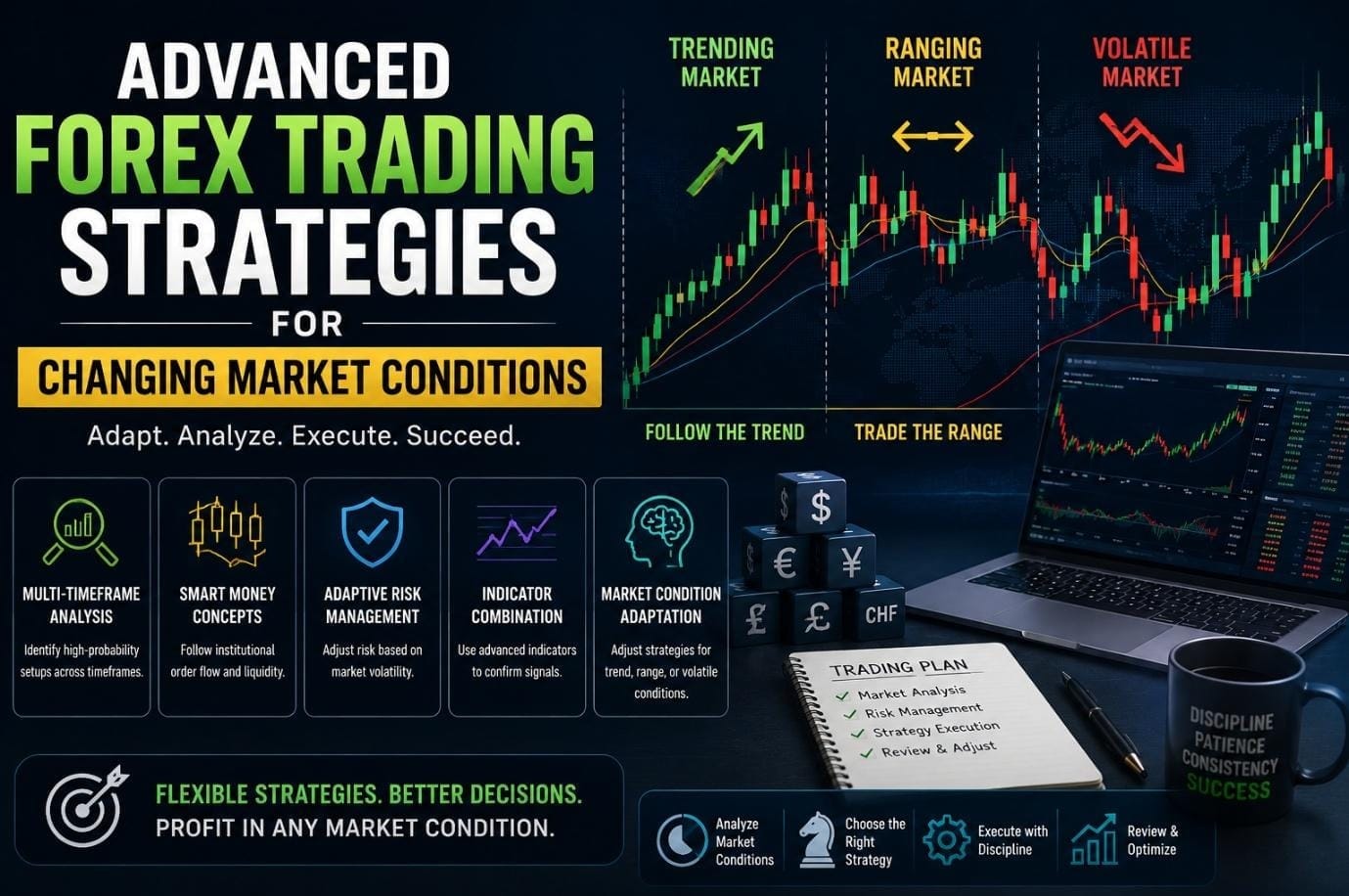
The forex market is one of the most dynamic financial markets in the world. Conditions can shift within hours. A trending market can turn into a ranging one. A quiet session can become volatile after a single economic announcement.
For traders looking to move beyond the basics, having a range of advanced forex trading strategies is essential. In this blog, we will break down the key strategies and how to apply them effectively.
What Makes a Forex Trading Strategy Advanced?
Basic forex trading strategies focus on simple concepts such as following the trend or using a moving average to confirm direction. These are important strategies. But they do not always work effectively when market conditions become complex.
Advanced forex trading strategies go beyond the basics. It requires a deeper understanding of market behaviour, recognising when conditions are shifting, and adjusting your approach accordingly.
For intermediate traders looking to develop their approach, understanding these strategies is an important next step. Not to use all of them at once, but to know which one fits the market at any given time.
Advanced Forex Trading Strategies
Not every strategy works in every market condition. Here is a closer look at the most widely used advanced forex trading strategies and when they tend to work best:
Price Action Trading
Many traders use price action trading to understand market movements. Rather than relying on indicators, they study how prices move and respond around key chart levels.
This strategy can be used in different market conditions. For instance, when the market is moving in a clear direction, traders look for opportunities to follow the trend. And when prices are moving within a range, they look for reversals near support and resistance levels. Because it focuses on actual price movements, many traders prefer it as part of their trading approach.
Carry Trade Strategy
The carry trade strategy is built around interest rate differences between two currencies. You borrow in a currency with a low interest rate and use those funds to buy a currency with a higher interest rate. The difference between the two rates is what you aim to earn; this is known as the carry.
A carry trade strategy usually works best when market conditions are stable, and interest rates remain unchanged. If the conditions change or central banks make unexpected decisions, prices can move quickly against your trade. Because of this, it is important to manage your risk when using this strategy.
Breakout Trading
Breakout trading involves watching support and resistance price levels. Support is where a price tends to stop falling, and resistance is where it tends to stop rising. Therefore, when the price breaks through one of these levels, it can signal the start of a new trend, and traders use that moment to enter the market.
A breakout trading strategy works well around major market events. For instance, interest rate decisions or economic data releases, where prices can move in one direction. But not every breakout leads to a strong move. Sometimes the price breaks a level and then turns back around. That is why many traders wait for a confirmation before entering.
Hedging
Hedging is a way to protect yourself when the market feels uncertain. Here, instead of closing a trade and taking a loss, you open another trade in the opposite direction. This, therefore, helps in balancing things out if the market moves against you.
It is not a way to make a profit. Traders use it when conditions get unpredictable or when they expect short-term turbulence before the market settles into a clearer direction.
Mean Reversion
Mean reversion is based on the idea that prices tend to return to their average over time after moving significantly in one direction. When a currency pair moves far from its historical average, a mean reversion trader looks for an opportunity to trade back towards that average.
This strategy works best in ranging or sideways markets where there is no strong directional trend. Technical tools that measure price deviation from the average are commonly used to identify when prices have moved too far. Knowing when prices are stretched beyond their normal range is the key signal that mean reversion traders look for.
How Market Conditions Can Affect Your Strategy
One of the most important skills in advanced forex trading is reading the current market conditions and choosing the right strategy. Not every approach works in every environment.
In a trending market, prices move in one direction. That is why trend-following and breakout strategies tend to perform well. The goal is to enter the trend's direction and ride it for as long as it continues.
In a ranging market, where price moves between defined support and resistance levels without a clear direction, mean-reversion and price-action reversal strategies tend to be more effective. That is why entering near support and exiting near resistance is the core approach here.
In a volatile market, geopolitical events and major economic data releases can cause sharp and sudden price movements. This is where breakout strategies are used, as traders look to act on those strong moves. At the same time, hedging helps to protect existing positions from unexpected swings in either direction.
Understanding which environment you are in before choosing a strategy is what advanced traders do consistently. And it is what makes the difference between adapting successfully and applying the wrong approach at the wrong time.
Risk Management in Forex and Advanced Trading
Advanced forex trading strategies do not reduce risk. In some cases, they can increase it. That is why risk management in forex becomes even more critical as your strategies become more sophisticated.
The fundamentals of risk management in forex remain the same regardless of which strategy you use. Never risk more than one to two per cent of your account on a single trade. Always use a stop loss. Know your risk-to-reward ratio before entering any position. And never let a losing trade run beyond your planned stop.
The more advanced your strategy, the more disciplined your risk management needs to be. That discipline protects your capital and keeps you in the market long enough for your strategies to work.
Conclusion
Forex markets are always changing. And the traders who perform consistently are those who adapt with them.
Advanced forex trading strategies are not about complexity. They are about having the right approach for the right conditions. Whether you are using price action, carry trades, breakout strategies, or mean reversion, every approach works best when paired with sound risk management in forex.
Related Articles

Bitcoin Surges to $64.3K: Why Contrarian Investors Are Watching the Market Closely
Bitcoin reaches $64.3K as contrarian investors look for opportunities. Explore m...

Navigating the Post-Halving Landscape: 3 Under-the-Radar Layer-1 Blockchains Institutional Capital is Quietly Watching
Discover 3 under-the-radar Layer-1 blockchains attracting institutional attentio...
Changing Mindset Regarding XRP Yield Opportunities for Altcoin Investors
Unlike many other altcoins, XRP has always had a somewhat unique place in the cr...

The 2029 Quantum Deadline: Will Altcoins Survive the Post-Quantum Migration?
Quantum computing could reshape crypto security by 2029. Discover which altcoins...