Are Bitcoin And Tech Stocks Really Linked? NYDIG Says Not So Fast
Alex Smith
3 months ago
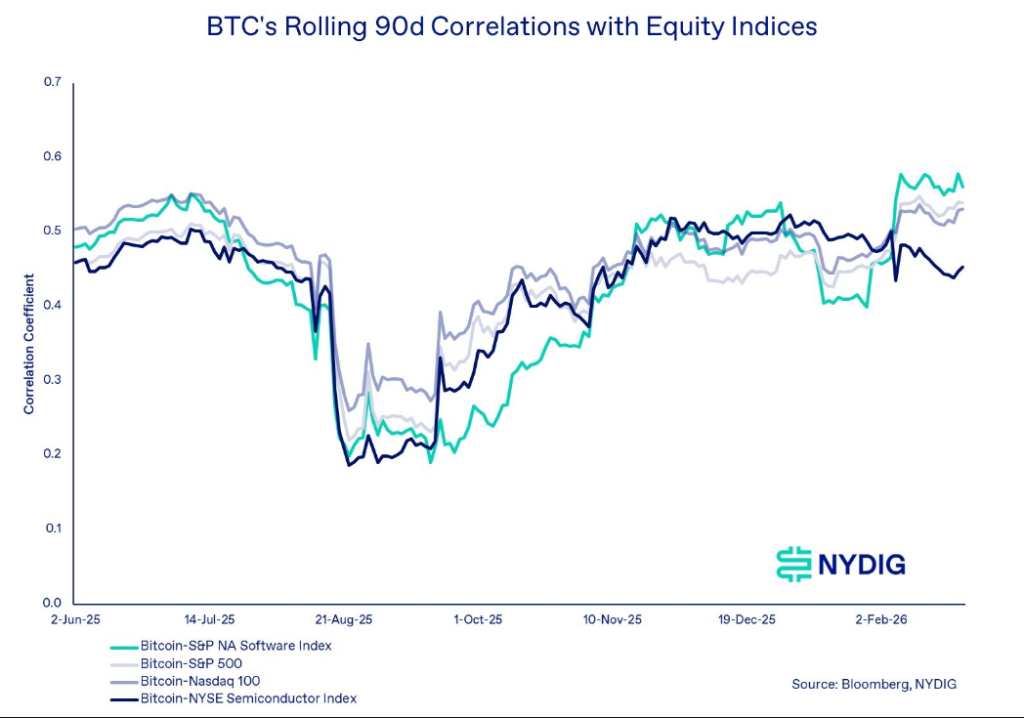
Traders watching Bitcoin climb alongside US software stocks last week may have drawn the wrong conclusion. According to NYDIG, a financial services company focused on Bitcoin, the visual parallel is misleading.
Only about 25% of BTC price movement can be traced back to its relationship with equity markets. The remaining 75% is driven by forces that have nothing to do with the S&P 500 or the Nasdaq.
Greg Cipolaro, head of research at NYDIG, made the case in a Friday note. His argument: when Bitcoin and software stocks move in the same direction, it is not because they are structurally linked. Both are reacting to the same macro pressures — the kind that push investors toward or away from risk assets broadly.
“The conclusion that Bitcoin and software equities have structurally converged is overstated,” Cipolaro wrote.
A Shared Macro Trigger, Not A Common Identity
Bitcoin’s 90-day rolling correlation with software stocks has climbed since the cryptocurrency hit a record above $126,000 in early October. But Cipolaro pointed out that its correlations with the S&P 500 and Nasdaq have risen at the same time.
Liquidity Sensitive Assets
That pattern suggests the shift is not specific to software stocks — it is a wider phenomenon tied to investor appetite for risk.
Data shows that both the alpha crypto and software equities are being treated as long-duration, liquidity-sensitive assets. When macro conditions favor risk-taking, both go up. When they don’t, both get hit.
That shared sensitivity to monetary conditions is what has been driving the parallel movement, not any deeper connection between the two.
The “Bitcoin is a tech stock” narrative has circulated before. It tends to resurface during periods when correlations tick higher and the assets appear to move in lockstep. Cipolaro’s note pushes back on that framing directly.
Crypto’s Distinct Drivers Keep It In A Category Of Its OwnDespite the elevated correlations, NYDIG argues that Bitcoin has a market structure that sets it apart. Network activity, adoption trends, and policy developments all shape its price in ways that do not apply to software companies.
Those factors, Cipolaro said, support Bitcoin’s role as a portfolio diversifier even when cross-asset correlations are climbing.
One tension the note acknowledges is Bitcoin’s failure to trade like gold. It has long been called “digital gold,” but reports indicate it is not being bought as a hedge against economic instability.
Traders appear to be allocating to it along a risk curve rather than out of any distinct monetary conviction.
Correlations with equities are elevated right now. But based on NYDIG’s analysis, they are far from the full story of what moves Bitcoin’s price — and far from enough to call it a software stock.
Featured image from ION, chart from TradingView
Related Articles
SEC’s 2026–2030 Plan Puts Crypto At The Center Of Its Regulatory Agenda
The US Securities and Exchange Commission (SEC) has again pointed to its goal of...
Bitcoin Eyeing $60,000 Support As Iran Strikes Hammer Crypto Markets
Bitcoin traders are watching $60,000 after US-listed funds tied to the coin shed...
Premier League Crypto Sponsors Under Fire In UK Regulatory Warning
The UK’s financial watchdog has raised concerns to Premier League football...

Over $7M In Crypto Scams Thwarted As Singapore Launches Second Crackdown
Over $7 million in potential losses has now been stopped across two back-to-back...