Bitcoin ETFs Record $545M in Outflows as $LIQUID Packs Muscle
Alex Smith
4 months ago

What to Know:
- U.S. Bitcoin ETFs saw $545M in outflows in a single week, indicating a temporary retreat by institutional investors due to macroeconomic uncertainty.
- Despite the headline outflows, capital is moving into infrastructure protocols that solve liquidity fragmentation rather than exiting the crypto ecosystem entirely.
- LiquidChain ($LIQUID) is gaining momentum by creating a unified execution layer that merges Bitcoin, Ethereum, and Solana, having raised over $526k in its ongoing presale.
- The industry’s inability to seamlessly move value between top chains remains a primary bottleneck, making cross-chain solutions a critical narrative for the next cycle.
The institutional love affair with Bitcoin has hit its first real rough patch. In a stark pivot, U.S. spot Bitcoin ETFs shed a massive $545M in a single trading week.
That exodus, the worst since post-launch volatility, signals a distinct ‘risk-off’ mood among TradFi allocators.
These flows aren’t just numbers on a screen. They measure Wall Street’s pulse. When Fidelity (FBTC) and Grayscale (GBTC) bleed simultaneously, it suggests macro headwinds (think stubborn inflation and a hawkish Fed) are forcing asset managers to rebalance.
The market reacted swiftly, losing support levels analysts had defended for months. But look closer. While ‘paper Bitcoin’ faces liquidation, on-chain activity tells a wildly different story.
In previous cycles, we’ve seen this pattern: when top-heavy assets sell off, capital flows downstream into infrastructure plays that solve structural inefficiencies. Right now, the market is plagued by fragmentation, liquidity is trapped in silos across Bitcoin, Ethereum, and Solana.
That friction is exactly what LiquidChain ($LIQUID), a new Layer 3 protocol, targets.
Unifying The Fractured Liquidity of $BTC, $ETH, and $SOL
The core issue stifling the market isn’t a lack of capital. It’s that the capital can’t move. Currently, a user holding assets on Bitcoin can’t interact with Solana DeFi without navigating high-friction bridges, wrapped asset risks, and exorbitant gas fees.
It’s a mess, three separate economies that barely speak to one another.
LiquidChain ($LIQUID) fixes this plumbing. Positioning itself as the ‘Cross-Chain Liquidity Layer’ (L3), it fuses the liquidity of the industry’s three giants, Bitcoin, Ethereum, and Solana, into a single execution environment. For developers, this is a paradigm shift.
Instead of rewriting smart contracts for three different virtual machines (EVM, SVM, and Bitcoin Script), LiquidChain offers a Deploy-Once Architecture. Build a lending protocol once, and it instantly accesses liquidity from all three chains.
Technically, this removes the ‘bridging’ risk that has historically resulted in billions of dollars in hacks. For the end-user, that complex backend is invisible. They experience single-step execution, trading or staking assets across chains without managing multiple wallets. In a market demanding efficiency over speculation, this utility-first approach is cooking.
Learn more about LiquidChain here.
Capital Rotates: Presale Metrics Defy Market Gloom
While ETF investors sell the news, early-stage participants are buying the tech. This divergence highlights a classic “barbell strategy” used by crypto natives: holding spot BTC for the long term while deploying stablecoins into high-beta infrastructure plays.
LiquidChain ($LIQUID) is capitalizing on this rotation. According to live data, the protocol has already raised over $526K. The native token, $LIQUID, is currently priced at $0.0135, an entry point early backers view as asymmetric compared to the multi-billion dollar valuations of existing (and still fragmented) L2 solutions.
Seeing this much inflow during a bearish weekly candle suggests high conviction in the ‘interoperability thesis.’ Investors are betting the next bull run won’t be driven by isolated pumps on Solana or Ethereum, but by applications that can use liquidity from everywhere simultaneously.
The project’s focus on Liquidity Staking further incentivizes sticky capital, money that stays to earn yield rather than fleeing at the first sign of macro volatility. As TradFi steps back to reassess, DeFi natives are doubling down on the infrastructure that will support the next wave.
Visit the $LIQUID presale now.
Disclaimer: This article is for informational purposes only and does not constitute financial advice. Cryptocurrency investments, including presales and ETFs, carry inherent risks, including high volatility and potential loss of principal. Always conduct your own due diligence.
Related Articles
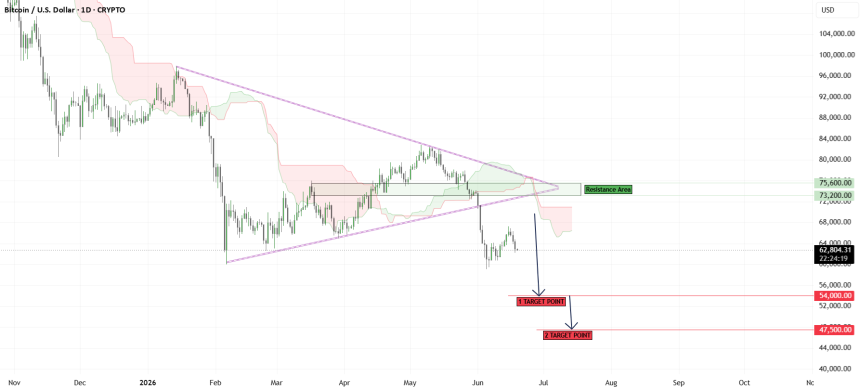
Bitcoin Bears Eye Lower Levels As TradingView Analysts Flag Failed Recovery
TradingView analysts warn Bitcoin's rebound may still be a resistance retest as...

Bitcoin Reclaims $63,500 As Traders Watch For Squeeze Toward $67,000
Bitcoin bulls are watching the $63,500 support zone as traders map a potential s...

Bitcoin Analysts Split Between Buyer Demand And Resistance Ceiling Near $65,000
Bitcoin analysts are split as BTC shows buyer demand but still faces a resistanc...

Bitcoin Faces Key $64,100 Resistance As Analyst Watches Fib Reaction Zone
An X analyst says Bitcoin is approaching local H4 resistance near $64,100, a lev...