Blockstream Unveils Quantum-Resistant Bitcoin Signing Demo On Liquid
Alex Smith
2 months ago
Blockstream Research says it has deployed post-quantum signature verification on Liquid, marking what it describes as the first time real transactions on a production Bitcoin sidechain have been signed with a post-quantum scheme. For Bitcoin infrastructure, the significance is less about an immediate emergency than about proving that quantum-resistant tools can be tested in live conditions before a crisis forces the issue.
The announcement centers on Simplicity, Blockstream’s smart contract language for Liquid. Rather than waiting for a network-wide consensus upgrade, the team used Simplicity to build a custom spending condition that lets users lock assets to a contract requiring post-quantum signatures for redemption. In practice, that means Liquid users can opt into quantum-focused protection for LBTC and other issued assets, including stablecoins and tokenized securities, without changing Liquid’s base consensus rules.
How Blockstream Tackles Bitcoin Quantum Threat
Blockstream framed that as the key breakthrough. “The traditional approach to adding post-quantum signatures would require consensus changes across the network—a slow, careful process involving all stakeholders,” the research note said. “But Simplicity, Blockstream’s smart contract language on Liquid, offers a different path.”
The verifier is based on SHRINCS, a compact hash-based post-quantum signature design that Blockstream Research says it developed specifically for blockchain environments. The system includes a stateful mode intended for normal use, which produces smaller signatures, and a stateless fallback mode designed for recovery scenarios so users can still access funds even if they lose state. That dual-track design speaks to a practical problem in post-quantum cryptography: theoretical safety is not enough if the system is too cumbersome for real-world wallet behavior.
Just as important, Blockstream says this is not a lab simulation. The team broadcast two live transactions on Liquid mainnet, one using the stateful mode and another using the stateless fallback. Those transactions secured real value, and Blockstream said the approach works not only for bitcoin on Liquid but for any asset issued on the network.
The note also highlighted a more symbolic detail. Because Liquid requires transaction size to scale with computational budget, the team had to fill excess space in the post-quantum transactions. “Rather than padding these transactions with zeros, Blockstream filled the extra space with the Bitcoin whitepaper—a nod to the cypherpunk roots of this work.”
Still, the company was careful not to oversell what has been shipped. “This verifier does not make Liquid fully quantum-resistant,” the post said. “Several critical components remain classically secured,” including the Bitcoin peg, Confidential Assets commitments and Liquid’s blocksigning consensus protocol. In other words, this is a meaningful first building block, not a full-stack answer to a future quantum threat.
That distinction matters for how the development should be read. The research note repeatedly stresses that cryptographically relevant quantum computers do not exist today and may not arrive for years or decades. But it argues that waiting until such machines are close would be a mistake, especially for Bitcoin-like systems whose security assumptions are deeply tied to classical ECDSA and Schnorr signatures.
“What we’ve done on Liquid—building, testing, and deploying post-quantum solutions on production systems—is how we prepare Bitcoin infrastructure for the future,” Blockstream wrote. That may be the clearest takeaway here: not that Bitcoin has solved the quantum problem, but that one credible path is beginning to move from theory into production-grade experimentation.
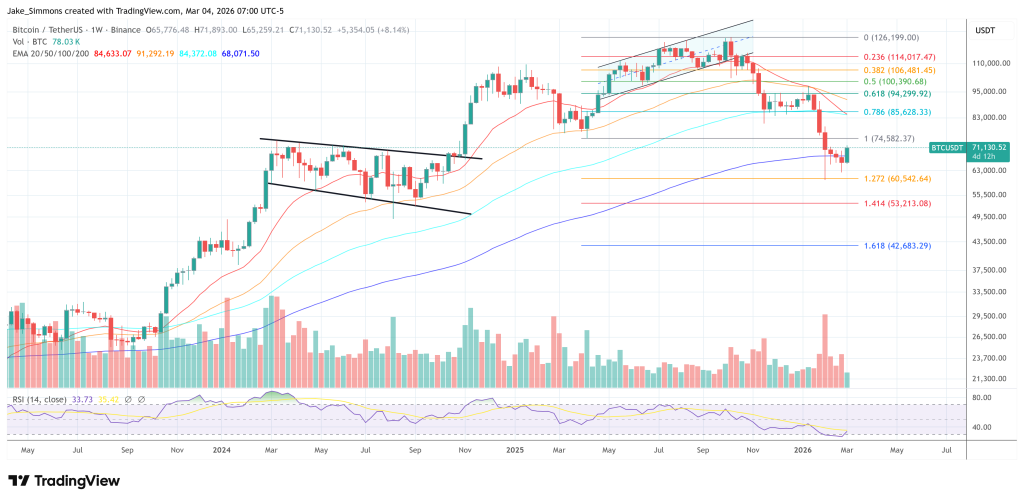
At press time, BTC traded at $71,130.
Related Articles

Corporate Giant Eyes $4.2 Billion Bitcoin Expansion While Saylor Moves To Sell
Strategy, the company led by Michael Saylor, sold 32 Bitcoin worth roughly $2.5...

Bitcoin’s Longest-Running Bottom Signal Is Back In Focus: Capitulation Fears Grow
Bitcoin has lost the $69,000 level as selling pressure and market uncertainty co...
Ripple Targets Türkiye’s $200 Billion Crypto Market With RLUSD Launch
Ripple has expanded its USD-backed stablecoin RLUSD into Türkiye through new par...

XRP Whale Activity Falls To A Four-Year Low – What Does It Mean For Price?
XRP is struggling as selling pressure keeps the price pinned near $1.28 without...