Can the Fusaka Upgrade Renew Ethereum’s Momentum After Recent Price Hit?
Alex Smith
6 months ago
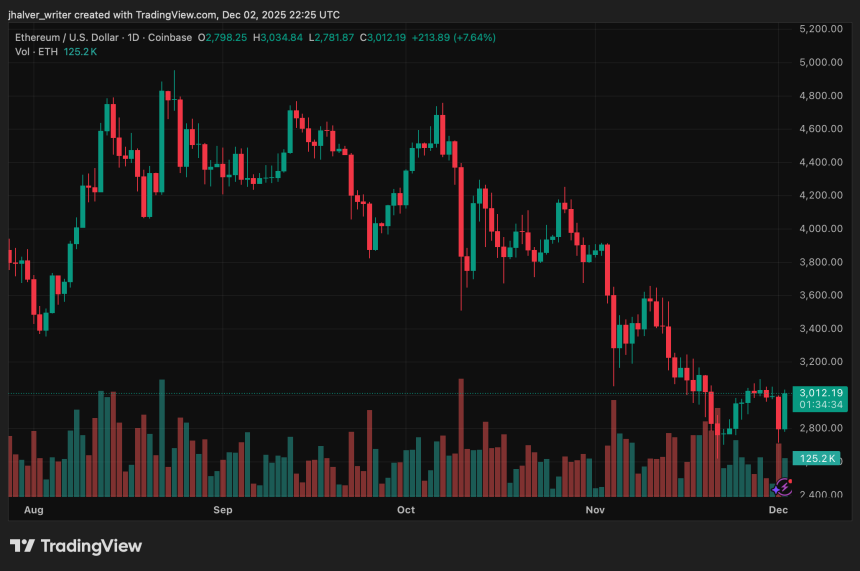
Ethereum fell more than 2% within 24 hours, sliding below $3,000 after losing its $2,900 support level. The drop triggered widespread liquidations, with around $500 million in long positions wiped out. Data shows that $79 million of the $106 million in ETH-focused contracts liquidated were long bets.
Trading activity spiked sharply during the decline, with daily volume rising 200% to $33.2 billion. The broader crypto market also contracted, falling nearly 1.2% and erasing an estimated $1100 billion in value within hours. Bitcoin, SOL, XRP, and DOGE followed similar downward moves.
Despite the volatility, some firms accumulated ETH during the downturn. BitMine Immersion Technologies increased its holdings by 96,798 ETH, diverging from the trend of companies reducing risk exposure.
Fusaka Upgrade Goes Live, Aiming to Boost Scalability
On December 3, Ethereum is set to activate its Fusaka upgrade, the network’s second major 2025 update. The upgrade aligns execution- and consensus-layer changes, introducing features that aim to improve Layer 2 and reduce costs.
A key component is PeerDAS, a data-sampling mechanism designed to reduce the bandwidth validators need to verify Layer 2 data. This system aims to cut validator bandwidth requirements by up to 85% and expand blob data capacity, potentially lowering Layer 2 transaction fees by 40–60%.
Fusaka also raises Ethereum’s block gas limit to 60 million, enabling more transactions per block, and introduces updates to the Ethereum Virtual Machine that streamline smart contract execution. These combined changes are expected to enhance the network’s transaction capacity.
Industry interest had been rising ahead of the upgrade. Major financial players, including Amundi and Fidelity, recently announced moves into tokenized products built on Ethereum, reflecting broader institutional activity across the network.
Can Ethereum (ETH) Recover From Oversold Levels?Ethereum (ETH) last traded at around $2,807, with technical indicators indicating continued bearish momentum. The MACD remains in negative territory, while the Relative Strength Index sits at 32, signaling oversold conditions.
Key support levels are at $2,700 and $2,500. A failure to hold these zones may deepen the downtrend, while a rebound could push ETH back toward $2,900–$3,000. Open Interest rose 4.3% after the decline, suggesting traders are reopening positions and preparing for higher volatility.
Whether the Fusaka upgrade can shift market sentiment remains uncertain, but its long-term scaling impact may play a role in Ethereum’s broader recovery.
Cover image from ChatGPT, ETHUSD chart from Tradingview
Related Articles
Bitcoin Bears Eye Lower Levels As TradingView Analysts Flag Failed Recovery
TradingView analysts warn Bitcoin's rebound may still be a resistance retest as...

Bitcoin Reclaims $63,500 As Traders Watch For Squeeze Toward $67,000
Bitcoin bulls are watching the $63,500 support zone as traders map a potential s...

Bitcoin Analysts Split Between Buyer Demand And Resistance Ceiling Near $65,000
Bitcoin analysts are split as BTC shows buyer demand but still faces a resistanc...

Bitcoin Faces Key $64,100 Resistance As Analyst Watches Fib Reaction Zone
An X analyst says Bitcoin is approaching local H4 resistance near $64,100, a lev...