Ethereum Founder Breaks Silence With Major Upgrade Proposal
Alex Smith
6 months ago
Ethereum co-founder Vitalik Buterin has unveiled a major proposal that could fundamentally reshape how the network handles transaction fees. His new design aims to replace unpredictable costs with a system that lets users plan and budget more effectively, signaling one of the most significant shifts in Ethereum’s economic framework in years.
Ethereum Gas Fees As Predictable, Prepaid Resources
Buterin’s proposal centers on a new on-chain gas futures market. Today, gas fees rise and fall based on network congestion and users have no way to know in advance what they will pay, which complicates planning for developers, businesses, and high-volume platforms.
The new model reshapes that dynamic by allowing users to purchase a defined amount of gas at a fixed price for future use. Rather than hoping the network will be affordable at the moment they need to transact, they can lock in their costs in advance. This moves Ethereum from a system dominated by short-term fee volatility to one anchored in stable, forward-looking pricing
Under the proposed design, these futures contracts would be traded directly on-chain. Their prices would naturally reflect expectations of future demand. When demand is expected to increase, futures prices rise; when expected to fall, they drop. This creates a transparent, market-driven view of upcoming network activity, giving developers and organizations a more reliable basis for planning their operations.
The structure also builds on the foundation set by EIP-1559, which introduced the base fee mechanism. Buterin’s futures market doesn’t replace that system—it extends it. It transforms gas from reactive cost into a resource that can be managed in advance, similar to how businesses lock in costs for electricity, bandwidth, or other essential inputs.
Operational Benefits For Developers, Businesses, And The Network
The most immediate benefit is cost certainty. High-volume users—exchanges, rollups, wallets, and automation services—often operate on tight margins, and sudden gas fee spikes disrupt operations and planning. By locking in future gas costs, this uncertainty is removed, supporting consistent service delivery. Developers also gain a stable environment, enabling them to schedule upgrades, plan deployments, and manage workloads without worrying about fee surges. This predictability strengthens project roadmaps and enhances user experience.
For enterprises integrating Ethereum into payments, verification, or data-processing workflows, predictable fees are essential. Buterin’s model addresses this barrier, positioning Ethereum as a more reliable foundation for long-term, large-scale adoption.
At the network level, the futures market introduces clearer economic signals. Rising futures prices indicate increasing demand for blockspace, guiding scaling decisions and resource allocation. Falling prices signal lower demand, enabling more efficient development and infrastructure planning.
The proposal does not lower gas fees but makes them manageable, converting an unstable cost into a predictable one. This enhances Ethereum’s appeal for serious applications, institutional activity, and reliable operational planning. By introducing a gas futures mechanism, the ecosystem can better manage costs and prepare for growth, marking a decisive step toward a more professional-grade Ethereum.
Related Articles
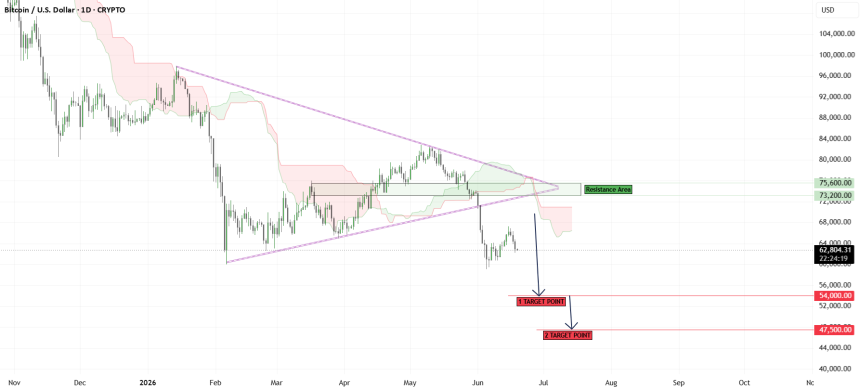
Bitcoin Bears Eye Lower Levels As TradingView Analysts Flag Failed Recovery
TradingView analysts warn Bitcoin's rebound may still be a resistance retest as...

Bitcoin Reclaims $63,500 As Traders Watch For Squeeze Toward $67,000
Bitcoin bulls are watching the $63,500 support zone as traders map a potential s...

Bitcoin Analysts Split Between Buyer Demand And Resistance Ceiling Near $65,000
Bitcoin analysts are split as BTC shows buyer demand but still faces a resistanc...

Bitcoin Faces Key $64,100 Resistance As Analyst Watches Fib Reaction Zone
An X analyst says Bitcoin is approaching local H4 resistance near $64,100, a lev...