Fidelity Sees Key Crypto Catalysts Emerging For Q2 2026
Alex Smith
2 months ago
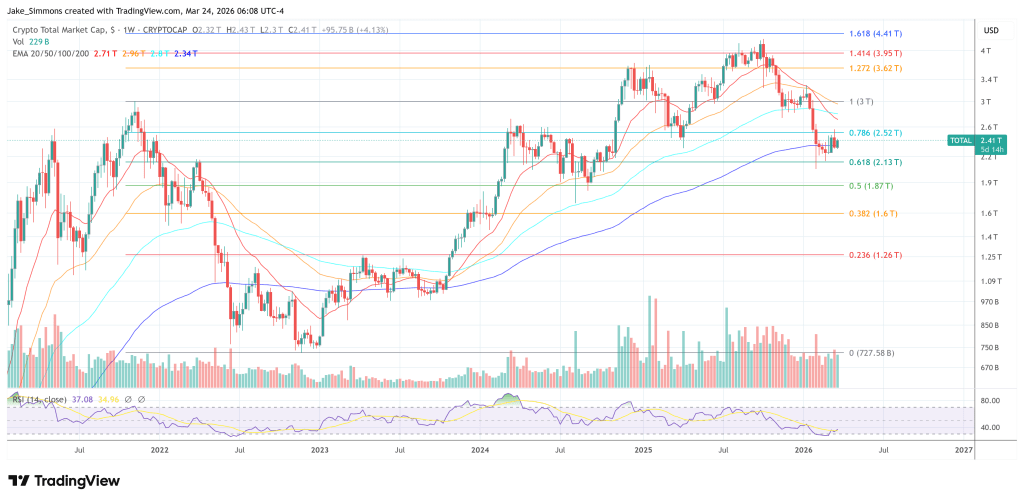
Fidelity’s latest quarterly crypto livestream framed the second quarter of 2026 as a transition period for crypto assets, with the firm’s speakers pointing to a mix of macro, regulatory, and on-chain developments that could shape the next phase of the market. The discussion centered on bitcoin’s current consolidation, the growing role of stablecoins, and whether smart contract platforms could find new momentum through tokenization and AI-driven developer productivity.
Crypto Outlook For Q2 2026
Jurrien Timmer, Fidelity’s director of global macro, described the recent selloff as a “mild winter” rather than the kind of deep crypto washout seen in prior cycles. Bitcoin, which he said peaked around $126,000 before falling to roughly $60,000, has already endured a drawdown of more than 50%, but he argued that such declines should become less severe as the asset matures.
“I’m not looking for an 80% drawdown, which would be a pretty harsh winter,” Timmer said. “I think a 50% to 60% drawdown, which is what we’ve had, is probably as much as it needs to go. Again, not market timing here, but I think we’re in the zone. So yes, a mild winter, but maybe spring is around the corner.”
That view ties into a broader Fidelity debate around whether bitcoin’s four-year cycle is still intact. Max Wadington of Fidelity Digital Assets said Q1 likely confirmed the timing component of the cycle, given that the prior all-time high in November 2021 lined up closely with the market peak in late 2025. But both speakers argued that the mechanism behind the cycle is changing as halvings matter less and demand-side factors take on greater importance.
For Timmer, the immediate setup is less about a fresh breakout than a base-building phase. He said bitcoin appears to be testing a range around $60,000 to $70,000 while the market searches for a new narrative after both the “hard money” and speculative trades lost momentum.
“We’ve done the hard money narrative. Gold is running that show right now. We had the speculative narrative,” Timmer said. “And so I think it’s sitting here waiting for a new storyline, if you will. It’ll still be related to those two. But something needs to happen.”
One possible catalyst is macro policy. Timmer said he is watching prospective leadership changes at the Federal Reserve closely, arguing that a closer alignment between the Fed and Treasury in managing the debt load could eventually revive the hard-money case for bitcoin if markets begin to question central bank independence. In his telling, gold has already responded to that theme, while bitcoin has lagged.
The macro picture is not one-dimensional, however. Timmer said bitcoin is currently caught between two identities: an “aspirational store of value” tied to monetary debasement and a speculative asset that often trades in line with tech risk.
He pointed to a disconnect between rising global money supply, which he pegged at around $120 trillion and up roughly 12% year over year, and bitcoin’s weaker recent performance. At the same time, he noted that software stocks have been under pressure, and bitcoin has moved more in that direction than alongside hard-money assets.
Wadington’s Q2 focus sits further down the stack. He highlighted tokenization, DeFi, and stablecoins as major themes already gaining traction, especially after Fidelity Digital Assets launched its own dollar-backed stablecoin, FIDD. He stressed that stablecoins should not be viewed as long-term investments so much as on-chain cash instruments designed for round-the-clock, low-cost global transfers.
More interestingly, he said the next leg for Ethereum and Solana may come not only from AI agents transacting on-chain, but from AI making crypto developers more productive in the near term.
“What I’m looking for are any signs or signals that show the thousands of crypto developers getting marginally or incrementally more productive,” Wadington said. “And I think that’ll have a direct impact on the underlying value of these assets. I personally don’t think it’s something that’s been talked about much that we could see come up in the metrics pretty shortly here.”
At press time, the total crypto market cap stood at $2.41 trillion.
Related Articles
Bitcoin Bears Eye Lower Levels As TradingView Analysts Flag Failed Recovery
TradingView analysts warn Bitcoin's rebound may still be a resistance retest as...

Bitcoin Reclaims $63,500 As Traders Watch For Squeeze Toward $67,000
Bitcoin bulls are watching the $63,500 support zone as traders map a potential s...

Bitcoin Analysts Split Between Buyer Demand And Resistance Ceiling Near $65,000
Bitcoin analysts are split as BTC shows buyer demand but still faces a resistanc...

Bitcoin Faces Key $64,100 Resistance As Analyst Watches Fib Reaction Zone
An X analyst says Bitcoin is approaching local H4 resistance near $64,100, a lev...