Fidelity Thinks Bitcoin May Be Leaving Its 80% Crashes Behind
Alex Smith
4 months ago
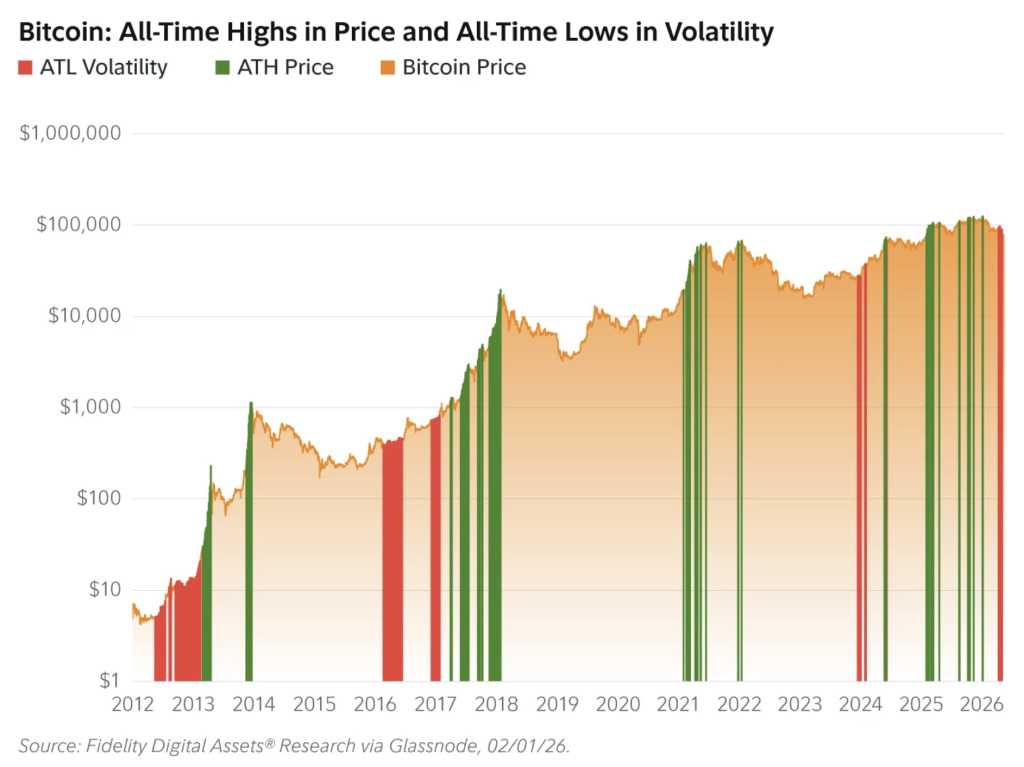
Fidelity Digital Assets argues Bitcoin’s market structure has shifted enough that the familiar four-year boom-bust pattern and the brutal 80% drawdowns that often followed, may no longer be the default outcome.
In a Feb. 24 research note titled “Is Bitcoin’s Four-Year Cycle Over?” research analyst Zack Wainwright frames the call around a simple observation: Bitcoin is now a very different-sized asset with a very different buyer base. Fidelity pegs Bitcoin’s market cap at an all-time high of roughly $2.5 trillion as of October 2025, alongside signs of deeper liquidity and a steadier volatility regime than prior cycles.
“As bitcoin matures, price behavior is diverging from previous cycles. Volatility decreasing even as price reached new highs above $126,000.”
Bitcoin Demand Is Being Re-Shaped
Fidelity’s volatility argument leans on one-year realized volatility and how it behaved around cycle peaks. In prior cycles, the pattern was broadly consistent: volatility would compress into new lows ahead of a major upside move toward new highs, then expand as the cycle overheated.
This time, Fidelity says the compression is arriving sooner after the peak. The note points to 17 new all-time lows in one-year realized volatility logged in January 2026—just months after Bitcoin notched fresh all-time highs in October 2025—calling it a meaningful divergence from the cadence of earlier cycles. The team attributes part of that dampening to scale: Bitcoin is about twice the market cap it was at the 2021 peak, roughly 10x 2017’s peak, and over 200x 2013’s.
The second pillar is who is holding supply, and how sticky that demand appears. Fidelity highlights a cohort of 49 public companies holding more than 1,000 BTC each, with combined holdings above 1 million BTC, over 5% of circulating supply. It also notes that, since Q1 2020, this group increased holdings quarter-over-quarter in every quarter except Q2 2022, when Tesla sold a large portion of its position.
On the ETF side, Fidelity writes that US spot Bitcoin ETFs launched in January 2024 and collectively held nearly 1.3 million BTC as of Jan. 30, 2026, about 6.4% of circulating supply. The note adds that the category leader surpassed $75 billion in assets under management in under two years, contrasting that pace with gold’s flagship ETF, GLD, which took nearly seven years to reach the same milestone.
Together, Fidelity says public companies and ETFs now hold nearly 12% of circulating supply, with most of the growth coming after 2023—a demand shift the team views as structurally important for drawdowns.
Fidelity also argues the cycle has looked “notably stable” across several on-chain and issuance-linked measures. Using a profit-window framework, when addresses in profit first exceed 95% through the last time they remain above 95%, the note says MVRV has stayed roughly around two times realized value through most of the bull market, rather than spiking toward four-to-six times as in earlier cycles.
The report flags a counterfactual to illustrate the point: if market cap reached four times realized cap in this cycle, it would imply roughly a $4.5 trillion market cap and about $225,000 per BTC as of Feb. 2, 2026. It also notes the Puell Multiple has stayed close to one, signaling daily issuance value hasn’t meaningfully deviated from its one-year average.
Fidelity’s new “Profit to Volatility Ratio” is where the drawdown claim becomes explicit. The team sets 0.01 as a stability line and says the ratio has stayed above 0.015 since late 2023, the longest sustained period at those levels in Bitcoin’s history. Even with a February 2026 downturn that pushed BTC below $70,000, the ratio remained above the threshold.
“A measurement above 0.01 can be considered very stable. Conversely, a measurement below 0.01 should be viewed with caution.”
The implication, Fidelity suggests, is not that volatility disappears—but that the classic cycle-ending wipeouts may be less likely in a market increasingly shaped by institutional channels and a larger, more liquid base. If that regime holds, the next phase could look less like a blow-off top and more like a slower, more methodical repricing, higher over time, but with fewer cliff-edge resets.
At press time, BTC traded at $66,677.
Related Articles
Bitcoin Bears Eye Lower Levels As TradingView Analysts Flag Failed Recovery
TradingView analysts warn Bitcoin's rebound may still be a resistance retest as...

Bitcoin Reclaims $63,500 As Traders Watch For Squeeze Toward $67,000
Bitcoin bulls are watching the $63,500 support zone as traders map a potential s...

Bitcoin Analysts Split Between Buyer Demand And Resistance Ceiling Near $65,000
Bitcoin analysts are split as BTC shows buyer demand but still faces a resistanc...

Bitcoin Faces Key $64,100 Resistance As Analyst Watches Fib Reaction Zone
An X analyst says Bitcoin is approaching local H4 resistance near $64,100, a lev...