Prediction Markets Don’t Just Reflect Crypto Sentiment; They Help Shape It
Alex Smith
1 month ago
- ▸ Prediction markets are increasingly functioning as early-warning systems for new information, often repricing risk ahead of traditional channels.
- ▸ Their edge is not just in forecasting accuracy, but in how prices move and what that reveals about participant behavior and liquidity.
- ▸ In crypto markets, prediction markets are becoming reflexive, where priced expectations can begin to influence positioning and price action itself.
When tensions between the United States and Iran escalated earlier this month, one of the fastest places to register the shift was not social media or breaking news alerts. Instead, attention shifted to prediction markets.
Odds on platforms like Polymarket and Kalshi moved in real time, pricing in the probability of escalation before much of the mainstream coverage caught up. Shortly after, sentiment around whether the price of certain cryptocurrencies would surge or drop followed.
That pattern is becoming increasingly difficult to dismiss. Prediction markets are starting to function less like standalone forecasting tools and more like early-warning systems for market-moving information, repricing risk before newsrooms, analysts, or social platforms fully process it.
“They update continuously and require participants to back their views with capital, so they can surface shifts in expectations faster than surveys, analyst reports, or social media sentiment,” said Francesco Mosterts, co-founder of Umia.
The shift is subtle but important: traders are no longer just reading prediction markets for probabilities. They are increasingly using them to infer what others know, and how quickly that information is spreading. Prediction markets are also shifting beyond merely reflecting sentiment to being able to shape it.
From niche betting tools to strong trading signal
An analysis of Polymarket betting activity conducted by the New York Times earlier this year found that over 150 accounts placed significant bets correctly pricing that the US would strike Iran the following day.
Similarly, a February 2026 Federal Reserve working paper found that Kalshi’s modal forecast has maintained a perfect record on the day before every Federal Open Market Committee (FOMC) meeting since 2022, outperforming surveys and futures. Kalshi’s forecasts for US inflation data also showed nearly 40% lower error than Wall Street consensus, according to Marcin Kazmierczak, co-founder and CEO of RedStone.
Taken together, the data points to a growing perception among traders and analysts that prediction markets can, in certain contexts, act as highly efficient forecasting tools.
“That said, prediction markets aren’t universally superior. They still carry biases, including demographic skew and a favorite-longshot effect. Well-aggregated expert panels can match or beat them in certain conditions. The edge is real but domain-specific,” Kazmierczak noted.
But for traders, the value is often not the probability itself.
The liquidity predicament and its impact on accuracy
While headline probabilities can appear authoritative, many prediction markets operate with relatively low trading volumes, where small amounts of capital can move prices significantly. In those conditions, odds may reflect the positioning of a handful of participants rather than a broad, well-informed consensus.
According to RedStone’s Kazmierczak, an analysis of thousands of resolved Polymarket markets showed that accuracy rises sharply to about 84% near $100,000 in cumulative volume.
- Under $10,000 in volume: ~61% accuracy
- Around $100,000: ~84% accuracy
- Above $1 million: 90%+ accuracy
The data implies that the probability is only as reliable as the liquidity behind it.
“…Volume alone is not enough. A Columbia University study from November 2025 found that approximately 25% of Polymarket’s historical volume was wash trading, peaking at nearly 60% of weekly volume in late 2024…The quality of liquidity matters as much as the quantity,” Kazmierczak noted.
For traders, that reinforces a key distinction. In low-liquidity environments, price is often a reflection of positioning rather than probability.
“A single participant can move the market, so you’re really analyzing behavior, not just the implied odds,” Mosterts said.
When signals spread, they can become influence
The challenge is not just how these markets function internally, but how their signals travel.
Prediction market probabilities are increasingly embedded in mainstream media coverage and amplified across social platforms, where they are often presented as objective indicators of likelihood.
“When there isn’t much money in the market, prices can move with very little effort, so they’re not very reliable,” Husnain Bajwa, senior vice president of risk solutions at SEON, said. “But once those prices get picked up and shared through social media or news, they can be mistaken for consensus.”
In that sense, the influence of prediction markets may not stem from their size alone, but from their visibility.
A reflexive sentiment loop in crypto markets?
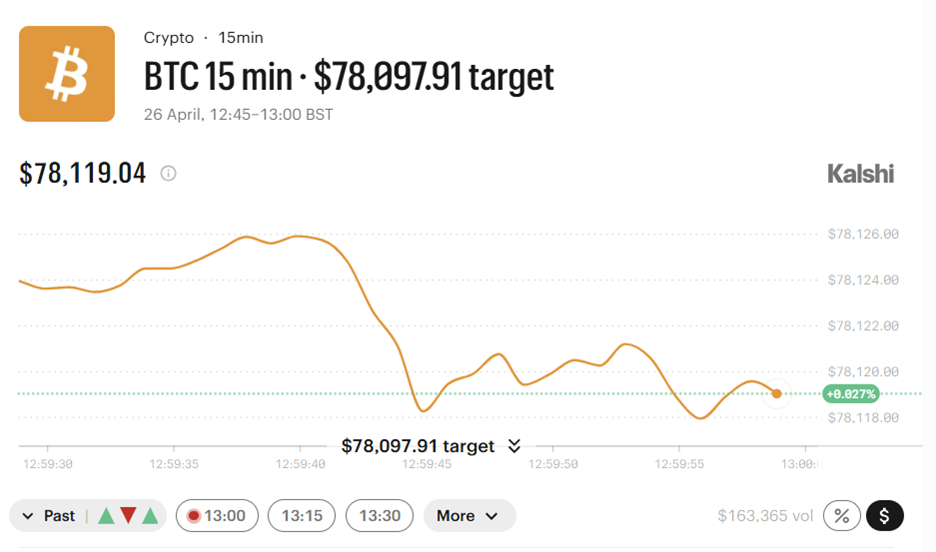
In crypto prediction markets, where price action is often driven as much by narrative as by fundamentals, prediction markets are beginning to do more than reflect sentiment. They are starting to coordinate it. On Polymarket and Kalshi, traders can now bet not only on long-term outcomes, but on where Bitcoin’s price will be within minutes.
In one such 15-minute market on Kalshi, participants placed bets on whether Bitcoin would exceed a target price of $78,097.91 at a specific timestamp. The contract attracted over $160,000 in volume and traded as high as 99¢.
These ultra-short-term markets compress expectations into extremely tight windows, effectively turning price direction itself into a tradable event.
“A few years ago, sentiment mostly lived in X posts, community chats, and conference conversations. Now, more sentiment is being expressed through market positions, which makes them easier to observe in real time. That creates a clearer signal, but it also makes the system more reflexive,” Mosterts said.
As probabilities are priced and publicly visible, they can anchor expectations and align positioning across the market.
“Prediction markets are evolving into a primary real-time gauge of sentiment, offering a clearer and more quantifiable signal than fragmented social media discussions or event-driven narratives,” said Alvin Kan, COO of Bitget Wallet.
At that point, prediction markets stop being passive indicators and start behaving more like market infrastructure.
Prediction markets: From signal to impact
Such added clarity can also reinforce momentum. As prediction market probabilities are observed and acted upon, they can feed back into positioning, and ultimately, price action itself.
Prediction markets are still evolving, and their reliability will ultimately depend on liquidity, transparency, and regulation. But their influence is already visible.
In a market as reflexive as crypto, where expectations can drive price as much as fundamentals, turning sentiment into something tradable may not just change how it is measured, but also how it is created.
The post Prediction Markets Don’t Just Reflect Crypto Sentiment; They Help Shape It appeared first on DeFi Rate.
Related Articles

Referrals Are Live: Refer & Earn on Synthetix
Referrals on Synthetix are now live.Create & share your referral code and ea...
Novig Receives CFTC Approval as ProphetX Launches Sports Prediction Markets Days After Designation
Novig targets a summer rollout after earning CFTC designation, while ProphetX we...
Introducing ETH as Margin on Synthetix
Multicollateral margin is now live on Synthetix and ETH is the first non-USDT as...
Polymarket Trader Loses $500K After Rules Change on Microstrategy BTC Market
A $175 million Polymarket market on MicroStrategy's Bitcoin holdings resolved ag...