Private Investment Firm Shares Why XRP Is Their Leading Investment
Alex Smith
6 months ago
A private investment firm has outlined why XRP constitutes the largest share of its portfolio. The firm explains that its investment rationale is anchored in XRP’s Proven operational performance and functional utility rather than aspirational projections, community momentum, or speculative price expectations. As a result, the position reflects a deliberate focus on infrastructure value, reinforcing XRP’s status as a core long-term holding rather than a tactical crypto trade.
Why XRP Aligns With A Function-First Investment Approach
The investment firm’s reasoning positions XRP as a natural fit for a portfolio strategy that prioritizes function over narrative. According to the firm, its heavy allocation is the byproduct of a disciplined evaluation of how well an asset performs its intended role. In this framework, concentration is justified only when an asset demonstrates clear operational strengths, and XRP is presented as having earned that status through its design and execution.
Building on that premise, the firm points to XRP’s specialization as a settlement-oriented digital asset as the primary driver of its allocation decision. The network is structured to deliver rapid and definitive transaction completion, eliminating the uncertainty that can complicate value transfer on many blockchain systems. This reliability is reinforced by consistently low transaction costs that remain stable regardless of usage levels, enabling predictable large-scale transfers without exposure to fee volatility. As transaction volume increases, XRP’s ability to maintain high throughput without congestion further supports its suitability for continuous, real-world payment activity.
These technical attributes also connect directly to the firm’s broader investment thesis around institutional usability. By operating without a proof-of-work mechanism, the ledger avoids the inefficiencies and regulatory friction often associated with energy-intensive networks.
In the firm’s assessment, this design choice enhances operational clarity and aligns more closely with the compliance and efficiency standards expected by financial institutions. Taken together, these factors explain why the firm views XRP less as a speculative vehicle and more as functional infrastructure, reinforcing its alignment with a function-first investment approach and justifying its central role within the portfolio.
Positioning For Institutional Adoption And Market Repricing
The firm frames its investment thesis around how markets evolve under regulatory pressure. As digital asset regulation advances, financial institutions are expected to prioritize reliability, compliance, and operational efficiency over popularity or community momentum. Adoption is therefore driven less by attention and more by seamless integration into existing financial frameworks.
This perspective also informs how digital assets may be valued. The firm expects a gradual shift from narrative-based pricing toward metrics such as transaction throughput, liquidity efficiency, and real-world demand. Assets able to move value at scale will likely be repriced as usage rises and speculative excess fades. In the firm’s assessment, XRP is one of the few assets already meeting these standards, and by concentrating its portfolio in XRP, it positions itself ahead of this transition.
Related Articles
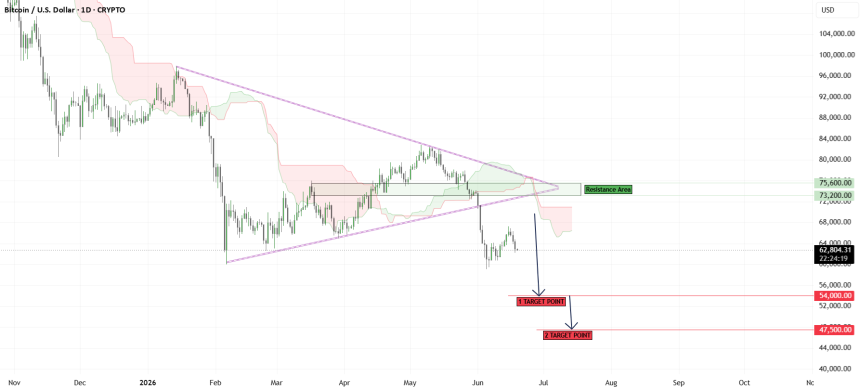
Bitcoin Bears Eye Lower Levels As TradingView Analysts Flag Failed Recovery
TradingView analysts warn Bitcoin's rebound may still be a resistance retest as...

Bitcoin Reclaims $63,500 As Traders Watch For Squeeze Toward $67,000
Bitcoin bulls are watching the $63,500 support zone as traders map a potential s...

Bitcoin Analysts Split Between Buyer Demand And Resistance Ceiling Near $65,000
Bitcoin analysts are split as BTC shows buyer demand but still faces a resistanc...

Bitcoin Faces Key $64,100 Resistance As Analyst Watches Fib Reaction Zone
An X analyst says Bitcoin is approaching local H4 resistance near $64,100, a lev...