Traders Pour Millions Into 2028 Presidential Race as Democrats Hold Early Edge
Alex Smith
1 month ago
- ▸ Traders are heavily positioning for 2028 despite unresolved 2026 midterms with $500M+ in notional volume already in play.
- ▸ Early odds cluster around J.D. Vance and Gavin Newsom, but a crowded field signals fluidity.
- ▸ GOP candidates top the board, but party-level markets still lean Democratic (~60%).
Traders are already throwing millions of dollars into the 2028 presidential race winner contracts on prediction markets despite not even knowing the outcomes of the 2026 midterms.
The midterm election odds are telling a clear story that prediction markets are pricing Democrats as slight favorites to retake the House, while the Senate looks like a toss‑up. That Democratic edge plays in the background of the 2028 presidential race, even as two of the top three spots on both Kalshi and Polymarket 2028 presidential election winner markets are held by Republicans in a year when President Donald Trump’s approval ratings are sinking.
The leaders in the contract reflect the markets’ forecasts for both the Republican and Democratic primary winner markets.
The 2028 prediction markets snapshot
On Polymarket’s Presidential Election Winner 2028 board, already with more than $556 million in volume, Vice President J.D. Vance and California Governor Gavin Newsom sit in a tight band at the top, with Vance at 19% and Newsom at 18%.
The field extends to 36 outcomes. That spread is still narrow enough that either potential candidate could slip or spike based on a single major event, but the baseline pricing tells you that the market is treating the race as a mostly two-person contest heading into the primaries.
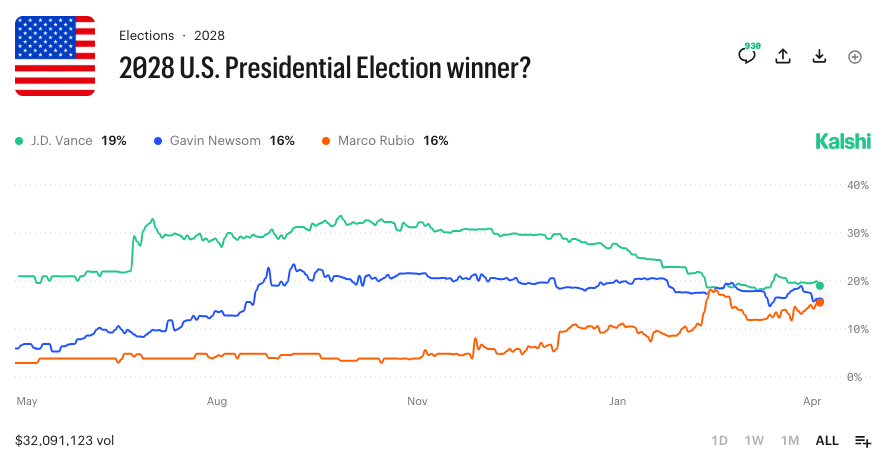
Kalshi’s 2028 US Presidential Election winner market paints a similar basic picture with over $32 million in volume. Vance leads at around 19% with Newsom and Marco Rubio not far behind at around 16%, with the rest of the field trading in single‑digits.
Kalshi snapshot of 2028 presidential market odds as of April 27, 2026What that tells you about the party trajectories
On the GOP side, the Vance pricing is a classic vice president narrative. The heir‑apparent Trump figure is still the clear favorite Republican primary winner, but the market is also pricing in enough risk that his support can erode if the Trump‑era momentum sputters or if a new challenger seizes the narrative.
The fact that Rubio can briefly surge into the top slot on Kalshi shows that the crowd is willing to shift around within the Trump‑aligned lane.
On the Democratic side, Newsom’s 18% standing is interesting because it is not quite a lock status, but more of an anchor for a widely dispersed coalition of potential Democratic candidates. The market is pricing him as the most likely 2028 Democratic presidential nominee, but the rest of the board is still crowded enough that the party’s base is clearly split between establishment figures and the more progressive wing.
The approval rating paradox
The 2028 presidential board is also notable for the way it sidesteps an obvious Trump approval rating issue.
Trump’s approval ratings are at least near their lowest of his two terms. Yet he still beats most of the 2028 field in favorability polls.
Prediction markets are pricing Vance and Rubio as the clear GOP leaders heading into 2028, not Trump himself. While Trump has teased a run at an unconstitutional third term, the markets are focusing on the succession structure.
The party winner overlay and the 2026 midterm backdrop
The 2026 midterm boards add another useful layer. Polymarket’s Which party wins 2028 US Presidential election contract is currently pricing Democrats at 60.5% to win, with the GOP at about 39.5%.
That spread suggests markets currently see the 2028 presidential winner as more likely to lean Democratic depending on the final candidate. Traders are also overwhelmingly predicting Dems will retake the House in the 2026 midterms with odds of retaking the Senate still at a toss-up.
Kalshi’s 2028 party winner contract and the related midterm election markets echo the same general structure. Traders heavily favor the Dems to take the House, while they price the Senate as a 50‑50 split. The presidential‑level pricing is more volatile but still modestly Democratic‑leaning.
Long-term prediction markets play
The 2028 presidential race markets are still looking out two years. But already trading with high volumes, it shows traders are excited to express their views on the world after Trump and Joe Biden presidencies.
While traders position Republicans as two of the top three spots on both Kalshi and Polymarket, party-winner markets favor the Democrats.
The 2028 presidential race boards are behaving like a crowded horse race, with the top two candidates already clear, but the second tier is still dense enough to create real‑world volatility.
The post Traders Pour Millions Into 2028 Presidential Race as Democrats Hold Early Edge appeared first on DeFi Rate.
Related Articles

Referrals Are Live: Refer & Earn on Synthetix
Referrals on Synthetix are now live.Create & share your referral code and ea...
Novig Receives CFTC Approval as ProphetX Launches Sports Prediction Markets Days After Designation
Novig targets a summer rollout after earning CFTC designation, while ProphetX we...
Introducing ETH as Margin on Synthetix
Multicollateral margin is now live on Synthetix and ETH is the first non-USDT as...
Polymarket Trader Loses $500K After Rules Change on Microstrategy BTC Market
A $175 million Polymarket market on MicroStrategy's Bitcoin holdings resolved ag...