Will Congress Ban Its Members from Trading Stocks? Prediction Markets Are Skeptical
Alex Smith
1 month ago
- ▸ Prediction markets show traders are skeptical that Congress will pass a stock trading ban this year, even as lawmakers introduce new proposals and expand restrictions into areas like prediction markets.
- ▸ Legislative efforts are shifting from banning insider trading to restricting participation altogether, with Sen. Kirsten Gillibrand leading proposals targeting both stock trading and prediction market activity.
- ▸ Lawmakers have moved quickly to approve prediction market trading bans, while broader stock trading restrictions, despite strong public support, have stalled for years, highlighting an uneven approach to reform.
The Senate banned its own members from trading on prediction markets in less than a week. A ban on stock trading has been stalled for years. And the very prediction markets now being restricted are pricing in long odds that lawmakers will ever impose the more meaningful limits on themselves.
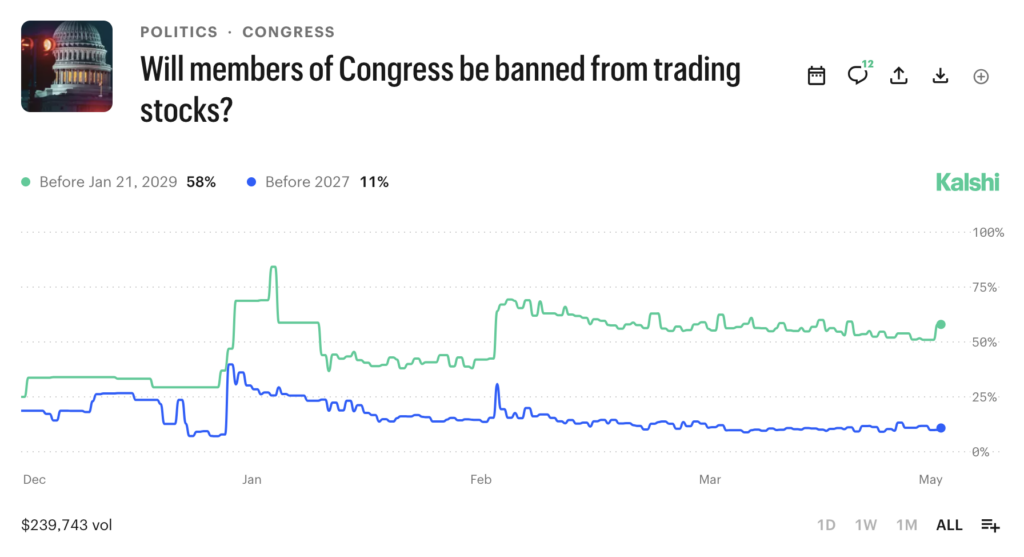
That contrast sits at the center of Washington’s uneven push to restrict how government officials participate in financial markets. Contracts on Kalshi and Polymarket tracking a potential congressional stock trading ban have hovered around 11–18% for passage this year, even after spiking briefly when the latest bipartisan bill was introduced in January. However, a longer-dated Kalshi contract tied to the end of Trump’s second term in 2029 sits near 58%, suggesting traders see it as a coin flip or better over time rather than a lost cause.
The easier question, prediction markets, moved fast. Sen. Bernie Moreno (R-Ohio) introduced a resolution on April 24 to bar senators and staff from trading on prediction platforms. It passed unanimously six days later.
Sen. Gillibrand’s push traces shift from insider trading rules to full bans
The broader effort to restrict congressional trading has been building for more than a decade. Sen. Kirsten Gillibrand (D-N.Y.) was a key advocate for the 2012 STOCK Act, which made explicit that members of Congress are subject to insider trading laws and cannot trade on nonpublic information, but stopped short of banning trading outright.
In January, she and Sen. Ashley Moody (R-Fla.) introduced the Restore Trust in Congress Act, a bipartisan bill proposing to bar members, spouses, and children from owning or trading individual stocks entirely. The Senate measure builds on a House version of the bill introduced in September 2025 by Rep. Chip Roy (R-Tex.) alongside a bipartisan group of lawmakers, which has attracted more than 100 co-sponsors. Efforts to force a vote on the House bill through a discharge petition have so far fallen short.
In announcing the legislation, Gillibrand’s office cited polling showing that 86% of Americans support passing a bill to ban members of Congress from trading individual stocks, pointing to widespread public backing for such restrictions.
Gillibrand is now extending that approach to prediction markets, introducing the Prediction Market Act of 2026 with Sen. Dave McCormick (R-Penn.). The bill which would bar all members of Congress and senior executive branch officials from trading event contracts on prediction markets.
The proposal, like the recent Senate ban, would prohibit participation outright, rather than rely on existing rules against trading on nonpublic information, mirroring the shift seen in stock trading proposals that move beyond insider trading restrictions to full bans. The bill would also direct the Commodity Futures Trading Commission (CFTC) to establish clearer insider trading standards for prediction markets and impose consumer protections like risk disclosures, age verification, and safeguards for customer funds.
“Elected officials should be working for the people they represent — not lining their own pockets with insider information,” Gillibrand said in a news release. “Americans deserve financial markets that are fair, transparent, and not tilted in favor of those with privileged access.”
I just introduced a bipartisan bill to ban members of Congress from trading on prediction markets.
— Sen. Kirsten Gillibrand (@gillibrandny) April 30, 2026
Elected officials should be working for the people they represent — not lining their own pockets with insider information. https://t.co/Npn7WBbTGK
Kalshi CEO Tarek Mansour, who has been vocal in backing legislative efforts to curb insider trading, expressed support for the bill in a post on X, calling it a “comprehensive and thoughtful approach.”
While we don’t agree with everything in this bill, Kalshi strongly supports it.
— Tarek Mansour (@mansourtarek_) May 1, 2026
Prediction markets have gone mainstream, from a niche corner of the internet, to a 500B asset class.
It’s time to strengthen the rules to make sure the markets are fair and transparent. This bill… pic.twitter.com/sFmiDDXNPG
Trading ban odds spike on bill introduction but point to low chances this year
Prediction markets tracking a potential ban on congressional stock trading show traders reacting to legislative developments but present low odds for passage in the near term.
On Kalshi, the contract on whether a ban will take effect before the end of 2026 surged from roughly 8% to as high as 40% on Jan. 12, immediately after the introduction of the Gillibrand-Moody bill, marking an all-time high. But the spike was short-lived. As of May 6, the same contract was trading around 11%, suggesting traders see little chance of a ban being enacted this year.
Kalshi screenshot of Congress stock trading ban oddsKalshi’s longer-dated contract, which tracks whether a ban will be in place by the end of President Donald Trump’s second term, Jan. 21, 2029, showed a similar reaction, climbing as high as roughly 84% shortly after the Gillibrand-Moody bill introduction before trending lower. That contract was trading around 58% as of May 6, suggesting traders see a better possibility of a ban over time, with longer-dated pricing potentially influenced by expectations around future shifts in congressional party control.
Markets on Polymarket show a comparable pattern. The platform’s contract on whether a stock trading ban will pass before the end of 2026 reached a high of about 34% in mid-January before falling to a low of 11% in late April and rebounding to around 14% as of May 6.
Polymarket screenshot of Congressional stock ban oddsTrading activity in both markets has been relatively limited. Kalshi’s contracts have drawn roughly $240K in volume since launching in December, while Polymarket’s market has seen about $17K traded since its introduction in November. The pricing and activity suggest that while traders respond to legislative developments, they remain skeptical that Congress will enact a stock trading ban this year, a dynamic that also raises questions about the likelihood of extending similar participation bans to prediction markets.
Quick action on prediction market bans contrasts with stalled stock trading efforts
The recent Senate vote to bar members from prediction market trading underscores how quickly narrower restrictions can move. Sen. Moreno (R-Ohio) introduced a resolution on April 24 to ban senators and their staff from trading on prediction markets, and it passed unanimously in just six days. Lawmakers have since called for extending those restrictions. Rep. Dina Titus (D-Nev.) has introduced similar legislation for House members and staff, while Senate Majority Leader Chuck Schumer has urged expanded action to bar prediction market participation by House members, while also calling for “a comprehensive federal ban covering every government official, staffer, and employee across the executive branch.”
Those efforts stand in contrast to repeated attempts to ban congressional stock trading, which have failed to advance despite years of bipartisan proposals. Lawmakers have introduced a series of bills since the STOCK Act, including the TRUST in Congress Act (2025) and the Ban Conflicted Trading Act (2021), but none have been enacted into law.
The difference reflects what is at stake. A stock trading ban would directly affect how lawmakers manage personal investments, an area where many members actively participate. Restrictions on prediction market trading, by comparison, likely apply to a much smaller slice of financial activity for lawmakers.
The result is an uneven push in Washington, as lawmakers move quickly on narrower restrictions while efforts that would impose more meaningful limits on their own financial activity remain uncertain.
The post Will Congress Ban Its Members from Trading Stocks? Prediction Markets Are Skeptical appeared first on DeFi Rate.
Related Articles
Kalshi Tops $7.5B With a Day Left, Smashing Its Own Weekly Volume Record
Kalshi has already surpassed $7.49 billion in notional volume for the week of Ju...

Referrals Are Live: Refer & Earn on Synthetix
Referrals on Synthetix are now live.Create & share your referral code and ea...
Novig Receives CFTC Approval as ProphetX Launches Sports Prediction Markets Days After Designation
Novig targets a summer rollout after earning CFTC designation, while ProphetX we...

Introducing ETH as Margin on Synthetix
Multicollateral margin is now live on Synthetix and ETH is the first non-USDT as...