93% in 3 Months: How Is Thangamayil Jewellery Stock Different Among Industry Players?
Alex Smith
4 weeks ago
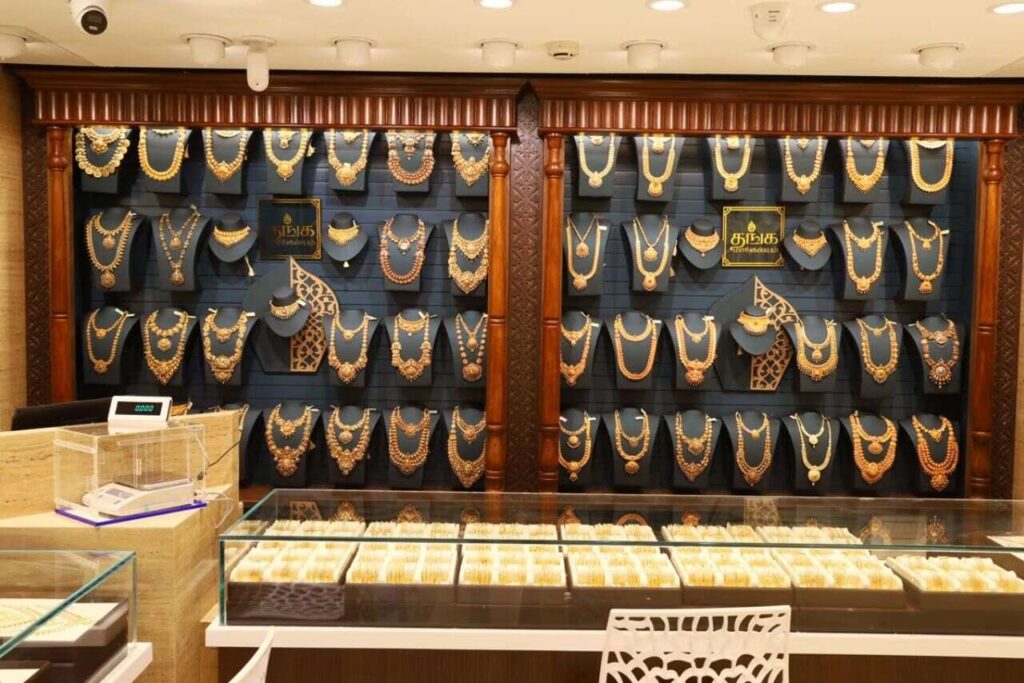
Synopsis: Thangamayil Jewellery Ltd stands out among industry players through disciplined expansion, strong regional understanding, and data-led execution, supporting consistent growth with 67 stores, a Rs. 11,914 crore market capitalisation, and nearly 1,140 percent stock returns in 5 years.
Thangamayil Jewellery Ltd is part of India’s fast-growing organised jewellery industry, a sector driven by rising incomes, increasing formalisation, and strong cultural demand for gold. Amid competition from large national chains and regional players, the company has carved out a distinct position through its focused business model and steady expansion strategy, making it an important name to track within the industry.
Thangamayil Jewellery Ltd, with a market capitalization of Rs. 11,913.74 crore, closed at Rs. 3,833 per equity share, up by 2.31 percent from its previous day’s close price of Rs. 3,746.60 per equity share.
Founded in 1947, Thangamayil Jewellery Limited operates a network of retail jewellery stores across India, offering gold, diamond, silver, platinum, and precious stone jewellery, along with silver articles and gold coins. The company is also engaged in the manufacturing and sale of jewellery and related accessories, offers gold savings schemes, and sells its products through online platforms, with its headquarters located in Madurai, India.
Thangamayil Jewellery Ltd has delivered strong returns across multiple timeframes, with a 3-month return of 93.05 percent, a 6-month return of 99.92 percent, and a 1-year return of 120.72 percent. Over the longer term, the company has achieved a 5-year return of 1,140 percent, reflecting consistent growth and robust performance in its sector.
Why Thangamayil Jewellery Stands Out Among Other Players?
Understanding of local culture
One of Thangamayil Jewellery’s biggest strengths is its deep understanding of Tamil Nadu’s cultural relationship with gold. Tamil Nadu consumes the maximum amount of gold in India because older generations traditionally save in gold and rely on it for loans. By aligning its business strategy with regional buying patterns and festivals like Akshaya Tritiya, Aadi 18, Dhanteras, Diwali, and Vasant Panchami, the company built a loyal customer base. This cultural insight gave it an advantage over peers who focused primarily on product or design metrics.
Unique expansion strategy
While many jewellery chains expanded aggressively across India, Thangamayil followed a cautious and disciplined growth path. It took nearly seven years to open its second store and focused first on strengthening its presence in tier-II and tier-III towns before entering larger cities. Today, Thangamayil operates 67 showrooms. This conservative approach helped the company avoid overleveraging, manage risks better, and build profitable stores, unlike peers that expanded rapidly but later faced financial stress.
Adoption of technology and data analytics
Thangamayil stood out by investing in technology much earlier than most traditional jewellers. When suitable software was unavailable, the company developed its own systems to track inventory, sales, and gold usage. Later, it adopted advanced data-driven tools like Symphony software to ensure the right jewellery reached the right store. This data-based decision-making improved stock turnover, reduced unsold inventory, and increased operational efficiency, giving it a clear edge over rivals dependent on intuition.
Proper risk management
Capital management has been a key differentiator for Thangamayil. Thangamayil maintained 10 percent unutilised working capital and 95 percent hedging of gold prices, which helped it survive challenges like rising gold import tariffs (from 4 percent to 6 percent) and high bank interest rates. During FY14 and FY15, when gold metal loan restrictions and higher costs affected many jewellers, Thangamayil used data to consolidate inventory, repay bank interest, and stabilise operations without major losses.
Pricing and margin strategy
During COVID, while gold prices were high, Thangamayil reduced wastage charges by 2 percent, whereas many competitors increased them by 2–3 percent. This created a 4–5 percent advantage over rivals, helping the company maintain 14 percent annual sales growth in FY21 and FY22, with only 8 percent profit decline. This approach reinforced customer trust and differentiated Thangamayil from other market players.
Adapting to Changing Consumer Preferences
The jewellery market has shifted from family elders to younger buyers who demand design variety, transparency, and price clarity. Thangamayil adapted by providing products based on customer preferences and using data analytics to place the right jewellery in the right store. This helped achieve 45 percent YoY sales growth in Q2 FY26, outperforming Kalyan Jewellers, which reported a 30 percent increase in the same period and Titan reported 26.6 percent increase in Q2FY26, as overall jewellery demand fell.
Financial Performance
The company delivered a strong revenue performance in Q2FY26, with revenue rising to Rs. 1,711 crore, up 44.9 percent YoY from Rs. 1,181 crore in Q2FY25 and 9.8 percent QoQ from Rs. 1,558 crore in Q1FY26. This growth reflects sustained demand momentum and improved execution compared to both the previous year and the immediately preceding quarter.
Profitability also saw a sharp turnaround. EBITDA improved to Rs. 106 crore in Q2FY26 from a loss of Rs. 7 crore in Q2FY25, marking a clear YoY recovery, and grew 21.8 percent QoQ from Rs. 87 crore in Q1FY26. Net profit stood at Rs. 59 crore in Q2FY26 versus a loss of Rs. 17 crore last year, while increasing 28.3 percent QoQ from Rs. 46 crore, indicating strengthening operating leverage and margin expansion.
Over the past three years, the company has demonstrated strong growth, achieving a revenue CAGR of 31 percent, a profit CAGR of 45 percent and a share price CAGR of 94 percent, reflecting both its operational performance and market confidence.
A return on equity (ROE) of about 14.9 percent and a return on capital employed (ROCE) of about 13.7 percent and debt to equity at 0.96, demonstrate the company’s financial position. At the moment, the company’s P/E ratio is 64.8x higher as compared to its industry P/E 24x.
Future Expansion
Recently, Thangamayil entered Chennai and raised Rs. 510 crore through a rights issue to fund new showrooms. The company plans to open 10 showrooms annually over the next three years, targeting 25–30 outlets in Chennai, focusing on smaller stores of 5,000–6,000 sq. ft. This measured approach ensures that expansion does not compromise profitability.
Conclusion
Thangamayil Jewellery Ltd stands out through its strong regional understanding, disciplined growth strategy, and prudent risk management. By balancing expansion with customer trust and operational efficiency, the company has built a resilient business model, positioning it well for long-term growth in India’s organised jewellery market.
Disclaimer: The views and investment tips expressed by investment experts/broking houses/rating agencies on tradebrains.in are their own, and not that of the website or its management. Investing in equities poses a risk of financial losses. Investors must therefore exercise due caution while investing or trading in stocks. Trade Brains Technologies Private Limited or the author are not liable for any losses caused as a result of the decision based on this article. Please consult your investment advisor before investing.
The post 93% in 3 Months: How Is Thangamayil Jewellery Stock Different Among Industry Players? appeared first on Trade Brains.
Related Articles

Why did KPIT Technologies share crash up to 29% in one month?
Synopsis: KPIT Technologies Limited shares fell nearly 29% in a month amid Europ...

Solar Industries, Caplin Point and 6 other stocks delivering back-to-back EPS growth
Synopsis: Stocks like Solar Industries, Waaree Energies, and Navin Fluorine and...

Will Max Financial share price cross ₹2,000 after announcing robust Q3 results?
Synopsis: Max Financial gains after robust Q3 performance; Jefferies reiterates...

Angel One Vs Groww: Which stockbroker performed better in Q3?
Synopsis: Angel One and Groww delivered contrasting performances in Q3 FY26. Ang...