Bitcoin Briefly Crashed On Bithumb Amid Airdrop Error Plus High-Performance $HYPER Climbs
Alex Smith
4 days ago
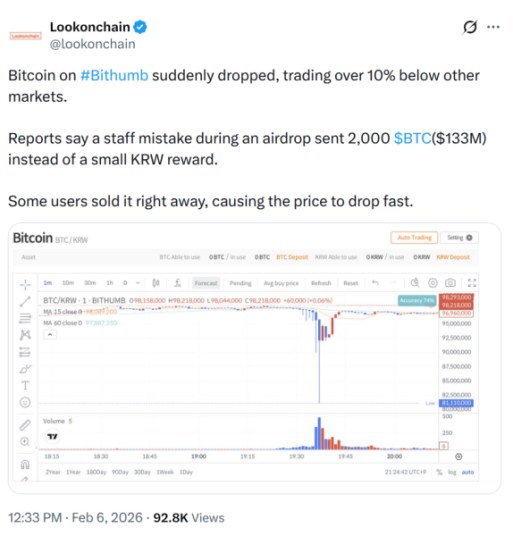
- A Bithumb flash crash exposed deep liquidity risks in centralized exchanges, driven by a rumored 2,000 $BTC airdrop error.
- Capital is rotating from volatile spot trading into infrastructure plays that solve Bitcoin’s speed and cost limitations.
- Bitcoin Hyper leverages the Solana Virtual Machine (SVM) to bring high-speed smart contracts and sub-second finality to the Bitcoin network.
Liquidity is the lifeblood of crypto. But this week on Bithumb? It looked more like a hemorrhage. The South Korean giant witnessed a sudden, violent dislocation in Bitcoin’s price following a messy rumor regarding a 2K $BTC airdrop distribution.
For a few heart-stopping minutes, order books evaporated. Wicks dived deep into sub-market territory before arbitrage bots and market makers could step in to stop the bleeding.
Call it a glitch if you want, but really, it was a stress test. Panic spiraled from a misunderstanding of an internal distribution mechanism, yet the reaction, immediate sell-side pressure followed by a violent V-shape recovery, exposes how fragile centralized order books get during high-velocity events.
While Western traders watched spreads widen, the ‘Kimchi Premium‘ briefly inverted. Institutional algorithms devoured that rare arbitrage window in seconds.
This incident exposes a narrative: Bitcoin, the asset, is pristine; the rails we trade it on are clunky. As legacy infrastructure creaks under volatility, capital is rotating toward protocols fixing these structural inefficiencies. Investors are looking past the drama of CEX wicks and toward the burgeoning Layer 2 ecosystem.
Leading the pack? Bitcoin Hyper ($HYPER), a protocol quietly amassing capital by promising to overhaul how value moves on the world’s oldest blockchain.
Solving The Latency Crisis: Bitcoin Hyper Integrates SVM
The Bithumb flash crash is a wake-up call regarding settlement layers. When networks congest or exchange engines falter, liquidity traps form. Bitcoin Hyper tackles this by fundamentally altering the Bitcoin transaction architecture.
By integrating the Solana Virtual Machine (SVM) as a Layer 2 execution environment, the project attempts to marry Bitcoin’s security guarantees with the throughput that makes Solana a favorite among high-frequency traders.
It moves Bitcoin from a passive ‘digital gold’ asset to an active, programmable platform. Right now, Bitcoin’s base layer manages roughly 7 transactions per second (TPS) with 10-minute block times, metrics that make modern DeFi applications impossible.
Bitcoin Hyper uses a decentralized canonical bridge and a modular design, L1 for settlement, SVM L2 for execution. The result? Sub-second finality and costs that are fractions of a cent, effectively enabling the kind of high-speed trading that prevents liquidity crunches like the one at Bithumb.
The implications for builders are huge. By supporting Rust-based smart contracts via the SVM, Bitcoin Hyper opens the door for complex DeFi swaps, lending protocols, and gaming applications previously stuck on other chains. The market is signaling a clear appetite for this utility; protocols that successfully activate dormant BTC capital are currently outperforming pure governance tokens.
CHECK OUT BITCOIN HYPER ON ITS OFFICIAL PRESALE SITE
Smart Money Rotation: Presale Metrics and Whale Positioning
While retail traders were glued to the Bithumb charts, sophisticated actors seem to be positioning themselves in the $HYPER presale. Internal data indicates robust inflows, with the project raising over $31M so far. Seeing that level of liquidity injection during a choppy market suggests institutional conviction in the ‘Bitcoin L2’ thesis is deepening.
On-chain behavior backs this up. Smart money is moving, with whale purchases as high as $500K scooping up early. With the token currently priced at $0.0136752, early entrants are betting on the gap between the current valuation and the massive addressable market of unwrapped Bitcoin liquidity.
The tokenomics structure prioritizes alignment over mercenary capital. Bitcoin Hyper features a high APY staking program active immediately post-TGE, paired with a 7-day vesting period for presale stakers. That’s designed to dampen post-launch volatility, ensuring liquidity is sticky rather than transient. In this case, sticky is good.
For investors watching the Bithumb chaos from the sidelines, the stability of a programmed L2 environment offers a sharp alternative to the ‘wild west’ of spot exchange trading.
The content provided in this article is for informational purposes only and does not constitute financial advice. Cryptocurrency markets are highly volatile; conduct your own due diligence before investing.
Related Articles
Solana (SOL) Under Pressure As Downtrend Looks Ready To Resume
Solana failed to settle above $90 and trimmed some gains. SOL price is now facin...

Ethereum Holders Shift To Self-Custody As Market Consolidates Near $2K
Ethereum is struggling to hold the $2,000 level as persistent selling pressure c...
XRP Price Faces Critical Test, Failure Could Trigger Another Slide
XRP price failed to surpass $1.550 and started another decline. The price is now...
Cardano May Be At A Prime Buying Point, Analyst Says
Reports say Cardano’s price has slid low enough that a fresh wave of buyers is t...