Bitcoin Gives US Leverage Against China, Defense Secretary Hegseth Says
Alex Smith
3 hours ago
Defense Secretary Pete Hegseth told Congress that Bitcoin can serve as a tool of US strategic leverage, linking the asset to classified Pentagon efforts and a broader competition with China. The comments mark one of the clearest public signals yet that parts of the US defense establishment now view BTC not only as a financial network, but as a national security domain.
The exchange came during an April 30 congressional hearing, when Rep. Lance Gooden pressed Hegseth on whether Bitcoin should be treated as an instrument of power projection. Gooden framed the issue through the lens of adversarial use, arguing that BTC has moved from a marginal asset to a strategic concern for Washington.
“Over the past decade, Bitcoin has evolved from a fringe asset into a matter of national security,” Gooden said. “Iran has demanded Bitcoin as a toll for transit through the Strait of Hormuz. North Korean cyber actors have leveraged it in ransomware campaigns, and China is believed to be stockpiling substantial holdings as part of a strategic reserve.”
Gooden then linked those concerns directly to the Indo-Pacific theater, citing recent testimony from Admiral Samuel Paparo, the commander of US Indo-Pacific Command. He said Paparo had stated that Bitcoin has “direct implications for power projection” and noted that USINDOPACOM was operating a Bitcoin node in furtherance of that mission.
Bitcoin Becomes Pentagon Focus
That framing put Hegseth in a position to answer a question that would have sounded unusual in a defense hearing only a few years ago: whether Bitcoin is a tool to project power, and whether the department is working to secure a US advantage against China’s “digital authoritarianism.”
Hegseth’s answer was brief but unusually direct. “I guess my short answer would be yes and yes,” he said. “Long an enthusiast of Bitcoin and crypto potential. And a lot of the things we’re doing, enabling it or defeating it, are classified efforts that are ongoing inside our department, which do provide us a lot of leverage in a lot of different scenarios. I appreciate that. And I share your views.”
The phrase “enabling it or defeating it” is the key policy signal. Hegseth did not describe BTC simply as an asset to be held, regulated, or monitored. He framed the Defense Department’s work around two operational tracks: using the technology where it creates strategic advantage, and countering it where adversaries use it against US interests.
The comments also build on Paparo’s earlier testimony. On April 21, Paparo told the Senate Armed Services Committee that Bitcoin can be relevant to American “power projection,” adding that “anything that supports all instruments of national power for the United States of America is to the good.” A day later, Gooden’s office said Paparo told the House Armed Services Committee that the US military was using a Bitcoin node to help “secure and protect networks.”
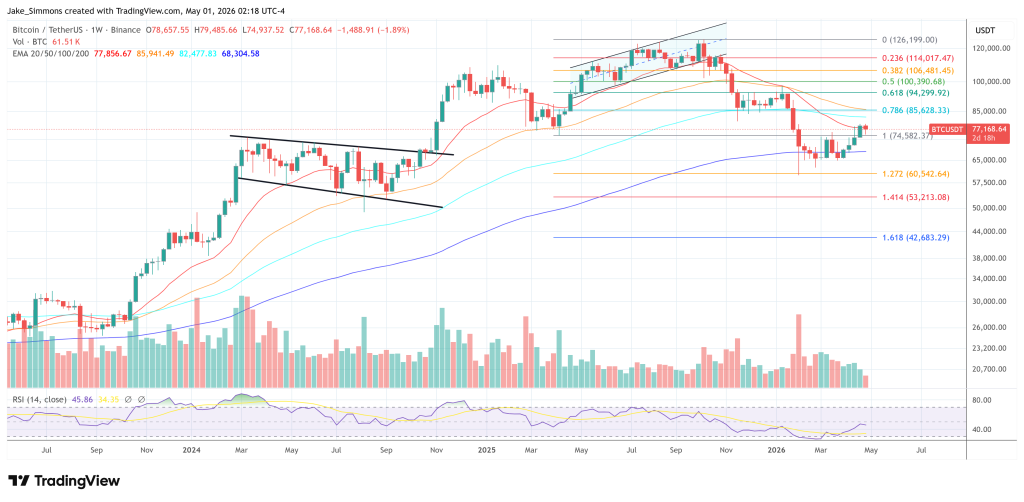
At press time, BTC traded at $77,168.
Related Articles
Garlinghouse Says Ripple Remains ‘Extremely Committed’ To XRP
Ripple CEO Brad Garlinghouse used an appearance at XRP Las Vegas on April 30 to...
Are Satoshi’s 600,000 BTC At Risk? Unveiling The Hard Fork That Targets Bitcoin
On-chain sleuth Tyler has drawn attention to a Bitcoin hard fork proposal amid t...
Global Crypto Pig-Butchering Crackdown: US, UAE, And China Bust 9 Scam Centers
The US, the United Arab Emirates (UAE), and Chinese authorities have cracked dow...

Bitcoin Is In An Institutional Support Zone: Here Are The Three Metrics Funds Need Before They Jump In
Bitcoin is holding above $75,000 as the bullish momentum that drove it toward $7...