Crypto Is A ‘Failed’ Asset Class, Says Renowned Economist
Alex Smith
2 hours ago
Economist and macro trader Alex Krüger has argued that “crypto” has largely failed as an asset class, even as blockchain-based adoption accelerates across stablecoins, tokenization, prediction markets, perps, AI and privacy-focused assets.
In a post on X, Krüger drew a sharp distinction between the speculative crypto market of recent cycles and the parts of the industry he believes are still showing meaningful traction. His central claim was blunt: most crypto tokens have failed to produce durable value for holders, while founders and insiders have repeatedly used the sector’s weak guardrails to extract liquidity from retail investors.
“I largely think of ‘crypto’ as a failed asset class at this point,” Krüger wrote. “I’ve written about the causes multiple times. Mainly, most crypto assets are worthless, or have dreadful value accrual, and most founders have abused the lack of guardrails and dumped on people indiscriminately, or are outright scammers.”
Krüger said the damage was compounded by what he called the “Memecoins SuperBullshitCycle,” describing it as a speculative trend that “brought the worst out of people” and drained both capital and morale from market participants. He also pointed to “the never-ending wave of DeFi hacks,” which he said has increased sharply since last April, as another factor weighing on crypto’s credibility as an investable asset class.
Krüger Sees Adoption Rising, But Not In “Old Crypto”
The economist acknowledged that his assessment may seem contradictory, given that several blockchain-linked sectors are still expanding rapidly. He cited growing stablecoin adoption, openly pro-crypto politicians in the United States, TradFi’s push to tokenize assets, rising usage of equities and commodities perps on offshore and DeFi venues, the early development of US perps markets, and the increasing presence of prediction markets in everyday information flows.
But Krüger framed many of those trends as “more ‘blockchain’ than ‘crypto’,” suggesting that the infrastructure and application layer may be advancing while the legacy token market remains structurally weak. In his view, the key exception is where tokens have clearer links to revenue, user demand or capital return mechanisms.
“A few among those exceptions even distribute most revenue to holders via buybacks,” he wrote, naming Hyperliquid in particular. “Which is what every investor actually wants to see to be invested in a good business rather than a fleeting narrative.”
That distinction sits at the core of Krüger’s argument. He is not saying that blockchain-based markets are dead. Rather, he is saying that broad, narrative-driven crypto exposure has failed to deliver the kind of value accrual investors were promised, while a narrower group of sectors has begun to resemble operating businesses or infrastructure plays.
Privacy And AI Stand Out
Krüger identified privacy as one of the few “old school” crypto categories that remains relevant. He argued that demand for private, non-custodial stores of value is real, even if part of that demand comes from illicit flows. He referenced the US Department of Justice’s confiscation of $15 billion in Bitcoin from Cambodia-linked pig butchering operations, saying the legal filing was submitted on October 8, 2025.
“Of course, everyone needs privacy, not just criminals, but crime flows are real, and large,” Krüger wrote. “The asset attracting the most flows in this niche is Zcash. Zcash’s recent performance has been fascinating, as it has been trending higher with bitcoin trending lower, a sign of real reallocation among bitcoiners.”
The other category Krüger said is not dead is AI. Still, his view of the sector was selective. He described most AI tokens as “high flying, fundamentally lacking, narrative driven tokens,” while naming Venice as a standout because he sees it as tied to a private AI platform with growing users and revenue.
That leaves Krüger with a more nuanced conclusion than the headline claim alone suggests. He sees the old token market as broken, but not the broader direction of crypto-enabled infrastructure. Stablecoins, tokenized assets, prediction markets, perps, AI and privacy may form the sector’s next investable narrative, provided the tokens attached to them can show actual value capture rather than recycled speculation.
“So one could say old ‘crypto’ is a failed asset class,” Krüger wrote, “but from the ashes come new beginnings, and the new face of crypto is one heavily dominated by the needs of Tradfi, prediction markets, AI, and privacy.” His closing line captured the contradiction he sees in the market: “Crypto sucks. Long live crypto.”
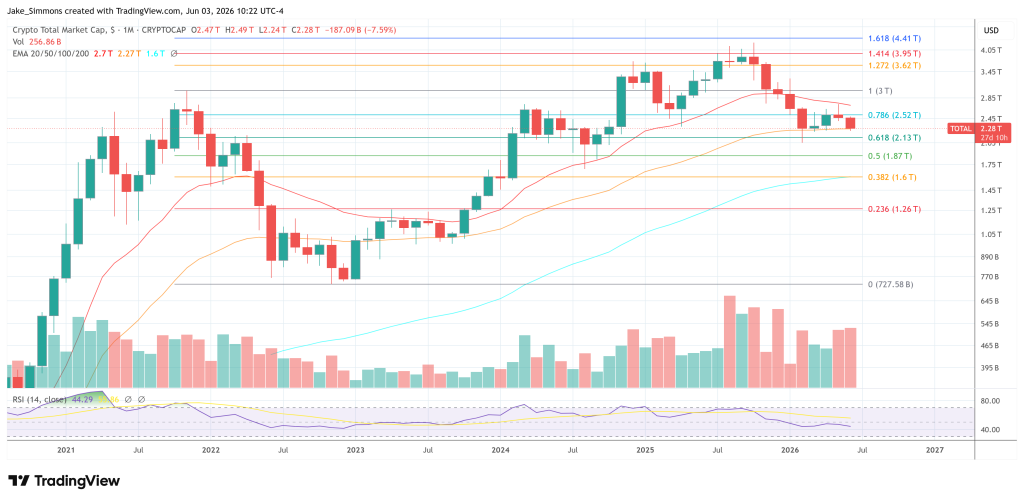
At press time, the total crypto market cap was at $2.28 trillion.
Related Articles

Bitcoin Falls Below $66K As Short-Term Holder Stress Reaches February Levels
Bitcoin has lost the $66,000 level as selling pressure and uncertainty intensify...

XRP Already Powers Real Banking Activity, Says Evernorth, With More Growth Expected
Evernorth says daily activity on the XRP Ledger has climbed to nearly 3 million...
Bleeding Bitcoin Holders Signal Stress — $60K Becomes Critical Battleground
Bitcoin’s futures market is flashing a warning that analysts say could mea...
XRP Price Takes Another Hit As Bitcoin-Led Weakness Spreads Across Crypto
XRP price extended losses and traded below $1.20. The price is now consolidating...