Data Centre Stocks: 45 Companies Riding The AI Megatrend In Cooling, Power & Infra
Alex Smith
2 hours ago
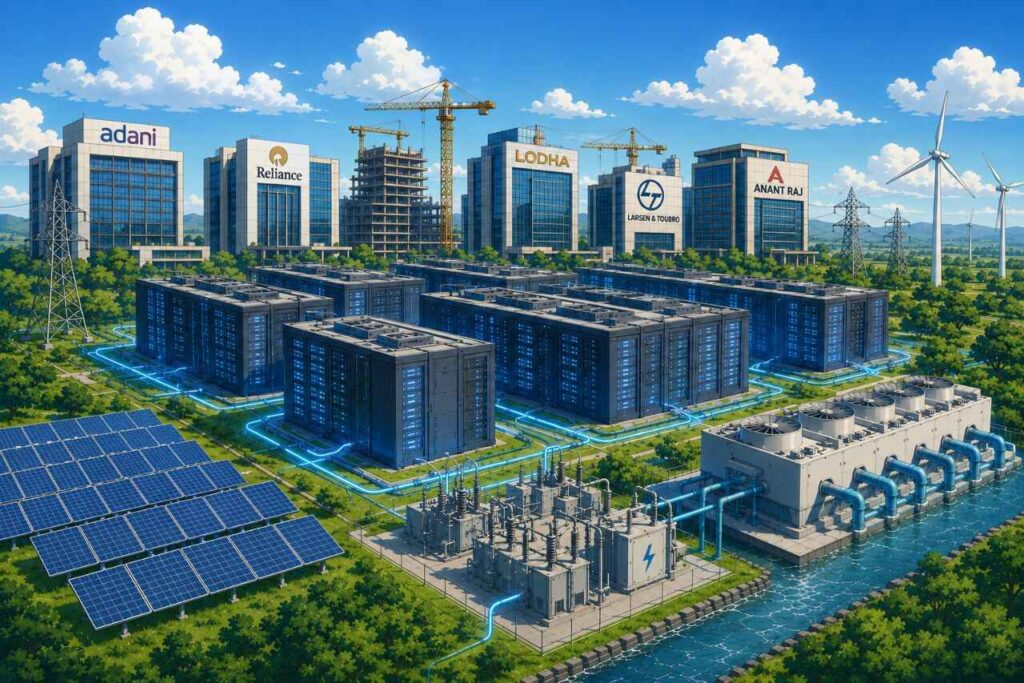
Synopsis: India’s data centre boom is fueling massive opportunities across AI, cloud, power, cooling and digital infrastructure. This article explores the full listed ecosystem driving hyperscale growth, sovereign compute and next-generation infrastructure as rising data centre demand reshapes India’s future investment landscape.
India’s data centre boom is creating a powerful new ecosystem of listed companies across AI, cloud, cooling, power and digital infrastructure. As demand for hyperscale facilities, artificial intelligence and sovereign compute rises, multiple sectors are emerging as key beneficiaries of this megatrend.
From data centre developers and power suppliers to cooling companies, cable manufacturers and GPU infrastructure players, this article covers the major listed stocks building and powering India’s rapidly expanding data centre ecosystem.
Artificial Intelligence
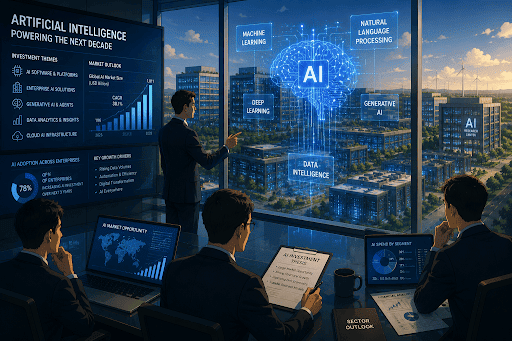
At the enterprise level, Fractal Analytics represents one of the purest AI plays, helping large global businesses embed artificial intelligence into critical functions such as pricing, supply chains, customer experience, and strategic decision-making, while maintaining strong investments in AI research and intellectual property.
This enterprise AI transformation is further supported by Persistent Systems, which has built a strong presence in generative AI, software product engineering, and enterprise modernisation. Through proprietary AI platforms and partnerships with major hyperscalers like Google Cloud, AWS, Microsoft, IBM, and Salesforce, Persistent enables businesses to deploy AI agents, automation, and advanced analytics across digital workflows.
Strengthening the industrial and engineering side of the ecosystem, L&T Technology Services is increasingly focused on Agentic AI, engineering intelligence, and digital engineering solutions across sectors such as sustainability, mobility, and medical technology. Its AI-led innovation, supported by NVIDIA partnerships and advanced full-stack engineering platforms, connects AI directly with physical industries and next-generation infrastructure.
On the consumer intelligence side, Affle 3i plays a major role through AI-powered digital advertising, leveraging connected devices, smartphones, wearables, and targeted advertising models to monetise consumer engagement. This positions the company as a key participant in applied AI across digital commerce and marketing ecosystems.
Expanding this broader AI stack, Coforge is strengthening its position through the acquisition of Encora, significantly enhancing its capabilities in AI engineering, cloud computing, product development, and digital design. This move broadens its role from traditional enterprise IT services into front-end AI innovation and global digital transformation.
Cooling
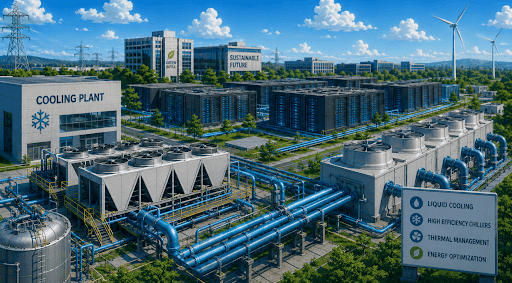
Cooling has become a critical pillar of the data centre ecosystem as rising AI workloads significantly increase heat generation, power density, and the need for advanced thermal management.
At the project execution level, Blue Star is strengthening its position through EPC capabilities, electro-mechanical projects, and an expanding liquid cooling portfolio. The company has seen strong data centre demand during 9MFY26, while several in-house liquid cooling models are in advanced stages and are expected to be commercially ready within 12 months. Beyond products, Blue Star is focused on leading MEP and EPC execution for data centres while also building capabilities in semiconductor air conditioning.
Strengthening the HVAC and chiller segment, Voltas is expanding through specialised screw, centrifugal, and oil-free chillers designed for data centre cooling. Its recent technology partnerships have improved energy efficiency, a critical factor since cooling power consumption remains one of the largest operating costs for data centres. This also strengthens Voltas’ role in district cooling infrastructure.
On the supply chain side, KRN Heat Exchanger manufactures chillers, dry air coolers, heat exchangers, and precision air-conditioning components for major HVAC suppliers serving data centres. The company supplies key players such as Schneider Electric and Climaventa, while also expanding into US and European markets. A major new client win, combined with capacity expanded to nearly 6 times earlier levels, supports KRN’s target of capturing at least 50 percent share of India’s data centre heat exchanger market.
ABB India plays an important role in the cooling infrastructure of data centres by supplying high-efficiency motors, drives, and automation systems that help run large cooling utilities such as HVAC systems, chillers, pumps, and ventilation networks.
In liquid cooling, Aeroflex Industries is targeting high-density AI data centres through integrated liquid-cooling skid assemblies and Secondary Fluid Network solutions. Its five-year exclusive Indian contract with a US multinational strengthens long-term visibility, while management aims to increase assemblies to 60 percent to 70 percent of revenue over the next three to four years.
Castrol is entering data centres by supplying specialized liquid cooling fluids for immersion and direct-to-chip cooling systems used in high-performance servers. The company is currently running trials in India, with commercialization expected after testing cycles as AI-led facilities increasingly adopt advanced liquid cooling technologies.
Gulf Oil Lubricants India has also created two products now undergoing testing and validation. It aims to supply next-generation cooling solutions as data centres gradually shift from air cooling to liquid cooling systems.
Thermax is building its presence through specialised cooling and energy infrastructure solutions, including a major US data centre order for hot water driven chillers with a combined 45,000 TR capacity. Alongside cooling, it is also targeting boiler and steam turbine-based captive power infrastructure, positioning itself as a broader thermal and energy solutions provider for global data centres. Together, these companies represent multiple layers of India’s rapidly growing cooling ecosystem.
Power Infrastructure
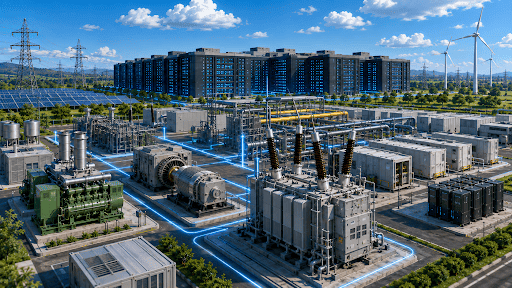
At the captive generation level, TD Power Systems plays an important indirect role by manufacturing industrial generators, gas turbine generators, gas engine generators, and rotating electrical equipment that support reliable power infrastructure. Through partnerships with global prime mover manufacturers such as INNIO and Siemens, TD benefits from rising demand for captive power systems, particularly in the US and Europe, where data centres are increasingly prioritising energy reliability and cost efficiency.
Supporting this ecosystem at the component level, Pitti Engineering supplies custom stators, rotors, laminations, and thermal components used in high-efficiency motors and generator systems, with Cummins Generator Technologies as a major customer. As global data centre expansion drives rising demand for continuous power and cooling, this segment is emerging as a fast-growing vertical for the company.
At the transmission equipment level, Yash Highvoltage provides transformer bushings, a niche but highly critical component that enables safe high-voltage electricity flow into transformers. By targeting approvals directly from data centres and expanding through its US sales platform, Yash is positioning itself within the broader global power infrastructure supply chain.
Welspun Corp participates further upstream through pipe manufacturing, benefiting from the growing need for natural gas pipelines that support dedicated power plants required for energy-intensive AI data centres, particularly in the United States.
On the electrical backbone side, ABB India, Siemens India, Siemens Energy, Schneider Electric, Hitachi Energy India, Cummins India, and Kirloskar Oil Engines represent the broader integrated infrastructure stack. These companies collectively provide switchgear, substations, transformers, UPS systems, power distribution, grid software, backup generators, battery storage, and intelligent energy management systems that help data centres maintain uptime, optimise power consumption, and scale efficiently. Siemens Energy focuses on large-scale generation and transmission hardware, while Siemens adds smart automation and software layers, creating a full-spectrum power ecosystem.
At the EPC and infrastructure deployment level, Bajel Projects extends this value chain through total electrification solutions, including GIS and AIS substations, transmission systems, electrical distribution, Diesel generators installations, and full data centre power infrastructure execution.
Power Suppliers
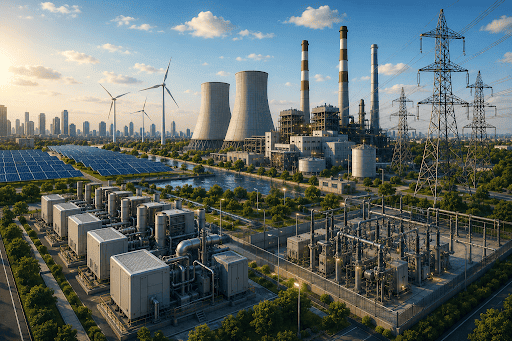
Torrent Power plays a major role through its large-scale power distribution network, supplying nearly 31 billion units annually across Ahmedabad, Gandhinagar, Surat, Dahej SEZ and Dholera SIR in Gujarat, Union Territory of Dadra and Nagar Haveli and Daman and Diu (DNH & DD), Bhiwandi, Shil, Mumbra and Kalwa in Maharashtra and Agra in Uttar Pradesh, while maintaining some of India’s lowest distribution losses and strongest reliability metrics, making it an important urban power enabler.
At the large-scale generation level, Adani Power serves as India’s largest private thermal power producer, with over 18 GW of installed capacity across Gujarat, Maharashtra, Karnataka, Rajasthan, Chhattisgarh, Madhya Pradesh, Jharkhand, and Tamil Nadu, apart from a 40 MW solar power plant in Gujarat, positioning it as a significant source of baseload power for energy-intensive infrastructure.
Supporting broader energy delivery, Adani Energy Solutions expands this through transmission, distribution, smart metering, and cooling infrastructure, serving over 13 million consumers while strengthening power access in key industrial and metropolitan regions like Mumbai, which is a colocation hub.
JSW Energy adds diversified generation exposure through thermal, hydropower, renewable energy, and transmission assets, giving it broad participation across India’s expanding electricity demand landscape. Similarly, Tata Power combines large-scale generation with extensive transmission and distribution infrastructure, serving nearly 13 million customers and reinforcing its position as one of India’s largest integrated private power providers.
On the renewable side, NTPC Green Energy is increasingly aligning with future data centre requirements through round-the-clock green power solutions, highlighted by its partnership with Nxtra Data for renewable energy supply to data centres.
Cables & Optical Fibres
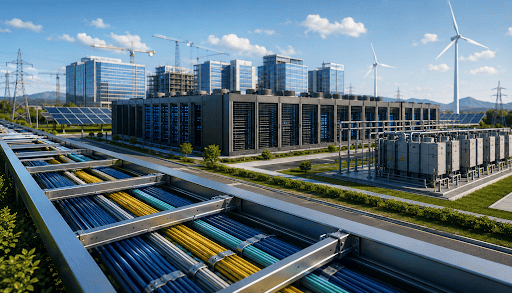
On the electrical side, R R Kabel is actively targeting data centres as a major long-term B2B growth driver, with management viewing the segment as a large opportunity over the next three to four years. Since data centres require extremely high reliability and multiple layers of power backup, this creates significant demand for extensive wire and cable deployment. The company is currently working to secure product approvals while preparing to serve this market through both direct and distribution-led channels.
Polycab, India’s largest organised wires and cables player, is similarly positioning data centres as a key structural growth vertical. With its dominant market position and existing specialised solutions for large projects, the company sees rising infrastructure and data centre capex as a major catalyst for future cable demand, particularly within its core wires and cables business. It is already providing specialised solutions for large data centre projects such as Vodafone Idea’s data centres.
KEI Industries is also expanding its focus toward data centre infrastructure, particularly through medium-voltage, high-tension, and flexible copper cable offerings. As exports to the US recover, management expects data centre projects to become an important growth lever, although competition in overseas markets remains intense.
Beyond electrical connectivity, Sterlite Technologies and HFCL play a crucial role in the digital and fibre infrastructure layer of modern data centres. Sterlite operates across the full optical connectivity value chain, supplying fibre, fibre cables, specialty cables, and enterprise connectivity solutions that support telecom networks, broadband, and increasingly fibre-intensive AI-led data centres. Management sees data centre expansion, alongside 5G and broadband, as one of its most important near-term demand drivers, particularly as GPU-heavy AI facilities require significantly more fibre density than traditional infrastructure.
HFCL is similarly evolving into a higher-value connectivity and optical infrastructure player, with growing exposure to optical fibre cables, passive connectivity systems, and next-generation digital infrastructure. The company is benefiting from rising global demand for high-fibre-count, high-performance cables, particularly from hyperscalers and AI-driven data centre projects, where manufacturing complexity and reliability create stronger competitive advantages.
According to management, only a limited number of global manufacturers can produce such complex cables at scale, which gives HFCL a stronger position in a market where product quality, manufacturing precision and reliability are becoming more important.
The Big Players
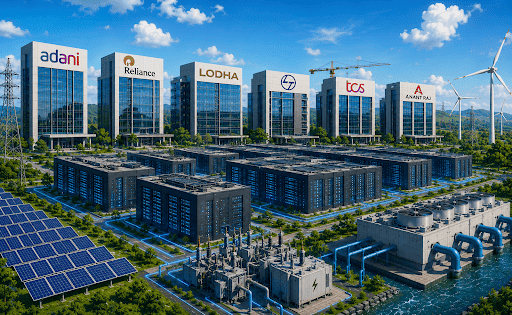
At the hyperscaler and large-scale digital infrastructure level, India’s data centre ecosystem is rapidly evolving into a multi-gigawatt opportunity, with major conglomerates, real estate developers, and technology companies building the foundational platforms that could define the country’s AI and cloud future.
Adani Enterprises has established itself through AdaniConneX, its joint venture with EdgeConneX, combining Adani’s strengths in land, power, renewable energy, and infrastructure with global data centre operating expertise. Its nationwide expansion strategy spans major hubs such as Noida, Mumbai, Pune, Hyderabad, Chennai, and Visakhapatnam, where its AI-focused campus with Google could attract nearly USD 15 billion in investment and operate at gigawatt scale. Supported by renewable power, subsea cable connectivity, and broader energy infrastructure, Adani is positioning itself not just as a colocation provider but as a full-stack AI and cloud infrastructure platform.
Reliance Industries is pursuing a similarly ambitious strategy through Digital Connexion and its broader AI infrastructure initiatives. Its planned Visakhapatnam and Jamnagar projects could collectively scale toward nearly 4 gigawatts, supported by advanced GPUs, TPUs, NVIDIA Blackwell processors, and dedicated renewable energy generation. Reliance’s integrated model combines clean power, semiconductor-grade AI compute, and hyperscale infrastructure, reinforcing its ambitions to become one of India’s largest AI and cloud infrastructure operators.
Lodha Developers represents a different but equally important hyperscaler enabler through its massive Palava data centre park. With roughly Rs. 1.3 lakh crore in planned investments, 2.5 gigawatts of capacity potential, strong power access, green energy, recycled water infrastructure, and pre-approved development capabilities, Lodha is positioning itself as a master developer that can attract hyperscalers, global operators, and AI infrastructure companies at scale. Amazon has already secured land and power for 15 years, while Singapore’s STT Global Data Centres has also acquired land within the park, with Lodha acting as the master developer.
Larsen & Toubro is increasingly aligning its engineering and infrastructure expertise toward sovereign AI and gigawatt-scale AI factories. Through partnerships with NVIDIA and the IndiaAI Mission, L&T is building AI-ready campuses, advanced GPU infrastructure, and scalable facilities designed to serve both domestic and global AI demand while anchoring critical workloads within India.
TCS is entering the sector through HyperVault, targeting up to 1 gigawatt of AI-ready infrastructure over the next five to seven years. Supported by TPG, AMD, and OpenAI-linked partnerships, TCS is building hyperscale-ready facilities with liquid cooling, high-density systems, and enterprise-grade digital infrastructure aimed at AI firms, enterprises, and government clients.
Anant Raj is emerging as one of the more unique domestic players by combining real estate, sovereign cloud, colocation, and AI infrastructure into an integrated digital platform. Its long-term roadmap to 357 MW, strategic cloud partnerships, government empanelments, and expansion into high-density liquid-cooled infrastructure positions it as a growing sovereign cloud and enterprise data centre operator.
Bharti Airtel’s Nxtra is rapidly expanding one of India’s largest integrated data centre platforms, operating 15 hyperscale facilities, 120+ edge sites, and over 230 MW of power capacity, while targeting 1 GW in the next few years targeting 25 percent market share. It provides colocation, built-to-suit, interconnect, cloud, and AI-ready digital infrastructure across major Indian markets.
GPUs, Supercomputers & More
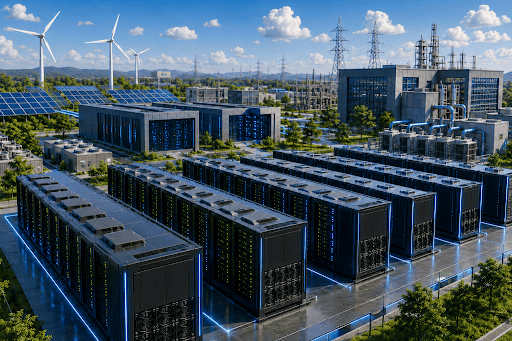
Netweb Technologies stands out as one of India’s most comprehensive sovereign compute players, operating across high performance computing, private cloud, AI systems, data centre servers, storage, and managed services. Its customised supercomputers power highly complex workloads ranging from scientific research and engineering simulations to sovereign AI and generative AI applications. Through its GPU-powered systems, OEM partnerships with NVIDIA and AMD, and private cloud platforms, Netweb offers full-stack domestic compute infrastructure, positioning itself as a critical enabler of India’s AI, enterprise, and cloud ambitions.
Complementing this infrastructure from the cloud layer, E2E Networks provides homegrown public cloud and AI cloud services built around advanced NVIDIA GPUs such as Hopper and L40S chips. Through its TIR AI/ML platform, the company supports developers, researchers, and AI innovators working on large-scale machine learning and data-heavy workloads. Its strategic partnership with Larsen & Toubro also strengthens access to large-scale data centre capacity, supporting long-term infrastructure expansion. The company is also in the business of leasing GPUs.
On the precision engineering and power systems side, MTAR Technologies plays a specialised but important role through its manufacturing partnership of hotbox (the core of a fuel cell system where electricity is generated) with Bloom Energy, a global leader in solid oxide fuel cells and electrolyzer systems increasingly used in high-performance computing and data centre power applications. As Bloom expands through multi-billion-dollar agreements and rising global capacity, MTAR benefits through strong order visibility, growing wallet share, and increasing demand for mission-critical fuel cell infrastructure.
Disclaimer: The views and investment tips expressed by investment experts/broking houses/rating agencies on tradebrains.in are their own, and not that of the website or its management. Investing in equities poses a risk of financial losses. Investors must therefore exercise due caution while investing or trading in stocks. Trade Brains Technologies Private Limited or the author are not liable for any losses caused as a result of the decision based on this article. Please consult your investment advisor before investing.
The post Data Centre Stocks: 45 Companies Riding The AI Megatrend In Cooling, Power & Infra appeared first on Trade Brains.
Related Articles

4 Renewable Energy Stocks With Profit Growth of Up to 10,180% in Q4 to Keep on Your Radar
Synopsis: Renewable energy stocks, including NLC India, Clean Max Enviro Energy...

Cupid Share: Company Announces Strong Future Revenue and Net Profit CAGR Guidance
Synopsis: Cupid Limited has provided strong FY29 guidance, targeting revenue CAG...
Seshaasai Technologies Shares Jump 3% After Net Profit Increases 32% YoY; Announces ₹2.50 Dividend
Synopsis: Seshaasai Technologies Ltd reported a strong performance in Q4 FY26 wi...

Subros in focus After Reporting 16% YoY Revenue Growth in Q4; Company Announces ₹3 Dividend
Synopsis: Subros Ltd reported a steady Q4 FY26 performance driven by strong dema...