KRN Heat Vs Aeroflex: Which Stock Can Become A Better Data Centre Cooling Opportunity?
Alex Smith
2 hours ago
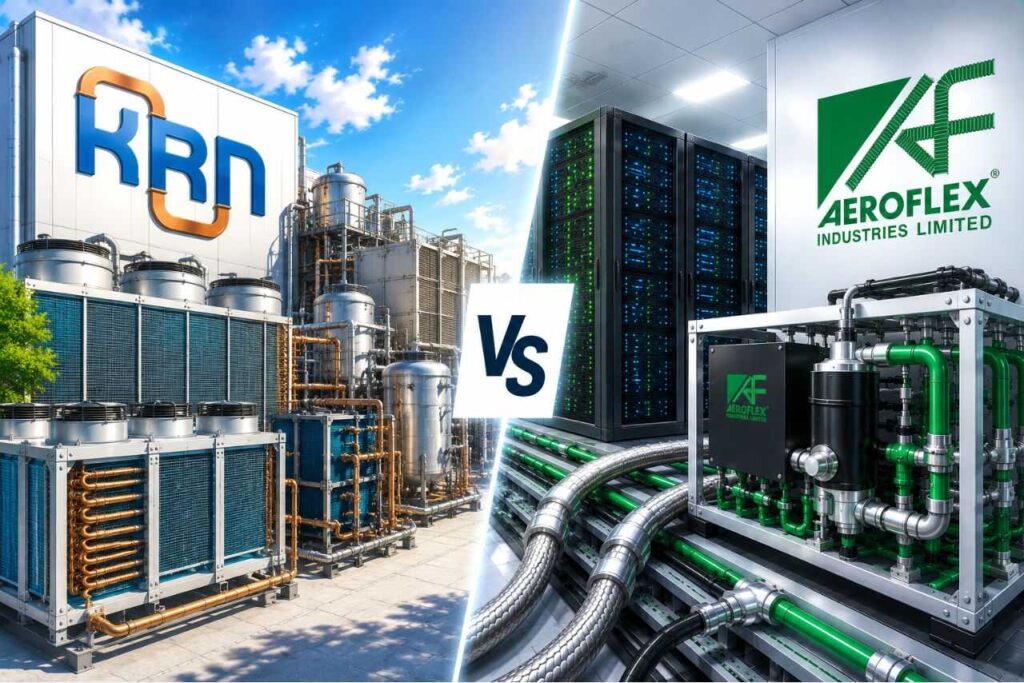
Synopsis: KRN Heat Exchanger and Aeroflex Industries are targeting the data centre cooling opportunity through two very different approaches. One is focused on heat exchangers and cooling systems, while the other is betting on liquid cooling solutions. As AI-driven data centre investments accelerate, which stock could emerge as the better opportunity?
India’s data centre cooling theme is moving from a simple air-conditioning opportunity to a more specialized thermal management opportunity. As AI workloads increase, data centres need stronger cooling systems, better heat transfer products and more reliable components that can support high-density computing.
This is where companies like KRN Heat Exchanger and Aeroflex Industries are trying to build their own positions, but both are approaching the opportunity from very different parts of the cooling value chain.
KRN Heat Exchanger is more directly linked to the outer cooling infrastructure of data centres through heat exchangers, coils, dry coolers, chillers and related HVAC products. Aeroflex Industries, on the other hand, is trying to capture the liquid cooling opportunity through flexible flow solutions, advanced flow control components and skid assemblies used in high-performance cooling applications.
This makes the comparison interesting because KRN is exposed to a broader HVAC and thermal equipment opportunity, while Aeroflex is building a sharper liquid cooling-led opportunity.
KRN Heat Exchanger and Refrigeration
KRN Heat Exchanger and Refrigeration has built its business around heat exchangers, cooling coils and integrated HVAC and refrigeration solutions. The company manufactures products such as fin and tube coils, bar and plate heat exchangers, microchannel heat exchangers, dry coolers, bus AC systems, refrigeration components, technical tubes, sheet metal parts and tubing solutions. Its end-use industries include HVAC, refrigeration, data centres, automotive, railways, industrial cooling and process applications.
For the data centre theme, KRN’s starting point is not inside-the-server liquid cooling, but the broader cooling infrastructure around the facility. Management has explained that data centres have two parts from a cooling perspective. The indoor side of AI data centres may increasingly move towards liquid cooling, but the outdoor side will still require chillers, dry coolers and heat exchangers. This is where KRN’s existing fin and tube products remain relevant.
The company is also not standing still. Management has said that it is working on microchannel heat exchangers and expects to add the product by the end of this year or early next year. It is also studying plate heat exchangers for CDU-related applications, which could become relevant if indoor cooling systems evolve further. This means KRN is currently stronger in conventional and outer data centre cooling, while it is preparing for more advanced cooling products.
Financial Performance And Scale
KRN delivered a strong FY26 performance, helped by demand across data centres, industrial cooling, transport applications and refrigeration. On a consolidated basis, FY26 total income stood at Rs. 609.81 crore, up 38.06 percent year-on-year. EBITDA grew by 59.52 percent to Rs. 112.48 crore, while net profit increased by 44.62 percent to Rs. 76.47 crore.
For Q4FY26, consolidated total income stood at Rs. 181.40 crore, up 33.5 percent year-on-year. EBITDA increased by 77.56 percent to Rs. 33.55 crore, while net profit rose by 57.14 percent to Rs. 23.36 crore. The numbers show that the business is scaling while operating performance is improving.
The bigger point is capacity. KRN’s existing plant is already near full utilization, while the new KRN HVAC Products facility has been positioned as a much larger growth engine. The data says Plant II has a peak revenue capacity of Rs. 1,800 crore to Rs. 2,400 crore, compared with Rs. 450 crore for the existing plant. Combined peak revenue capacity is indicated at around Rs. 2,250 crore to Rs. 2,850 crore, which is much higher than its FY25 consolidated revenue base.
Data Centre Opportunity
KRN’s data centre opportunity is already visible in its revenue mix. In the Q3FY26 call, management said that data centres had contributed around 15 percent of the company’s top line till Q3. In the Q4FY26 call, management said that the data centre share in Q4 was around 18.7 percent. This indicates that the segment is not just a future story, but has already started contributing meaningfully.
The company also has good order visibility in this segment. Management said it has good order booking from data centres, including customers with long lead time orders of six to seven months. Earlier, the company had also said that it was receiving big orders and inquiries from data centre customers, and that the segment could become a larger number for the company over the next 3-4 years.
KRN’s advantage is that it is already a heat exchanger manufacturer and has the infrastructure to handle large data centre heat exchanger sizes. Management said that earlier, the old facility did not have the required infrastructure, space or financial support to achieve large numbers from data centres. With the new facility, the company believes it is better placed to participate in this market.
What Investors Should Watch
The first thing to watch is how quickly the new facility ramps up. Management expects around 50 percent utilization from the new facility in FY27, compared with only around 15 percent utilization in FY26. If this ramp-up happens smoothly, it can support strong revenue growth.
The second thing to watch is whether KRN can move beyond conventional data centre cooling products. Currently, the company is receiving orders mainly for fin and tube products used in HVAC data centre components in India. Microchannel and plate heat exchanger products are still under development or study. This means KRN has an existing data centre business, but its liquid cooling relevance is still evolving.
The third thing to watch is raw material movement. KRN uses copper, aluminium, steel and other components. Management has said it can pass on almost 100 percent of copper LME, aluminium LME and USD-INR movement to customers on a quarter-on-quarter basis. This pricing model reduces risk, but investors still need to watch execution and working capital as the business scales.
Aeroflex Industries
Aeroflex Industries is positioned differently from KRN. The company manufactures metallic flexible flow solutions used for controlled flow of solids, liquids and gases. Its products include flexible hoses, composite and interlock hoses, assemblies and fittings, metal bellows, miniature metal bellows, hydraulic fittings, fluid connectors, flanges and liquid cooling skid assemblies.
For data centres, Aeroflex has a more direct liquid cooling angle. Its skid assemblies and advanced flow control components are used in high-performance liquid cooling applications for data centres and AI infrastructure. Management has said that traditional air cooling has limitations as AI, cloud and high-performance computing workloads increase. As chip power rises, faster and more efficient cooling becomes important, which is where liquid cooling becomes relevant.
Aeroflex entered this opportunity in FY26 through skid assemblies and advanced flow control solutions. This gives it a sharper connection to next-generation data centre cooling compared with KRN, which is still more focused on heat exchangers and outer cooling systems.
Financial Performance And Core Business
Aeroflex also reported its highest-ever quarterly and yearly performance in FY26. For Q4FY26, total income stood at Rs. 126.46 crore, up 38 percent year-on-year. EBITDA stood at Rs. 30.03 crore, up 59 percent, while EBITDA margin improved by 326 basis points to 23.86 percent. Profit after tax stood at Rs. 17.64 crore, up 57 percent, and cash profit stood at Rs. 25.42 crore, up 67 percent.
For FY26, total income stood at Rs. 443.29 crore, up 17 percent year-on-year. EBITDA stood at Rs. 99.74 crore, up 26 percent, with an EBITDA margin of 22.57 percent. Profit after tax stood at Rs. 55.53 crore, up 6 percent, while cash profit increased 28 percent to Rs. 81.60 crore.
The core hoses and assemblies business continues to provide stability, while value-added products are becoming more important. Management said value-added products, including assemblies, fittings and bellows, contributed 52 percent of total sales in FY26. This matters because the data centre cooling business is also a value-added, engineering-led opportunity.
Liquid Cooling Traction
Aeroflex’s biggest advantage in this comparison is that its data centre cooling business has already moved from development to commercial supply. The company sold 617 skid assemblies in FY26, generating around Rs. 21.2 crore of sales in just four months. Out of this, Q4FY26 alone saw the sale of 571 skid assemblies worth Rs. 18.9 crore, with an average price of Rs. 3.31 lakh per skid.
The company has increased skid assembly capacity from 2,000 units per annum to 6,000 units per annum and plans to scale it further to 15,000 skids per annum by Q2FY27. Management also said peak utilization can be around 75 percent to 80 percent, though it would take time to reach that level after commissioning.
Aeroflex also has an exclusive agreement for the India market with a US-headquartered company’s India subsidiary. Management clarified that there is no royalty payment and the relationship works as a buyer-seller model. The customer provides a yearly pipeline, which is then broken into quarterly purchase orders. This gives Aeroflex visibility, though the company has not disclosed the order book because it is working with one specific customer under disclosure restrictions.
What Investors Should Watch
The first thing to watch is customer concentration. Aeroflex’s liquid cooling skid assembly business is currently linked to one specific partner. This gives visibility and access to data centre customers, but also creates dependence on one relationship. The company’s ability to add more customers over time will be important.
The second thing to watch is whether the 15,000-skid capacity gets utilized well. The revenue opportunity can become meaningful if volumes scale, but the business is still new. FY26 skid sales were Rs. 21.2 crore, which was only around 5 percent of FY26 sales. So, the segment is promising, but it still has to become large enough to change the company’s overall revenue mix.
The third thing to watch is margins. Management has said skid assembly margins are in line with the company’s average margins in hoses, but it has not disclosed specific margins because of customer sensitivity. Aeroflex is targeting a full-year EBITDA margin of around 23 percent in FY27 and aims to reach around 25 percent annually over the next couple of years. If skid assemblies scale without diluting margins, the data centre opportunity can become more attractive.
KRN Vs Aeroflex: Which Looks Better Placed?
KRN looks better placed for investors who want broader exposure to data centre cooling infrastructure. It already has a meaningful data centre revenue contribution, a much larger capacity runway, a wide product portfolio and exposure to HVAC, industrial cooling, refrigeration and mobility. Its opportunity is not limited to one product or one customer. The new facility also gives it a large growth base if utilization improves as planned.
Aeroflex looks better placed for investors who want a more direct liquid cooling opportunity. Its skid assemblies are already being supplied for data centre liquid cooling applications, and the capacity expansion from 2,000 to 15,000 skids per annum shows management’s confidence in demand. The company also has a strong margin profile and a cash-generative core business that can support this new segment.
However, the difference lies in maturity and risk. KRN’s data centre opportunity is already contributing a larger share to revenue, but its liquid cooling products are still under development. Aeroflex has a stronger liquid cooling product link, but the skid assembly business is still small in the overall revenue mix and depends heavily on one customer relationship.
Disclaimer: The views and investment tips expressed by investment experts/broking houses/rating agencies on tradebrains.in are their own, and not that of the website or its management. Investing in equities poses a risk of financial losses. Investors must therefore exercise due caution while investing or trading in stocks. Trade Brains Technologies Private Limited or the author are not liable for any losses caused as a result of the decision based on this article. Please consult your investment advisor before investing.
The post KRN Heat Vs Aeroflex: Which Stock Can Become A Better Data Centre Cooling Opportunity? appeared first on Trade Brains.
Related Articles

PSU Stock Falls After the President of India Sells 2% Stake in the Company
Synopsis: The President of India has completed a stake sale in Coal India throug...
Navratna Stock Crashes 5% as Govt Launches ₹4,300 Cr OFS at 8% Discount
Synopsis: NHPC shares fell 5% after the Government of India launched an Offer fo...

Bank Stock Jumps After RBI Clears Mirae Asset Mutual Fund to Acquire Up to 9.5% Stake
Synopsis: RBI has approved Mirae Asset Mutual Fund to acquire up to a 9.5% stake...

Ashish Kacholia Stock Rallies 5% After Announcing a New 50,000 Sq Ft Facility in Karad
Synopsis: Micro-Cap shares rose 5% after announcing a new 50,000 sq ft Karad fac...