Lodha Share: How Much Revenue Could the Company Generate from Data Centres?
Alex Smith
2 hours ago
Synopsis: India’s rapidly expanding data centre ecosystem is opening new opportunities for large real estate developers. Lodha is building a massive integrated campus designed to attract global hyperscale operators and AI infrastructure. With land monetisation and long-term leasing models, the project could unlock significant revenue potential over the coming years.
India’s data centre industry is entering a phase of rapid expansion as demand for cloud computing and artificial intelligence infrastructure accelerates globally. Morgan Stanley estimates India’s installed capacity could rise from about 1.8 gigawatts in FY26 to nearly 10.5 gigawatts by FY31, attracting close to USD 60 billion in investments. As this massive infrastructure build-out begins, how much revenue could Lodha potentially generate from its large-scale data centre ambitions?
What Is Lodha Group Planning?
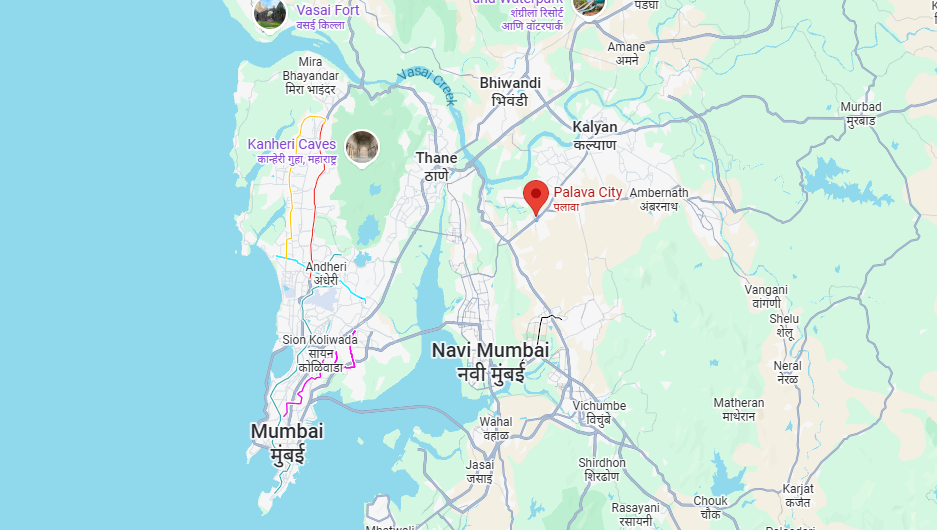
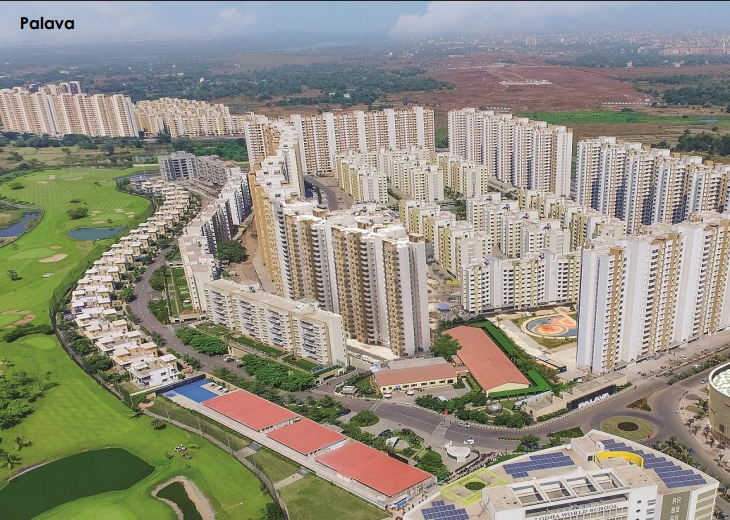
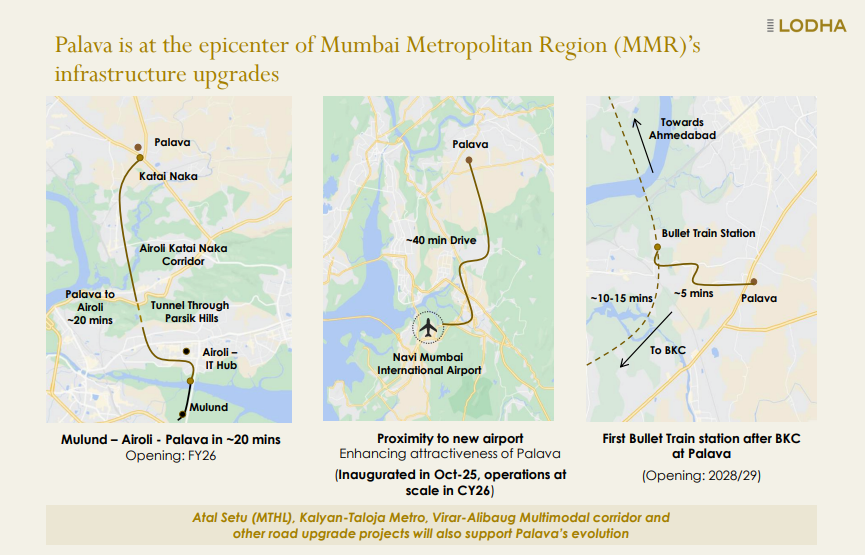
Lodha Developers Ltd has rapidly positioned itself as an emerging player in India’s growing data centre ecosystem. The company is developing a large integrated data centre park with reliable infrastructure and significant capacity for hyperscale and colocation operators. The project is being built on roughly 400 acres of contiguous land that has already received the required approvals, with the broader site designed to support around 3 gigawatts of data centre capacity. The 400 acres of land is part of the 4,000 acre land parcel owned by the company in Palava, Navi Mumbai (Extension).
The scale of Lodha’s ambition became clearer after the company signed a memorandum of understanding with the Government of Maharashtra. Initially, the group committed an investment of Rs. 30,000 crores to develop the data centre park. However, on January 19, 2026, during the World Economic Forum in Davos, Lodha signed another agreement committing an additional Rs. 1 lakh crore. This brings the total planned investment to Rs. 1.3 lakh crores for a 2.5 gigawatt data centre park, making it one of the largest projects of its kind in India.
The proposed park is expected to generate more than 16,000 direct and indirect jobs and will host multiple international and domestic operators. Some major players have already secured land within the project. Amazon has acquired land and arranged power supply for the next 15 years, while Singapore-based STT Global Data Centres has also taken a parcel inside the park. Lodha plans to leverage its decades of construction experience by acting as the developer for these companies and enabling large-scale deployment of data centre infrastructure.
Abhishek Lodha, Managing Director and Chief Executive Officer of Lodha, said, “Over and above the Rs. 30,000 crores commitment last year to develop the data centre park, we have signed another agreement with Government of Maharashtra to invest additional Rs. 1 lakh crore. The state has already scaled newer heights under the leadership of Shri Devendra Fadnavis, Hon’ble Chief Minister of Maharashtra. His vision and actions directed towards developed Maharashtra, gives us immense confidence in committing to such a large investment.”
The company is following a two-pronged strategy to monetize the opportunity. First, Lodha plans to continue selling land to data centre operators at targeted price points of around Rs. 0.5 billion to Rs. 0.6 billion per acre over the next few years. This approach helps build an ecosystem of hyperscale and colocation operators within the park. Second, the company is exploring the development of powered shell facilities that can be leased to global clients, creating long-term rental income streams.
Management believes that the location will continue attracting additional global operators. The company expects more colocation or hyperscale players to sign agreements for the site over the next 12 to 18 months. At the same time, Lodha plans to begin constructing build-to-suit facilities designed specifically for end users, which could generate recurring rental income in the years ahead.
According to Shaishav Dharia, Whole-Time Director and CEO of the Extended Eastern Suburbs business and Annuity Assets, the data centre initiative has become a significant opportunity for the company. He noted that Lodha began working on this project nearly five years ago and has since earmarked 400 acres of land with approvals already in place. Based on the preparation done so far, the company believes it has built one of the most reliable infrastructure packages for artificial intelligence data centres in the country.
Abhishek Lodha also highlighted during a Q2 concall that the company will continue some level of third-party land sales in the coming years to strengthen the data centre and artificial intelligence ecosystem at Palava. Over the past two years, Lodha’s teams have assembled what he described as one of the most comprehensive infrastructure packages available to data centre operators in India. With land, permits, water supply and power infrastructure already in place, the site is designed to allow operators to move from construction to operationalization in less than 24 months.
Beyond simply providing land and infrastructure, Lodha is also exploring additional value-added models. The company is evaluating partnerships with entities that have strong artificial intelligence expertise or global networks. It is also considering models such as powered shells, which involve constructing partially built facilities that can be leased to operators who then install their own computing equipment.
Abhishek Lodha, in Q2FY26 Concall, explained that such powered shell facilities could potentially generate an annualized profit of approximately Rs. 0.1 billion per megawatt per year, highlighting the long-term monetization potential of the project as the ecosystem around the park expands.
Lodha’s Edge
Lodha believes the Palava data centre park has several structural advantages that make it attractive for global hyperscale and colocation operators. The project has been designed as a large integrated data centre campus with infrastructure that can support some of the most demanding artificial intelligence and cloud computing workloads.
One of the biggest strengths of the site is its power infrastructure. The campus has the ability to provide around 3 gigawatts of electricity through four 400 KV lines and one 220 KV extra high voltage line, including connections to the national grid. According to management, this allows power to be supplied through multiple circuits, creating one of the most reliable power networks available for a data centre location in India. Many locations face challenges with power availability or quality, but Lodha believes this site can deliver reliability close to Tier 4 data centre standards, which is considered the highest global benchmark.
Water availability is another key requirement for large data centres, particularly for cooling systems. Lodha has secured access to nearly 100 million litres of recycled water per day from a nearby industrial park. This water will be used in cooling towers and does not require potable water. Management believes this arrangement significantly improves cooling efficiency while also reducing costs for operators.
Connectivity is also a critical factor for hyperscale facilities. The Palava site currently has more than five optical fibre routes already in place, and the network can potentially expand to around ten routes over time. This multi-route connectivity helps ensure reliable data transmission and strengthens the park’s ability to support large-scale digital infrastructure.
The project has also been approved under the Maharashtra government’s Green Integrated Data Centre Park Policy, which provides significant fiscal incentives for operators setting up facilities at the site. These incentives are expected to make the location one of the lowest-cost options for building and operating data centres.
Management estimates that the cost of building a turnkey powered shell facility at Palava could be around USD 6 million per megawatt. Globally, similar facilities typically cost between USD 8 million and USD 12 million per megawatt. This implies that the project could offer capital expenditure savings of up to 15 percent for operators setting up infrastructure at the park.
Operating costs are also expected to be significantly lower. Electricity represents the largest component of data centre operating expenses, and Lodha believes operators could reduce their operating costs by more than 30 percent at the Palava site. This is partly due to the Green Data Centre policy and the ability to source about 90 percent of power from renewable energy sources. As a result, power costs at the site could be around USD 0.06 per kilowatt-hour, compared with approximately USD 0.10 to USD 0.12 per kilowatt-hour in the United States.
These advantages also help address two of the most common environmental concerns associated with data centres. By using recycled water for cooling and relying heavily on renewable energy, the project aims to reduce both water stress and carbon intensity for operators setting up facilities at the park.
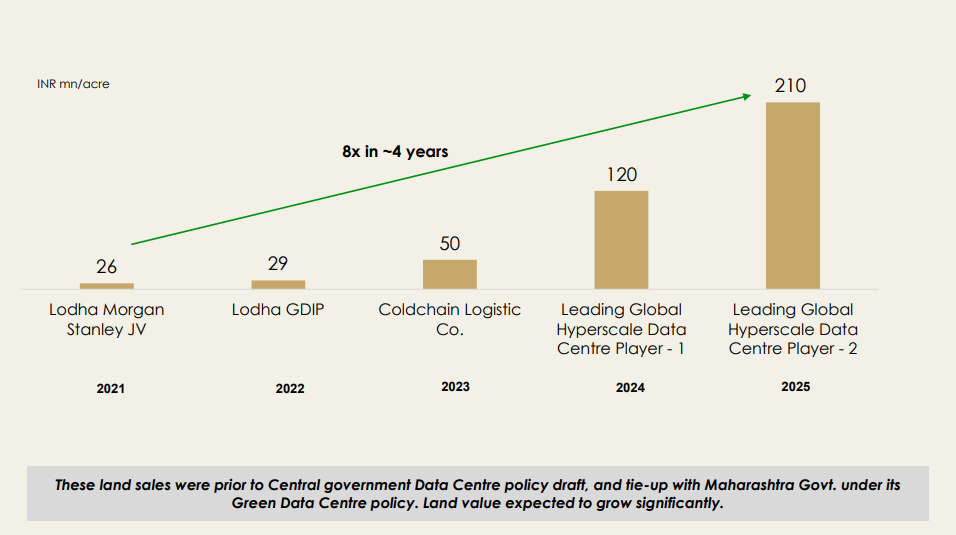
The project has already begun attracting global operators. Two large international data centre companies have signed agreements for land within the Palava campus. The most recent land transaction was completed at roughly Rs. 21 crores per acre. However, management expects land values to increase steadily as the ecosystem develops. Over the next three years, Lodha believes prices could rise to around Rs. 50 crores to Rs. 60 crores per acre.
Beyond land sales, Lodha is also planning to create a large annuity business through powered shell facilities. The company’s model focuses on building power shells on a build-to-suit basis for clients. According to management, the cost of constructing such powered shells is expected to be approximately Rs. 3 million per megawatt, including the value of land.
Another structural advantage comes from Palava’s location near Mumbai, which is currently India’s largest data centre hub. Around half of the country’s data centre capacity is located in Mumbai, largely because many global undersea internet cables land there. These cables provide high-speed connectivity to different parts of the world.
At present, the time required to transmit data between Mumbai and Europe is around 140 to 150 milliseconds, and management believes this could fall further to around 120 milliseconds with additional investments in connectivity infrastructure. Data transmission to the United States currently takes about 220 to 240 milliseconds but could potentially decline to around 170 milliseconds over time. According to management, these improvements in latency could make India increasingly attractive as a location for global computing workloads, particularly artificial intelligence training operations that require large amounts of scalable infrastructure at relatively lower costs.
How Much Will They Earn?
According to a report by Morgan Stanley, India’s rapidly expanding data centre sector could create meaningful growth opportunities for real estate developers. The brokerage believes Lodha Developers Ltd and Mindspace Business Parks REIT have the highest exposure among the companies it tracks to this emerging ecosystem, which includes land acquisition, development of data centre shells and eventual monetisation through REIT structures. Morgan Stanley estimates that data centre-led growth alone could add more than 20 percent upside to the valuations of both companies over time.
The report highlighted that property developers play a critical role in enabling data centre expansion because they provide large land parcels, handle regulatory approvals and have expertise in constructing and leasing large commercial assets. Once operational, data centres generate stable and predictable income streams similar to office real estate, but with faster development timelines and stronger rental growth. While construction costs are roughly 20 percent higher than conventional commercial buildings, data centres can deliver yields of around 13 percent to 16 percent, compared with typical office yields of about 10 percent to 11 percent.
Morgan Stanley also noted that other developers such as DLF and Prestige Estates have exposure to the data centre opportunity, but it believes Lodha and Mindspace are best positioned due to their development pipelines and ability to monetise assets through REITs. Based on its estimates, the brokerage expects Lodha’s planned data centre developments to generate potential rental income of around Rs. 21 billion from a 1 gigawatt platform.
-Manan Gangwar
Disclaimer: The views and investment tips expressed by investment experts/broking houses/rating agencies on tradebrains.in are their own, and not that of the website or its management. Investing in equities poses a risk of financial losses. Investors must therefore exercise due caution while investing or trading in stocks. Trade Brains Technologies Private Limited or the author are not liable for any losses caused as a result of the decision based on this article. Please consult your investment advisor before investing.
The post Lodha Share: How Much Revenue Could the Company Generate from Data Centres? appeared first on Trade Brains.
Related Articles

Which conglomerate has produced the most number of multibagger stocks?
Synopsis: This article explores high-performing multibagger stocks from Indian c...

Go First Airlines And 4 Other Companies That Have Turned Insolvent In The Past 5 Years
Synopsis: Several well-known Indian companies, including Future Retail, Go First...

Stocks to Watch: Castrol India and 5 other Stocks That Will Trade Ex-Dividend Next Week
Synopsis: 6 stocks that had announced divided for its share holders of upto Rs....

This New AI Tool May Explain Anthropic’s $380 Billion Valuation But Does It Hold Up?
Synopsis: Anthropic’s Claude Code Security AI tool sparked a $15B cybersec...