Mukul Agrawal Portfolio: How Is He Betting on India’s Real Estate Market Through This One Stock?
Alex Smith
2 hours ago

Synopsis: While most investors focus on real estate developers, Mukul Agrawal has backed a company working behind the scenes. From Lodha and DLF to Oberoi and Godrej, this construction company has become an execution partner for some of India’s biggest developers and now sits on a Rs. 13,498 crore order book.
India’s real estate boom is no longer only about the companies selling flats. Behind many premium towers, redevelopment projects, government housing schemes and high-rise buildings, there is another layer of companies quietly doing the actual execution work.
These companies do not own the land, do not sell apartments and do not advertise projects to homebuyers. But they are the ones that physically build the towers for some of the biggest names in the sector.
One such company is Capacit’e Infraprojects, where investor Mukul Agrawal owns around 6.62 percent stake, valued at approximately Rs. 126 crore. The interesting part is not just that he owns the stock. The bigger story is that this company acts as a construction partner to some of India’s largest real estate developers and government agencies, giving Mukul Agrawal indirect exposure to the real estate construction cycle without betting on a real estate developer itself.
What Does Capacit’e Actually Do?
Capacit’e Infraprojects is a focused EPC company that provides end-to-end construction services for buildings and factories. Its work spans residential buildings, commercial buildings, institutional buildings and mixed-use projects. This includes high-rise buildings, super high-rise buildings, shell and core work, complete lock-and-key projects, MEP works, malls, hotels, office complexes, hospitals, data centres, factories, metro stations, townships and gated communities.
In simple words, Capacit’e is not a company that sells homes. It is the company that builds the towers for developers and government clients. If a developer launches a luxury residential project, the developer may handle land, approvals, sales and branding, while Capacit’e may be responsible for execution at the construction site. That is why the company’s model is closer to being the “builder behind the builder.”
The company says it has delivered more than 75 million square feet of area across segments in 12 years of operational history. It has also highlighted its single-segment focus, customer commitment and delivery track record as reasons why it has become a preferred partner for large private sector and public sector projects.
This is important because construction is not just about getting orders. It is about getting repeat orders from clients who trust execution quality, timelines and balance sheet strength.
The Real-Estate Giants Behind The Story
The most interesting part of Capacit’e is its client base. A credit report from Infomerics Ratings mentions reputed private developers such as Oberoi Realty, Raymond, Godrej Properties, Signature Global and Lodha. The company data also showcases developers like DLF, Prestige Group, Phoenix Mills, Brookfield, Hubtown and Piramal Realty along with premium projects such as The Park Towers 3 and 4 for Lodha Group, One Altamount for Lodha Group, Auris Serenity for Transcon Developers, 25 South Prabhadevi for Hubtown Group, Piramal Mahalaxmi for Lodha Group and Garden City Phase 3 for Oberoi Realty.
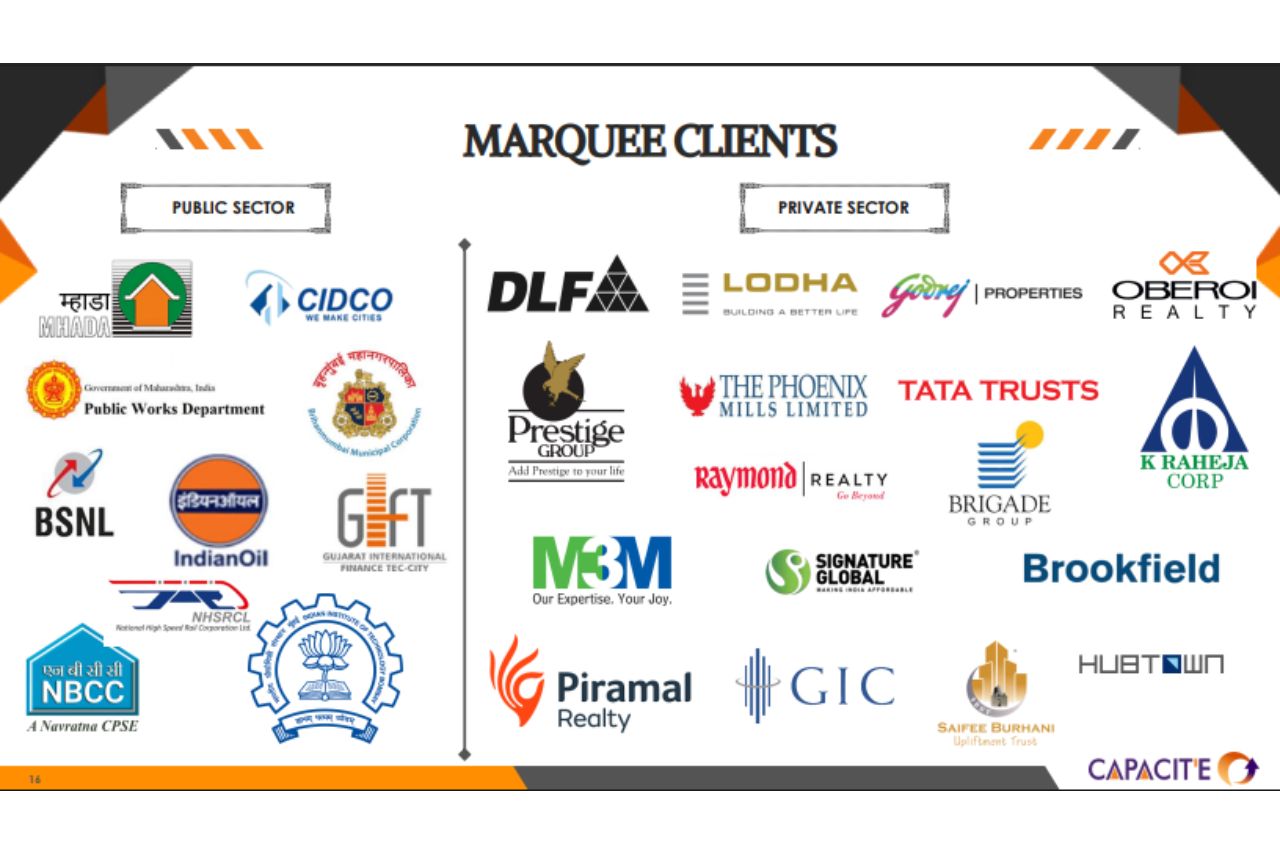
Source: Capacit’e Infraprojects Investor Presentation
This changes the way one should look at the business. A normal investor may think Lodha, Raymond, Godrej or Oberoi build everything themselves. But in large real estate projects, the developer often hires specialist contractors for execution. Capacit’e becomes one of those execution partners.
This is also why Mukul Agrawal’s investment thesis becomes interesting. Through one stock, he is not directly betting on only one developer. He is indirectly exposed to the broader building construction cycle of several large developers and government agencies. The company does not benefit from real estate prices in the same way as a developer, but it benefits when large projects are awarded, construction activity increases and execution ramps up.
The company’s current order book also shows why this is not a small construction story. As of March 31, 2026, Capacit’e had a standalone order book of Rs. 13,498 crore. Public sector projects formed 57 percent of the order book, while private sector projects formed 43 percent. By segment, residential projects contributed 62 percent, mixed-use projects contributed 29 percent and institutional projects contributed 9 percent.
Why 40-Floor Buildings Matter
One of the most important points is that 60 percent of Capacit’e’s order book is made up of buildings above 40 floors. This is not a small detail. It tells us what kind of construction work the company is doing.
Building a 10-floor or 15-floor apartment is very different from building a 50-floor or 60-floor tower. As the height increases, construction becomes more complex. Foundation work, concrete pumping, safety systems, sequencing, manpower management and technical execution all become more difficult. This naturally reduces the number of contractors who can qualify for such projects.
That is where Capacit’e’s niche becomes visible. It is not only trying to be a general contractor. It is trying to be a specialist building construction company with capabilities in high-rise and super high-rise structures.
This matters because order book quality is as important as order book size. A large order book made of low-margin, highly competitive projects may not create the same value as a large order book coming from complex projects with marquee clients. Capacit’e’s positioning in high-rise construction gives it a better story than a normal construction contractor.
FY26 Financial Performance
During FY26, Capacit’e reported revenue from operations of Rs. 2,622.7 crore, compared to Rs. 2,349.5 crore in FY25, showing a growth of 12 percent. EBITDA, excluding other income, stood at Rs. 427.2 crore, compared to Rs. 379.4 crore in FY25, growing 13 percent. EBITDA margin stood at 16.3 percent in FY26 compared to 16.1 percent in FY25.
However, profit after tax declined to Rs. 193 crore in FY26 from Rs. 204 crore in FY25. At first glance, this may look weak. But the reason is important. Other income fell sharply from Rs. 57.6 crore in FY25 to Rs. 20.9 crore in FY26. In Q4 alone, other income declined to Rs. 1.5 crore from Rs. 33.5 crore in Q4 FY25. This affected EBIT and PAT, even though the core operating business improved.
Management clarified that FY25 other income included one-time write-backs, while FY26 primarily consisted of regular interest income, making the year-on-year comparison less meaningful from an operational perspective.
In Q4 FY26, revenue from operations stood at Rs. 711.8 crore, up 6 percent from Rs. 671.3 crore in Q4 FY25. EBITDA rose 27 percent to Rs. 109.1 crore, and EBITDA margin improved to 15.3 percent from 12.8 percent. PAT, however, declined to Rs. 45 crore from Rs. 53 crore, mainly due to lower other income.
The bigger positive was cash flow. Net cash from operating activities stood at Rs. 224 crore in FY26 compared to Rs. 52 crore in FY25. The company also reduced working capital days, including retention debtors, by 43 days on the back of improved debtor collection. For an EPC company, this is important because weak cash conversion can become a serious risk even when reported profits look healthy.
What Went Right And What Went Wrong?
The biggest positive in FY26 was order inflow. Capacit’e reported order inflow of Rs. 4,446 crore during the year, beating its full-year guidance of Rs. 3,500 crore. This indicates that clients continued to award work to the company despite execution challenges during the year.
The second positive was the improving credit profile. The company’s bank credit rating was upgraded to BBB+/Stable from BBB/Stable. The company also said that its assessed working capital limits, both fund-based and non-fund-based, are fully tied up. Over the last two years, its interest rate on fund-based limits reduced from around 12.5 percent to 9.65 percent, while non-fund-based commission charges also moderated from around 2.5 percent to 1.20 percent. Management expects the benefit of lower finance cost to be visible in FY27.
But FY26 was not perfect. Management said execution was temporarily affected by election-related disruptions in the MMR region, labour migration during the assembly election period and regulatory interruptions in NCR. These factors slowed project execution and affected revenue momentum during the year.
Commodity cost was another issue. Management said prices of electrical items and aluminium product items increased by nearly 18 percent over three months from February 2026 to April 2026. While these items are covered under escalation, the upward movement in escalation was only 2 percent in February and March.
As a prudent step, the company factored Rs. 10 crore in procurement cost in FY26. If escalation receivables from clients match the increase over the next two quarters, this provision may be reversed.
FY27 Growth Triggers And Blunt View
Management is guiding for around 20 percent revenue growth year-on-year over the next two years. The company believes its current order book supports this guidance with some headroom for betterment. The biggest disclosed project drivers are CIDCO and MHADA. Management said all projects are operational, MHADA has opened up meaningfully, and the company expects around Rs. 500 crore to Rs. 600 crore revenue from CIDCO and Rs. 350 crore to Rs. 400 crore from MHADA in FY27.
These two clients alone can become major revenue drivers if execution happens as planned. Along with this, projects from private developers and government clients such as Signature Global, Raymond, NBCC and others can support the growth story.
Conclusion
In conclusion, Capacit’e has the right ingredients for a strong execution cycle. It has a large order book, marquee clients, high-rise construction capability, improving cash flow, better working capital and lower borrowing cost. Mukul Agrawal’s stake adds curiosity, but the real reason to track the company is its position as a contractor behind some of India’s biggest real estate projects.
The risk is also clear. This is still an EPC business. Revenue depends on execution, site handovers, labour availability, client approvals, collections and commodity prices. A large order book only matters if it converts into revenue and cash flow. FY26 showed both sides of the story: strong order wins and better cash flow on one side, but execution disruptions and PAT pressure on the other.
So the real question for FY27 is simple. Can Capacit’e convert its Rs. 13,498 crore order book, 40-floor-plus construction niche and marquee client relationships into faster revenue growth without new execution issues?
If it can, Mukul Agrawal’s bet may be less about one construction stock and more about India’s high-rise real estate boom being built through one hidden contractor.
Disclaimer: The views and investment tips expressed by investment experts/broking houses/rating agencies on tradebrains.in are their own, and not that of the website or its management. Investing in equities poses a risk of financial losses. Investors must therefore exercise due caution while investing or trading in stocks. Trade Brains Technologies Private Limited or the author are not liable for any losses caused as a result of the decision based on this article. Please consult your investment advisor before investing.
The post Mukul Agrawal Portfolio: How Is He Betting on India’s Real Estate Market Through This One Stock? appeared first on Trade Brains.
Related Articles
Greenlam Industries Share: Can Chipboard and Plywood Drive Its 18% Revenue Growth Target?
Synopsis:The company is entering a monetization phase after years of expansion....

Can Lumax Share Deliver Its Ambitious ₹11,000 Crore Revenue Target by FY31?
Synopsis: Lumax Auto Technologies targets Rs. 11,000 crore revenue by FY31, aimi...
3 Large Cap Power Stocks With ROCE Above 25% and Strong Earnings Growth
Synopsis: Three large-cap power sector names are posting record revenues, expand...

5 Auto Ancillary Stocks That Could Benefit From India’s Next Vehicle Growth Cycle
Synopsis:While automakers often grab the spotlight, some of the biggest long-ter...