Ratnaveer Precision Share: Can Its CCL Entry Benefit From India’s Semiconductor and PCB Boom?
Alex Smith
2 hours ago
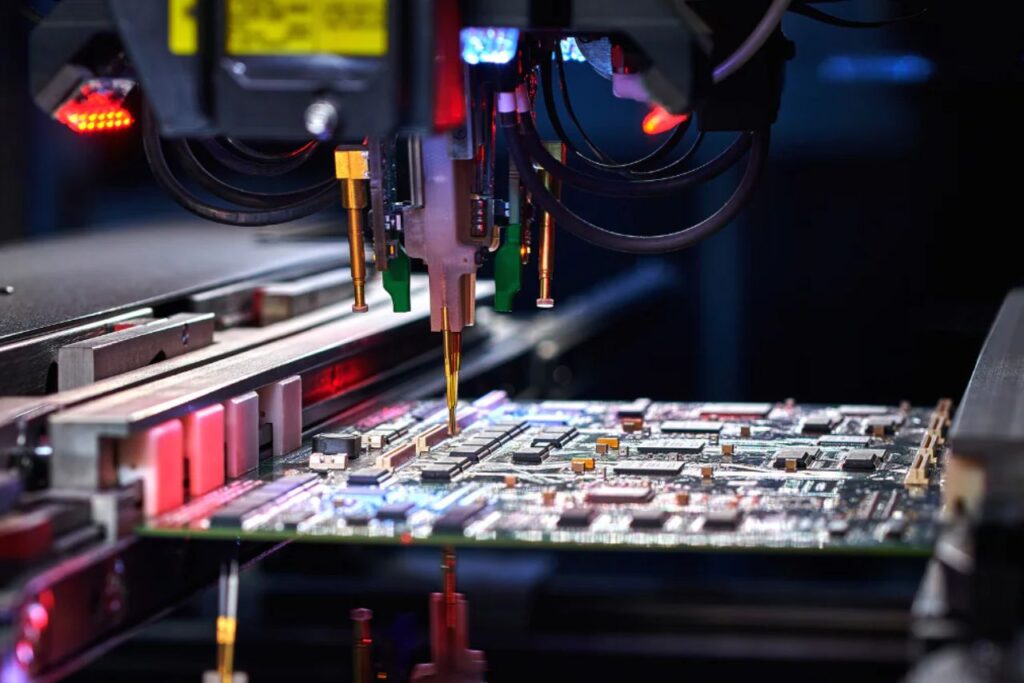
Synopsis: Ratnaveer Precision Engineering is entering the copper clad laminate (CCL) market to capitalise on India’s growing semiconductor and PCB ecosystem. Backed by Rs 338 crore in government incentives, technology support, and strong import-substitution opportunities, the company aims to build a Rs 750 crore business that could become a significant long-term growth driver.
Ratnaveer Precision Engineering has made a name for itself in the last two decades in the stainless steel products manufacturing sector, catering to a range of industries like automobiles, railways, aerospace, pharmaceuticals, and engineering.
While Ratnaveer Precision Engineering keeps growing with the expansion of its current stainless steel product range, it looks forward to venturing into another industry altogether. Ratnaveer aims at participating in India’s electronics manufacturing revolution through the launch of copper-clad laminate (CCL).
The firm has got approvals for incentives under the Indian government, forged a technology agreement, started its project execution and formulated a plan for a very successful future that will enable the company to contribute up to Rs 750 crore to its turnover.
India is on a quest to foster semiconductor, printed circuit board, and electronics manufacturing in the country, and Ratnaveer looks to take advantage of it. With a market cap of Rs 1,200 crore, the shares of Ratnaveer Precision Engineering Ltd are trading at Rs 171 and are trading at a PE of 18 compared to their industry’s PE of 21. The shares have given a return of more than 45% since their listing in September 2023.
A Strategic Entry Into The Electronics Value Chain
Copper-clad laminates were identified by management as one of the most important raw materials for printed circuit board and semiconductor manufacturing applications. Every PCB maker needs CCL as a basic material, which makes it an essential component of the electronics manufacturing value chain.
As per the management of the company, almost all of the requirements are met through imports, presenting an opportunity for domestic production in a period where India is striving hard to become self-sufficient in electronics manufacturing. Ratnaveer feels that by setting up its manufacturing capacity, the company will be able to lower its reliance on imports while positioning itself strategically in a booming market.
The difference between this and its stainless steel manufacturing operation is that while it deals with a fairly mature market in its stainless steel operations, CCLs present an area where there is huge growth potential in demand and not much indigenous manufacturing activity.
Riding The Semiconductor And PCB Growth Wave
Throughout the earnings call, management kept emphasising the growth opportunities of India’s electronics ecosystem, which the company believed could provide reasons for investing in the segment. Management noted that demand for CCL products was being triggered by overall growth in chip, PCB and electronics.
Management expects that the ecosystem around PCB, CCL and semiconductors would grow at a CAGR of about 35%-40%. Ratnaveer further emphasised investments being made across the electronics value chain as a reason to expect strong growth from the sector in the coming years.
They believe that the coming two decades would see growth in semiconductors, digitisation, electronics manufacturing and data infrastructure, creating opportunities for products such as CCL. The company believed that this environment would create strong growth opportunities for a new manufacturer entering the industry.
Building A Domestic Alternative To Imports
Import substitution was one of the most important strategies employed by Ratnaveer in its CCLs business. It was reported by management that currently, copper-clad laminates are being imported into India, while very little of it is manufactured locally.
The firm opined that the locally made CCLs could be advantageous for the PCB makers. They include the reduction in logistics costs, inventory costs, and foreign currency risk. Management also reported that buyers could achieve better supply chain security through local procurement.
The reason behind this is that there is a likelihood that local manufacturers of the material will receive government support through various incentives to their buyers.
According to Ratnaveer management, if the company was able to provide world-class products at a competitive price, then PCB manufacturers could have several good reasons to buy from the locals rather than abroad.
Technology Partnership To Accelerate Execution
With a realization of the technological sophistication that is required for CCL manufacturing, Ratnaveer has opted for partnering with a seasoned Chinese technology vendor.
It was noted by the management that the technology vendor will be providing the equipment along with installation and commissioning services, operating procedures, manpower training and even quality management. It has been mentioned that several rounds of machinery inspections have been undertaken at the factories outside the country.
Management pointed out that the factory would be set up as a completely automated factory and produce products as per international standards. The technology vendor would be providing assistance for one-and-a-half to two years post-commissioning in ensuring customer approvals.
It has been made clear by management that the project is essentially turnkey in nature and involves responsibilities starting from equipment supply all the way through production stability.
Government Incentives Strengthen Project Economics
Government incentives play a very important part in the feasibility of the project. According to Ratnaveer, the project had obtained incentives of Rs 338 crore through the ECMS scheme of the Government of India.
Along with government incentives from the central government, there is also scope for incentives from state-level schemes for electronics. Management confirmed that the project was receiving favorable response from both central and state governments.
According to management, government incentives were in terms of capital-based, power-based, logistics support, and others that would make domestic electronics manufacturing more profitable. The presence of government incentives was among the main factors influencing the company to pursue the project despite heavy capital expenditure required.
Project Execution And Commercialisation Timeline
The CCL plant project execution is already underway with Ratnaveer. According to management, machines have already been ordered, and a series of inspections have already taken place.
On-site construction works are ongoing, while machine production is being done on time. It is anticipated that shipment of the equipment will start from July or August 2026, leading to installation and commissioning activities.
Management has projected a period within which trial productions will take place in October 2026 and commercial productions in November 2026. In the beginning, the company’s plan is to start production using the first line.
After reviewing how the first line performs and customers’ reactions, then plans are made to install the other four lines. This may be done at once or gradually over the coming years depending on how the operations go on. Management has assured me that all the five lines will contribute to future revenue generation.
Revenue Ambitions And Financial Potential
There are also some high financial targets set by Ratnaveer’s management for the current operations and the CCL project. Ratnaveer anticipates growth of about 25% CAGR in its stainless-steel operations. It also envisions that its current business will reach a level of revenues of around Rs 1,800 crore in the coming years.
In addition to the above, there is also an expectation that the CCL project will bring revenues of about Rs 750 crore once it fully becomes operational. The above two sources of revenues form the base from which Ratnaveer’s management envisions achieving consolidated revenues of about Rs 2,500 crore.
These projections by management are based on a utilisation rate of around 69%. However, the company suggested that higher utilisation rates of 80% to 85% are feasible. The higher rates will mean higher revenues than currently anticipated.
Also, the management expects attractive profits from the new business. According to the management, the first line is expected to generate EBITDA margins of around 20% to 21% and PAT margins of approximately 13%.
Can Ratnaveer Capture A Meaningful Share Of A Large Market?
One of the most outstanding features in the management’s comments is the certainty surrounding the market size. According to Ratnaveer, despite the full operation of all the five production lines, the company will still only be satisfying about 1.8% of the current demand in the market.
Demand for PCBs from manufacturers and other semiconductor-related businesses is very high, and it is growing fast. The management has already received some soft confirmations from potential customers about their intent to make future purchases, and management believes that just one or two customers can take all the products produced by the first production line.
The management believes that the risk in meeting demand is not as high as the risk in execution. According to the management, all that matters is that they complete the projects in time, maintain international standards, and get customer approval. Once they achieve these, demand should come easily.
As India accelerates efforts to develop a domestic electronics manufacturing ecosystem, copper-clad laminates represent a strategic component of that supply chain. Ratnaveer’s planned entry into the sector positions the company at the intersection of semiconductor growth, PCB expansion and import substitution.
While the venture remains at an early stage, management believes strong demand, government incentives, technology support and limited domestic competition could create a meaningful opportunity. If execution proceeds according to plan, the CCL business has the potential to become one of the company’s most important growth drivers over the coming years.
Disclaimer: The views and investment tips expressed by investment experts/broking houses/rating agencies on tradebrains.in are their own, and not that of the website or its management. Investing in equities poses a risk of financial losses. Investors must therefore exercise due caution while investing or trading in stocks. Trade Brains Technologies Private Limited or the author are not liable for any losses caused as a result of the decision based on this article. Please consult your investment advisor before investing.
The post Ratnaveer Precision Share: Can Its CCL Entry Benefit From India’s Semiconductor and PCB Boom? appeared first on Trade Brains.
Related Articles

IndiGo Shares Dip After Temporarily Suspending India-Manchester Flights
Synopsis: Caught between Middle East airspace constraints that are stretching fl...

₹15,900 Cr Order Book: PSU Stock to Buy Now for an Upside of 56%
Synopsis: BEML has drawn attention after Elara Capital maintained a Buy rating w...
Why Is Concord Biotech Stock Up by 8% Today?
Synopsis: Concord Biotech Ltd shares jumped 8% after USFDA approval for its ANDA...

Mrs Bectors: Can New Product Launches and Outlet Expansion Fuel the FMCG’s Next Growth Phase?
Synopsis: Mrs Bectors Food Specialities received a Buy rating from Anand Rathi w...