₹156 Lakh Crore of Credit: Is India Getting Too Comfortable with Borrowing?
Alex Smith
1 month ago
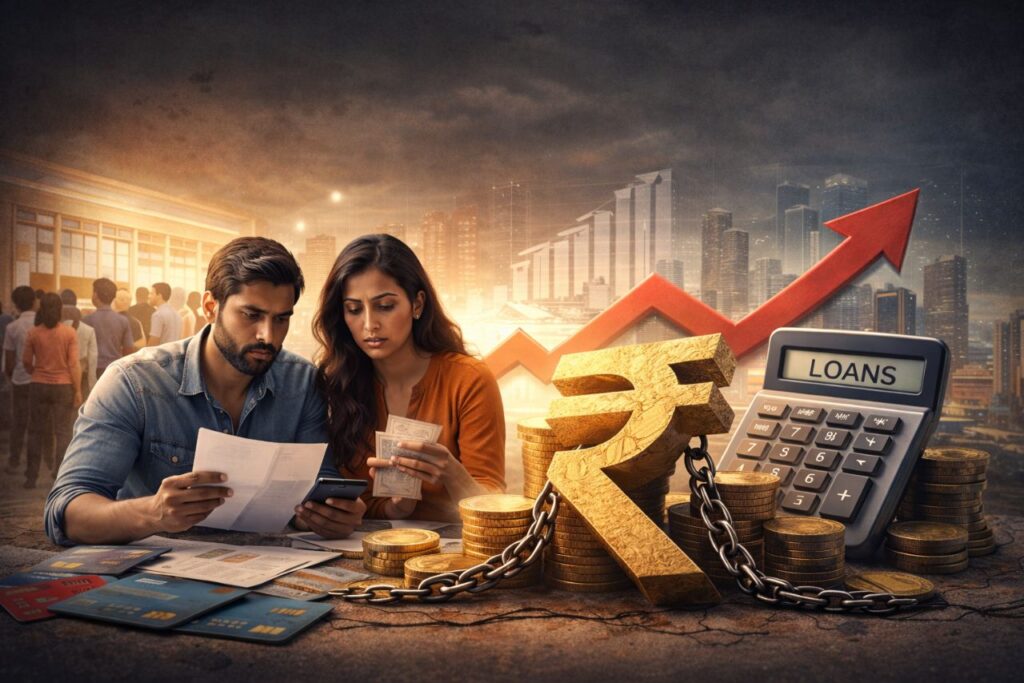
A newly built two-wheeler showroom that did not exist just two years ago now stands as a symbol of a much larger shift. The gleaming machines aren’t there by accident; they represent India’s consumption lending revolution, a financial transformation quietly rewriting the economic destiny of 1.4 billion people. From gold-backed loans fueling agricultural seasons to personal credit powering urban aspirations, India’s lending landscape has evolved into a sophisticated engine of inclusive growth, making the nation’s Rs 156 lakh crore retail credit market one of the world’s most dynamic financial stories.
The Great Credit Expansion: A Historical Pivot
India’s journey from a credit-scarce economy to a consumption-driven lending powerhouse represents one of the most significant financial transformations in emerging market history. The retail lending portfolio has expanded from modest beginnings to reach Rs 156 lakh crore as of September 2025, registering a robust 18% year-on-year growth. This expansion reflects not just growing prosperity but a fundamental shift in how Indians access, utilize, and repay credit.
The story begins with home loans, which remain the largest segment at Rs 42.1 lakh crore as of September 2025, commanding 11.1% annual growth. However, the narrative has evolved beyond traditional mortgages. Gold loans have emerged as the breakout performer, surging 35.8% year-on-year to Rs 14.5 lakh crore, driven by regulatory tailwinds and the timeless Indian tradition of storing wealth in gold. Personal loans, despite moderating to 12% growth from earlier highs of 25%, still represent Rs 15.4 lakh crore in outstanding credit.
The transformation is equally visible in smaller-ticket consumption. Two-wheeler loans have grown 15% year-on-year to Rs 1.7 lakh crore, while auto loans maintain healthy expansion at 16.3% to reach Rs 8.6 lakh crore. Consumer durable loans and credit cards complete the picture, reflecting an aspirational India that increasingly leverages credit for lifestyle upgrades.
Digital Infrastructure: The Backbone of Lending Growth
What distinguishes India’s consumption lending boom from previous credit cycles is its technological foundation. The country’s fintech sector is racing toward a $250 billion revenue milestone by 2030, with lending technology projected to contribute over 53% of this value. From 2020 to H1 2025, digital lending startups attracted the highest share of funding at 37%, making it the dominant segment within fintech.
India’s total fintech market is projected to reach $2.1 trillion in size by 2030, with digital lending expected to capture more than $133 billion of the revenue opportunity by the end of the decade. The lending technology segment has achieved a compound annual growth rate of 31% between 2015 and 2024.
The Reserve Bank of India’s Financial Inclusion Index reaching 67 in March 2025, a 24.3% increase since inception in 2021, underscores how financial access has expanded across demographics. Enhanced financial literacy initiatives and expanded digital infrastructure have been primary drivers of this improvement.
The Stock Rally: Market Recognition of Lending Leadership
The lending sector’s structural strength has translated into compelling stock market performance. Shriram Finance has rallied more than 40% in the last three months, breaking out from a 14-month consolidation phase in November 2025 to hit fresh record highs.
CLSA has identified Nifty 50 targets of 26,333, with specific “buy” recommendations on lending names, including Cholamandalam Investment and Finance.
State Bank of India has reclaimed its position as the top home loan lender, surpassing HDFC Bank by close to Rs 24,000 crore in the Sept quarter. SBI’s home loan portfolio stood at Rs 8.80 lakh crore as of Sept 2025, registering 15.22% year-on-year growth, compared to HDFC Bank’s 6.7% expansion to Rs 8.56 lakh crore. This shift reflects PSU banks’ aggressive pricing strategies and government-backed initiatives supporting affordable housing.
HDFC Bank reported a 9% rise in loans to Rs 27.9 lakh crore and 15.1% growth in deposits to Rs 27.1 lakh crore for Q2 FY26. The bank is witnessing strong momentum across personal loans, business loans, and auto loans, with management optimistic about the festive season consumer spending.
Bajaj Housing Finance has demonstrated robust growth, posting a Q2 FY26 profit of Rs 643 crore, up 17.84% year-on-year, while revenue increased 14.30% to Rs 2,755 crore.
Sectoral Deep-Dive: Where Credit is Flowing
- Home Loans: PSU Banks Seize Market Share—PSU banks have expanded their home loan origination market share dramatically, rising from 41.9% in Q2 FY25 to 50% in Q2 FY26. This gain has come primarily at the expense of private banks, whose share declined from 31.5% to 25.2% during the same period. The shift toward higher-ticket loans has been notable; the Rs 75 lakh+ segment now accounts for 40% of origination value, and the Rs 5L – Rs 35L ticket size range constitutes 54% of origination volume, highlighting that smaller and mid-sized loans continue to dominate disbursal counts.
- Gold Loans: The Breakout Category—Gold loan origination value growth jumped 53% year-on-year in Q2 FY26 to Rs 6.04 lakh crore, driven by rising gold prices and regulatory support. PSU banks lead in origination value share at 52.1%, while NBFCs dominate small-ticket lending volumes by 42%. The RBI’s April 2025 revised gold loan guidelines, which raised the loan-to-value ratio from 75% to 85% for loans up to Rs 2.5 lakh, have further stimulated demand.
- Personal Loans: NBFC Dominance Grows—NBFCs have significantly expanded their personal loan market share, with origination value rising from 38% in Q1 FY25 to 40.6% in Q1 FY26. Later witnessed a drop to 37% in Q2 FY26. Volumes have reached 91.4% market share, reflecting their dominance in small-ticket lending below Rs 1 lakh. However, delinquency trends warrant monitoring; portfolio at risk (PAR) 180+ has increased to 5.6% from 4% a year earlier, indicating stress in longer-overdue accounts.
- Auto Loans: Monsoon Recovery—Auto loan originations are expected to recover following GST rate cuts and the festive season. Q2 FY26 saw auto loan originations rebound to Rs 96,061 crore, up 15.9% QoQ and 13.6% YoY, following a slowdown in previous quarters. The proportion of loans above Rs 20 lakh has grown from 17.4% in Q2 FY24 to 19.3% in Q2 FY26, with a marginal rise in the Rs 15–Rs 20 lakh category as well. At the same time, the contribution of smaller loans (below Rs 5 lakh) has been steadily decreasing in both value and volume.
Government Support: Policy Catalysts for Credit Growth
The government and regulatory framework have been instrumental in fostering lending growth. The RBI’s October 2025 monetary policy unveiled five key measures to boost credit flow:
- Acquisition Finance Framework: Banks will receive an enabling framework to finance acquisitions by Indian companies, widening lending opportunities.
- Enhanced Lending Against Securities: Regulatory ceilings on loans against listed debt securities have been removed, while lending limits against shares increased from Rs 20 lakh to Rs 1 crore per person.
- IPO Financing Enhancement: IPO financing limits increased from Rs 10 lakh to Rs 25 lakh per person, supporting capital market participation.
- Infrastructure Funding Support: Risk weights on loans by microfinance banks to high-quality infrastructure projects will be reduced, cutting financing costs.
- Expected Credit Loss Framework: Implementation is scheduled for April 2027 with a five-year glidepath, improving provisioning accuracy and banking sector resilience.
- The Pradhan Mantri Awas Yojana 2.0 continues driving affordable housing demand, with SBI maintaining leadership in this segment through government-backed schemes. Priority sector lending norms ensure continued credit flow to agriculture, SMEs, and weaker sections of society.
The Industry Outlook: Navigating Growth and Risk
The lending industry faces a nuanced outlook, balancing growth opportunities against emerging risks. Non-food bank credit growth moderated to 9.9% year-on-year as of August 2025, down from 13.6% in August 2024. Credit to micro, small, and medium industries maintained strong momentum, while industrial credit growth slowed to 6.5% from 9.7%.
Personal loans grew 11.8% year-on-year, slower than the previous year’s 13.9%, due mainly to a moderation in vehicle loans and credit card outstanding. This reflects prudent risk management following RBI advisories on unsecured lending.
Asset Quality Trends: Most consumption loan products have shown improving or stable asset quality. Home loan PAR 31-90 remained stable across lender types, PAR 31-180 levels, although both showed improvement on a QoQ basis. Gold loans maintained resilient delinquencies with early-stage PAR improving. However, personal loans show elevated stress in PAR 180+ buckets at 5.6%, warranting continued monitoring.
NBFC-MFI assets under management declined 12% in FY2025, though ICRA anticipates growth to resume at 10-15% in FY2026. The microfinance portfolio contraction reflects lender recalibration and cautious lending strategies to manage rising stress.
Key Stocks Driving India’s Lending Progress
Several listed entities stand at the forefront of India’s consumption lending revolution:- State Bank of India (SBI) has emerged as the undisputed home loan leader with an Rs 8.51 lakh crore portfolio, 15% annual growth, and expanding market share driven by competitive pricing and government scheme participation. Q2 FY26 net profit grew 9.97% to Rs 20,160 crore.
- HDFC Bank maintains dominance in private sector lending with advances of Rs 27.94 lakh crore in Q2 FY26, 9% year-on-year growth, and superior return on assets at 1.91%. The bank’s retail lending remains strong across personal, business, and auto loan segments.
- Bajaj Finance continues to lead the NBFC space as a digital-first consumer finance company with AUM of Rs 4.62 lakh crore and grew 24% YoY as of H1 FY26. Trading at Rs 1,014 as of December 2025, the stock has shown resilience amid broader market volatility.
- Shriram Finance has emerged as a standout performer with 40%+ gains over three months, breaking through a 14-month consolidation to reach record highs. The company’s vehicle and equipment financing portfolio continues to expand in semi-urban and rural markets.
- Cholamandalam Investment and Finance: Chola continues to scale across multiple retail finance verticals while maintaining a strong balance sheet, improving margins, and healthy segmental diversification. As of Q2 FY26, its total AUM stood at Rs 2.14+ lakh crore, with disbursements rising to Rs 24,442 crore.
- LIC Housing Finance maintains a substantial market presence with a loan portfolio exceeding Rs 3 lakh crore, though the stock has experienced a recent correction at the current P/E of 5.48.
- Bajaj Housing Finance demonstrated robust Q2 FY26 performance with 18% YoY profit growth and AUM at Rs 1.26 lakh crore, witnessing 24% YoY growth as of H1 FY26.
Conclusion: The Promise of Responsible Credit
India’s consumption lending transformation represents more than financial engineering; it embodies the aspirations of a rising middle class, the formalization of an economy, and the democratisation of credit access. With retail loans at Rs 156 lakh crore and growing at 18% annually, the sector has become fundamental to India’s economic architecture.
The RBI’s recent policy moves have sharply strengthened economic momentum. On December 5, 2025, it cut the repo rate by 25 bps to 5.25%, completing a 125 bps easing cycle since February, the largest since 2019. Lower rates will quickly translate into reduced MCLR and EBLR, easing EMIs and boosting demand for personal loans, two-wheelers, and small business credit.
To support transmission, the Reserve Bank of India has infused Rs 1 lakh crore via open market operations and announced $5 billion in FX swaps, enhancing banking system liquidity. This will encourage banks to expand lending, especially in affordable housing, vehicle finance, and MSME working capital. Real estate experts expect a rise in home loan applications in H2 FY26 as cheaper credit offsets rising property prices.
The path forward demands balance. Regulators must continue fostering innovation while ensuring responsible lending practices. Lenders must embrace digital transformation while maintaining asset quality discipline. Investors should recognize that the sector’s long-term structural tailwinds, urbanization, rising incomes, financial inclusion, and digital infrastructure, remain firmly intact.
As the RBI’s Financial Inclusion Index demonstrates, India is building a financially empowered nation where credit serves not as a burden but as a bridge to better lives. The consumption lending surge is, ultimately, a story about millions of Indians accessing their first home loan, financing their first vehicle, or leveraging their grandmother’s gold to fund a child’s education. This is the quiet revolution that charts India’s path toward becoming a developed economy by 2047.
The post ₹156 Lakh Crore of Credit: Is India Getting Too Comfortable with Borrowing? appeared first on Trade Brains.
Related Articles
Why did KPIT Technologies share crash up to 29% in one month?
Synopsis: KPIT Technologies Limited shares fell nearly 29% in a month amid Europ...

Solar Industries, Caplin Point and 6 other stocks delivering back-to-back EPS growth
Synopsis: Stocks like Solar Industries, Waaree Energies, and Navin Fluorine and...

Will Max Financial share price cross ₹2,000 after announcing robust Q3 results?
Synopsis: Max Financial gains after robust Q3 performance; Jefferies reiterates...

Angel One Vs Groww: Which stockbroker performed better in Q3?
Synopsis: Angel One and Groww delivered contrasting performances in Q3 FY26. Ang...