Saylor Says Strategy’s Bitcoin Credit Model Is Not A Ponzi Scheme
Alex Smith
2 hours ago
Michael Saylor defended Strategy’s Bitcoin-backed credit model after critics argued that the company’s STRC dividend structure resembled a Ponzi scheme, saying the business is built around monetizing Bitcoin capital gains rather than relying on perpetual equity issuance.
Speaking in an interview shared via X on May 9, Saylor addressed the market reaction to Strategy’s recent earnings call, where the company said it was prepared to sell Bitcoin, if needed, to fund dividends on its STRC preferred instrument. The remark drew attention because Saylor has long been associated with the phrase “never sell your Bitcoin.”
According to Saylor, the more precise formulation is that Strategy does not intend to be a “net seller” of Bitcoin.
“I’m very famous for saying, never sell your Bitcoin. And that’s why the internet went crazy when we said we might sell it,” Saylor said. “But if I was being more precise, I’d say never be a net seller of Bitcoin. It just wouldn’t have been so viral or so catchy to say never be a net seller of Bitcoin.”
Why Strategy Is Not A Bitcoin Ponzi Scheme
The issue became a point of contention after Peter Schiff and other critics suggested that Strategy’s willingness to sell Bitcoin to support STRC dividends exposed weakness in the model. Saylor rejected that framing, saying the company’s balance sheet should not be treated as if its Bitcoin holdings were unusable or worth zero.
“If you had $65 billion worth of something and people wanted to value it at zero, it’s not very good,” he said. “We don’t want the credit rating agencies to think the company has $0 of assets. We want the credit rating agencies to think we have $65 billion of assets.”
Saylor said the core model is straightforward: Strategy issues credit, uses the proceeds to buy Bitcoin, and expects the asset’s long-term appreciation to exceed the cost of the dividend. He compared the structure to a real estate development company raising capital through credit, acquiring land, improving it, and later monetizing the appreciation through sales, rent, or refinancing.
“What we wanna do is we wanna reinforce the business model is we sell credit to make a capital investment in an asset, Bitcoin, digital capital,” Saylor said. “The capital investment accretes over time faster than the dividend. We then monetize the capital gain and we pay the dividend.”
That distinction is central to Saylor’s response to Ponzi allegations. In his view, critics conflate selling common equity to fund dividends with the broader economic structure of the business. He said Strategy historically used MSTR equity, which he described as a derivative of Bitcoin that typically trades at a premium to Bitcoin, to fund dividends. But the company now wants the market to understand it could also use appreciated Bitcoin directly.
Saylor said that does not mean Strategy expects to shrink its Bitcoin position. He argued that even if the company sold Bitcoin for dividend payments, its credit issuance would allow it to buy substantially more Bitcoin than it sells.
“If we sell Stretch, if we issue Stretch credit equal to 2.3% of our Bitcoin holdings, then that means we will be a net buyer of Bitcoin forever, even if we sell Bitcoin to pay the dividend,” he said. “Another point is that if Bitcoin appreciates 2.3% a year, we can pay the dividends forever, right? And continue to grow value, right? And we can do it without selling any common equity.”
He added that Strategy sold $3.2 billion of STRC in April, while the monthly dividend requirement was roughly $80 million to $90 million. In that scenario, he said, the company would effectively be “buying 30 Bitcoin and selling one Bitcoin,” leaving it a net accumulator.
The interview also directly addressed Schiff’s criticism. Saylor said Schiff’s objection begins with a rejection of BTC itself, making it unlikely that he would accept a credit instrument built on top of it.
“Peter thinks Bitcoin’s a Ponzi scheme. Peter is not really a lover of anything in this space,” Saylor said. “Bitcoin is digital capital and we’ve created a digital treasury company by selling equity and credit instruments to buy capital. I think that Bitcoin is going to continue because it represents economic wealth in tokenized form with full property rights for the world.”
Saylor described STRC as a form of “digital credit” designed to strip out some Bitcoin volatility while producing a defined yield. He said Strategy overcollateralizes the instrument, with “for every $5 of Bitcoin” the company selling “$1 of credit.”
“If you don’t acknowledge Bitcoin as legitimate, you’ll never acknowledge any derivative on top of it as legitimate,” he said. “But for those people that believe that Bitcoin is digital capital, as a store of economic wealth in tokenized form, then what we’re doing is very straightforward.”
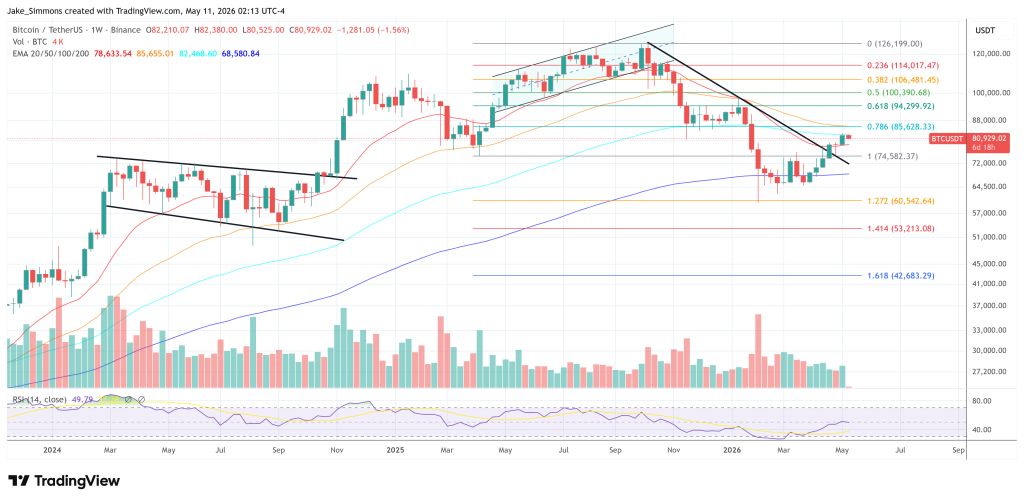
At press time, BTC traded at $80,929.
Related Articles
Trump Media’s Crypto Bet Implodes With Massive $406M Quarterly Loss
Trump Media & Technology Group’s stock now trades around $8.93. That n...

Strategy CEO Highlights Scenarios Where Company Would Sell Bitcoin — Report
Strategy CEO Phong Le has highlighted scenarios in which the company would offlo...
Bitcoin Leverage Returns In Force As Open Interest Surges Past 2025 ATH Levels
On-chain data shows Bitcoin’s latest price move to $80,000 has not been based of...

Is XRP Repeating A Setup That Once Led To 126% Rally? This Analyst Thinks So
The altcoin market has been one of the major losers in this bear market, with la...