Titagarh Rail: Freight Visibility Running Out, Supply Issues Persist – Is Shipbuilding A Risky Diversion?
Alex Smith
3 hours ago
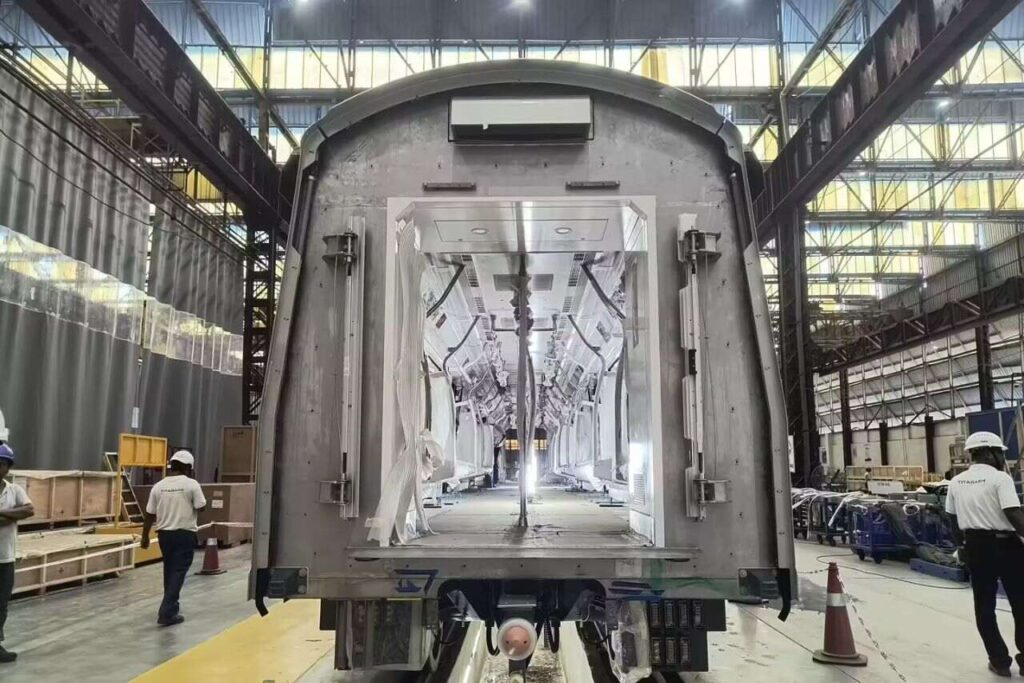
Synopsis: Freight visibility is weakening while passenger rail is becoming the main growth driver. At the same time, the company is entering shipbuilding and increasing investments. With multiple changes happening together, the key question is whether it can manage all this smoothly without putting pressure on its business?
Titagarh Rail Systems is now at an interesting turning point. The older freight wagon business is still giving the company near-term revenue visibility, but it is no longer the clean growth engine it once looked like. Wheelset disruptions have already hurt dispatches and revenue in FY26, and even CRISIL noted that the current wagon order book mainly supports execution till the first half of FY27. Beyond that, fresh ordering will matter a lot.
At the same time, the company is changing shape. Passenger rail now accounts for roughly 77 percent of the order book, and management has become much more confident that this side of the business could overtake freight in the next few years. So the big question is no longer whether Titagarh is still a wagon maker. The real question is whether it can manage three transitions at once: stabilising freight, scaling passenger, and entering shipbuilding.
Freight Still Gives Visibility, But It No Longer Gives Comfort
The freight business is not broken, but it is clearly under pressure. CRISIL said operating income during the first nine months of FY26 fell 17 percent year-on-year to Rs. 2,285 crore, mainly because of weak performance in the freight rolling stock segment amid wheelset supply issues. Wagon dispatches during that period also fell to 5,270 from 6,976 in the previous period. That is not a small operational issue. It is a real volume hit in the company’s legacy business.
Management’s commentary across Q2 and Q3 broadly supports that view. In Q2, it said wheelset availability had normalized from August 2025 and that the company had returned to a run rate of around 800 wagons a month, with a plan to stay around 800 to 850 wagons per month. But by Q3, the tone had become more cautious again. Management said there was another “seesaw” in wheelset availability, including a type mismatch between 840 diameter and 1,000 diameter wheels, which again affected the industry and Titagarh as well. It added that imports had started for private wagons, and trial production at the wheel JV was expected by March or April, though full stabilization could still take one to two quarters.
This is why the freight outlook needs to be read carefully. The company still has a meaningful order book here. Management said in Q2 that it had about 9,000 wagons in hand, giving visibility for around four quarters, while CRISIL said the present wagon order book should support execution till the first half of the next fiscal. The message is broadly the same: there is work in hand, but not enough to relax. New orders in the segment will be critical for plant utilisation after that window.
That matters because Titagarh has the capacity. Management repeatedly said the company is not constrained by freight manufacturing capacity and can produce up to 1,000 wagons a month. The problem is supply and order continuity, not installed capacity. So for investors, freight now looks like a business with decent medium-term demand potential, but weak short-term smoothness. The long-term argument remains tied to Indian Railways’ freight ambitions, yet the near-term earnings path depends on something much more basic: wheel availability and fresh tender flow.
Passenger Rail Is Becoming The Main Story
If freight is the business that is supporting the company right now, passenger rail is the business that could drive its future growth and value. The order book makes that very clear. As of December 31, 2025, Titagarh’s standalone order book stood at around Rs. 13,955 crore, of which passenger rail contributed about Rs. 10,791 crore, or 77.33 percent. Even excluding the JV share, this is now a passenger-led company on order mix.
Management has not been subtle about that shift. In Q3, it said passenger rail constituted almost 75 percent-plus of the order book on a standalone basis and that the passenger business could become the dominant part of the company in about one or two years. That does not mean freight disappears. It means freight may stop being the main driver of growth.
The operating trend is already moving in that direction. In Q3, management said passenger rail revenue rose from around Rs. 40-odd crore to around Rs. 160-odd crore, while EBITDA jumped from less than Rs. 5 crore to about Rs. 22 crore. Notably the passenger rail segment achieved its highest-ever turnover in the quarter, with revenue up about 237 percent year-on-year and segment profit up about 364 percent year-on-year.
The execution timeline also suggests that FY27 and FY28 could look very different from FY26. Gujarat Metro has already moved into series production. Bangalore is being executed continuously. Mumbai Metro is expected to start execution from Q3 of next financial year. Vande Bharat production has already started, with the first rake’s car bodies expected to be completed by March 2026 and the first train likely by Q3 of the coming financial year. Management also said the aluminium metro line should be completed by Q2 FY27, which will deepen backward integration and improve control over execution. In other words, freight may provide near-term base revenues, but passenger is where the scale-up is likely to come from.
The Rs. 1,000 Crore Capex Plan Is A Big Bet, But It Is Not Reckless Yet
The company’s next major move is capital spending. CRISIL said Titagarh has laid out a capex plan of Rs. 1,000 crore, largely aimed at the passenger rolling stock segment, with coach manufacturing capacity expected to rise from 300 to 850 coaches a year by March 2027. A part of the capex will also go toward the freight segment. Management reiterated on the Q3 call that the overall capex for passenger rail to achieve the projected production scale was about Rs. 1,000 crore.
That is a meaningful step-up, and it does come with balance-sheet consequences. CRISIL expects leverage and coverage metrics to moderate in FY26 because of weaker-than-expected operating performance and the extra debt taken to fund capex. It estimated net debt to EBITDA at around 0.8 times and interest coverage at around 5.2 times in FY26, compared with negative 0.2 times and 6.9 times in FY25. Still, the agency also said liquidity remains healthy, with cash and equivalents of about Rs. 530 crore as of December 31, 2025, and only moderate utilisation of the company’s fund-based limits. There is also a Rs. 200 crore warrant issue from promoters, of which Rs. 50 crore has already been received, with the balance expected before March 2027.
So the balance sheet is likely to become less comfortable than it was, but not yet uncomfortable. That is an important distinction. The capex is large, but it is being spent behind visible passenger orders rather than speculative capacity.
Firema Remains An Overhang, But It No Longer Looks Strategic
One overhang that investors should not ignore is Firema. CRISIL flagged current exposure in the form of investment value of around Rs. 113 crore, receivables of around Rs. 66 crore, and a Rajasthan land parcel with a book value of Rs. 157 crore provided as collateral to Firema’s secured lenders. It also said the exact write-offs were still being finalised and that these would negatively affect the financial risk profile.
Management’s position, however, is fairly clear. It has argued that the original objective of Firema was to transfer technology, know-how and credentials into India, and that this objective has largely been achieved. In Q2, management said Titagarh would continue to export from India rather than keep a manufacturing presence in Europe. In Q3, it said producing in Europe for Europe had not succeeded, the Italian business continued to make losses, and the Italian State Railways had made an offer to buy out the company. It also added that most of the worst-case scenario had already been disclosed and that much of the impact was non-cash. So Firema is still a financial clean-up issue, but it does not look like a strategic distraction anymore. The strategy has effectively moved on.
Shipbuilding Is Not A Random Idea, But It Is Still A New Risk
This is where the key question becomes important. Is shipbuilding a risky diversion? The answer is that it is risky, but it is not random. From the company’s filings, it is clear that shipbuilding is not being treated as a side business. Management in Q2, said it has already delivered more than 35 vessels over the years, including projects for the Indian Navy, Coast Guard, National Institute of Ocean Technology and GRSE, along with an export order to Guyana.
It also highlighted that the focus will remain on specialised vessels, typically in the 100 to 160 metre range, and that its Falta facility in West Bengal, which already has a jetty, could scale up to handle around 16 to 18 vessels annually. The current order book for this segment is around Rs. 500 crore, with a healthy enquiry pipeline, indicating that the business already has some base to build on.
What has changed now is the scale of ambition. Titagarh Naval Systems, the company’s wholly owned subsidiary, is planning a major expansion with an investment of around Rs. 550 crore. This includes setting up a new facility spread across 50 acres in West Bengal, along with a dry dock and slipway infrastructure. The key shift here is capability. With this expansion, the company aims to build larger vessels, including Medium Range tankers, which is a step up from its current positioning in specialised ships.
Importantly, this expansion is not happening in isolation. The project is being partly supported by a 25 percent capital subsidy from the Government of India under the Shipbuilding Development Scheme. In fact, the economics of the project itself improved because of this support. Without the subsidy, the company was initially planning only a smaller expansion focused on fabrication and slipway infrastructure. But with government backing, it has now added a dry dock of around 200 metres, which significantly increases its potential vessel size and overall capability.
This also fits into a broader government push towards strengthening domestic shipbuilding capacity. Management itself highlighted that the sector is receiving increasing policy emphasis So the macro logic is clear. India wants more domestic shipbuilding capacity, and Titagarh is positioning itself early in that cycle with both existing experience and fresh investment.
But the risk is also clear. Shipbuilding is capital intensive, execution heavy, and very different from rolling stock manufacturing. At the same time, Titagarh is already in the middle of a major transition in its core business, shifting from freight wagons to passenger rail. Adding another growth engine at this stage increases complexity.
So shipbuilding is not a random diversification. It is a calculated bet aligned with policy tailwinds. The real question is whether the company can scale this business without distracting from its much larger and more immediate opportunity in passenger rail.
So, Is It A Risky Diversion?
Yes, but only if management allows it to compete with the passenger ramp-up for capital, execution attention or balance-sheet flexibility. Right now, the filings suggest management is trying to prevent exactly that. The shipbuilding business has already been transferred to Titagarh Naval Systems, a separate vehicle, and management has explicitly said it wants that business to grow on its own, potentially with strategic or financial partners, rather than remain fully embedded inside the rail parent. That is the right structure if the goal is to capture upside without contaminating the core rail story.
For now, the bigger investment case is still rail. Freight has visibility only till H1FY27 and remains exposed to wheelset and tender timing. Passenger, on the other hand, has the order book, the capex roadmap, the execution ramp-up and the margin improvement pathway. Shipbuilding may become a valuable story later, especially if policy support in India accelerates the sector. But today, it should be seen as an option on future growth, not the core reason to own the stock.
That is why the real answer is: shipbuilding is a risk only if it becomes a distraction. If it stays ring-fenced while passenger rail scales the way management expects, it could instead become a second growth engine built on top of the first.
Disclaimer: The views and investment tips expressed by investment experts/broking houses/rating agencies on tradebrains.in are their own, and not that of the website or its management. Investing in equities poses a risk of financial losses. Investors must therefore exercise due caution while investing or trading in stocks. Trade Brains Technologies Private Limited or the author are not liable for any losses caused as a result of the decision based on this article. Please consult your investment advisor before investing.
The post Titagarh Rail: Freight Visibility Running Out, Supply Issues Persist – Is Shipbuilding A Risky Diversion? appeared first on Trade Brains.
Related Articles

Tata Steel Partners with Google Cloud for India’s Largest Industrial AI Rollout
Synopsis: In one of the largest industrial AI rollouts by an Indian company, Tat...

EV Stock Jumps 4% After Stake Dilution to 92.23% in Dutch Arm Post OCD Conversion
SYNOPSIS: Company approved $5.5 million OCD conversion in Netherlands subsidiary...
Steel Exchange India In Focus After ₹75 Cr Capital Infusion And ₹28 Cr Debt Reduction
Synopsis: Steel Exchange India Limited, which is experiencing major financial re...

Why did Shadowfax Technologies shares crash by 6% today? Check the reason
Synopsis: Shadowfax will unlock 35 million shares after three months, increasing...