What will happen if Donald Trump Chairs The US Federal Reserve?
Alex Smith
1 month ago
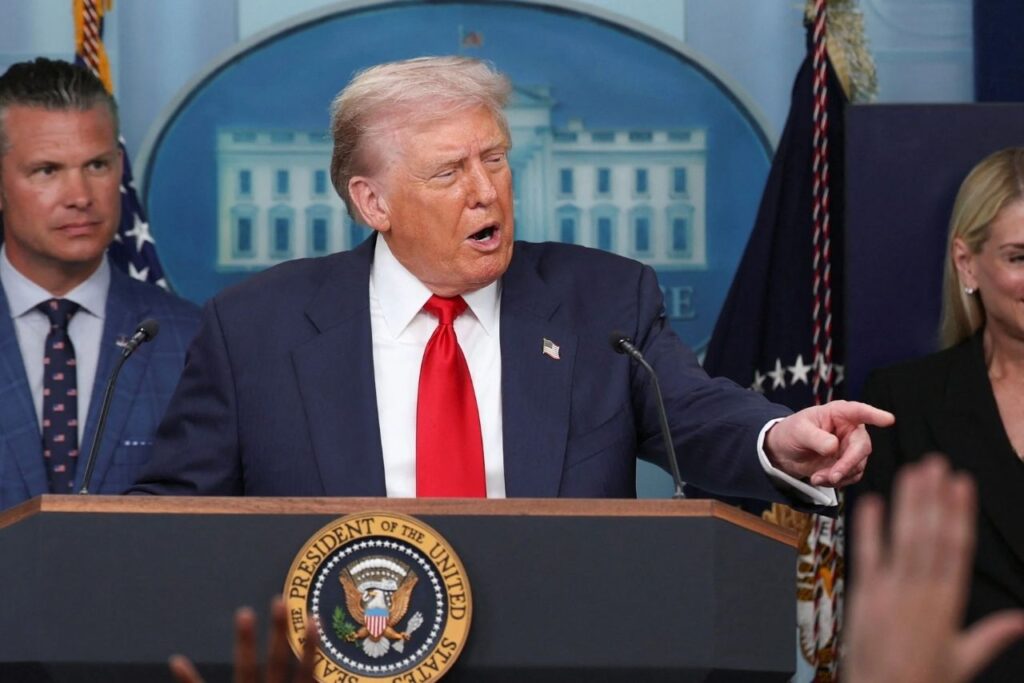
Synopsis: SBI’s hypothetical “Monetary Multiverse” explores how interest rates might change if personality, symbolism, and language shape policy instead of models. From a Trump-led Fed to RBI signals hidden in ties and speeches. Could perception matter more than data?
Imagine a world where interest rates are not decided by economic models or data, but by midnight tweets, personal instincts, and even the colour of a central banker’s tie. This is the idea behind SBI’s hypothetical report, which steps away from traditional thinking to explore how monetary policy might look in an alternate universe shaped more by behaviour and communication than by numbers.
What if Donald Trump, instead of Jerome Powell, had chaired the U.S. Federal Reserve, cutting rates not because inflation softened or growth slowed, but in reaction to market swings or headlines he disliked? And closer to home, could early signals on repo decisions be hidden in subtler cues like the RBI Governor’s wardrobe or the words used in speeches?
Through its “Monetary Multiverse,” SBI builds these scenarios to show how personality, symbolism, and language could influence how monetary policy is read and understood, even though all of it remains purely hypothetical.
What Would Happen If Donald Trump Took Over the Fed from Jerome Powell
In this alternate “monetary multiverse,” Donald Trump replaces Jerome Powell as the U.S. Federal Reserve Chair. SBI’s report constructs a counterfactual scenario to explore how monetary policy and public attention might have evolved under a Trump-led Fed.
Drawing on Trump’s well-documented preference for lower interest rates, the report models a “Trump-style” monetary policy by modifying the standard Taylor Rule, which is normally used to guide interest rate decisions based on inflation and economic output. In this version, the neutral real rate is set at a low 0.25 percent to reflect post-crisis natural rate estimates. The responsiveness to inflation is reduced, and the output gap (the measure of how far the economy is from full capacity) is ignored entirely. On top of this, the model subtracts an additional 100 basis points (1 percent) to capture Trump’s repeated calls for lower rates even during periods of economic expansion. According to Trump, as of June 7, 2025, the Fed has been too slow to reduce borrowing costs and should cut rates by a full percentage point.
Using this adjusted model, SBI finds that between 2018 and 2025, the Fed’s actual policy was consistently tighter than what a Trump-aligned approach would have recommended. In some quarters, conventional policy was 40–70 percent tighter, and in Q2 2022, it was 94.25 percent tighter. Under Trump’s hypothetical chairmanship, interest rates would immediately decline by 100 basis points, reflecting a much more accommodative stance.
The report also examines how Trump’s presence would affect public engagement with monetary policy. Using Google Trends data for Fed and interest-rate-related searches, SBI constructs a Trump Attention Score (TAS) to measure the increase in public interest. By applying a dynamic Trump Engagement Multiplier, which amplifies public attention in proportion to Trump’s media prominence, the analysis shows that weekly engagement with Fed decisions could rise by around 30 percent. In other words, not only would Trump cut rates, but the public’s focus on interest rate cycles would become significantly more intense under his leadership.
Overall, this scenario highlights two key effects of a Trump-led Fed: a sharp, 100-basis-point reduction in interest rates compared with current policy, and a notable surge in public attention toward monetary decisions, illustrating how personality and communication style can influence economic discourse even when technical mechanisms remain unchanged.
Wardrobe Becomes the Indicator for Repo Decisions
In this universe, interest rate decisions do not just respond to inflation or GDP forecasts. They follow something far more visual: the RBI Governor’s wardrobe. Specifically, the colour of the tie worn during Monetary Policy Committee announcements.
SBI’s report explores whether visual symbolism can act as a signalling mechanism in monetary policy communication. The idea is simple but unconventional. If central banking is as much about signalling as it is about models, could the Governor’s choice of necktie quietly reflect the tone of the policy decision?
To test this, the report examines the colours of ties worn during past MPC announcements and groups them into broader tone categories based on established psychological and visual perception theory. Warm tones include red, peach, coral, and orange. Cool tones include blue, light blue, aqua, and royal blue. Dark tones consist of black, black with silver, and dark blue. Mixed tones include colours such as purple and yellow.
Each policy decision is then numerically coded to allow comparison. A rate hike is assigned a score of 1, a hold is given 0, and a rate cut is marked as minus 1. Using this framework, SBI constructs the Tie Volatility and Tilt Index, designed to measure both the directional bias of each colour group and how consistently that colour is associated with a particular decision.
For every tone category, two scores are calculated. The Policy Tilt Score represents the average of the action scores and indicates whether a colour leans hawkish, dovish, or neutral. The Policy Volatility Score measures the standard deviation of these action scores, showing how consistently a particular tie colour is used for the same kind of decision. A low volatility score implies a stronger signal, while a high score suggests ambiguity. These two measures are combined into the Tie Volatility and Tilt Index, which adjusts the policy tilt by the consistency of its use.
The results reveal distinct patterns. Warm-coloured ties show a slightly hawkish tilt and are more likely to be associated with rate hikes. Cool-coloured ties appear neutral, most often coinciding with no change in rates. Mixed colours display the highest volatility, making them the least predictable, often followed by one policy outcome and then another. Dark-coloured ties stand out not for directional bias but for decisiveness. When dark tones are worn, a policy action is more likely to occur, regardless of direction.
In an increasingly uncertain world, this association becomes particularly striking. Dark tones have been linked with moments of clear decision-making, including the jumbo rate cut of 50 basis points in June 2025. While the model does not suggest causation, it highlights how visual cues may reinforce or accompany policy communication in ways that traditional economic models do not capture.
When Words Speak Louder Than Numbers
In this parallel monetary universe, policy signals do not emerge only from data points or rate formulas. They emerge from language. The words chosen by the central bank do not merely describe policy decisions; they begin to guide them.
The text analysis in the report shows that shifts in the RBI Governor’s vocabulary often mirror bigger changes in policy priorities. When references to “growth” start appearing more frequently than mentions of “inflation,” it reflects a clear rebalancing of focus within the central bank. These linguistic changes are not cosmetic. They tend to translate into policy action.
This pattern becomes visible through text mining and word cloud analysis, where the size of each word represents how often it appears in the Governor’s speeches. As terms like “growth” grow larger relative to “inflation,” the visual itself signals a change in emphasis. Such shifts have historically been followed by changes in policy stance, including the jumbo rate cut of 50 basis points in June 2025. In the June policy communication alone, the word “growth” was mentioned 24 times, underscoring the pivot in priorities.
The post What will happen if Donald Trump Chairs The US Federal Reserve? appeared first on Trade Brains.
Related Articles

Why did KPIT Technologies share crash up to 29% in one month?
Synopsis: KPIT Technologies Limited shares fell nearly 29% in a month amid Europ...

Solar Industries, Caplin Point and 6 other stocks delivering back-to-back EPS growth
Synopsis: Stocks like Solar Industries, Waaree Energies, and Navin Fluorine and...

Will Max Financial share price cross ₹2,000 after announcing robust Q3 results?
Synopsis: Max Financial gains after robust Q3 performance; Jefferies reiterates...

Angel One Vs Groww: Which stockbroker performed better in Q3?
Synopsis: Angel One and Groww delivered contrasting performances in Q3 FY26. Ang...