Who Won Survivor 50? Kalshi Traders Picked Aubry Early, Raising Insider Trading and Spoiler Concerns
Alex Smith
2 hours ago
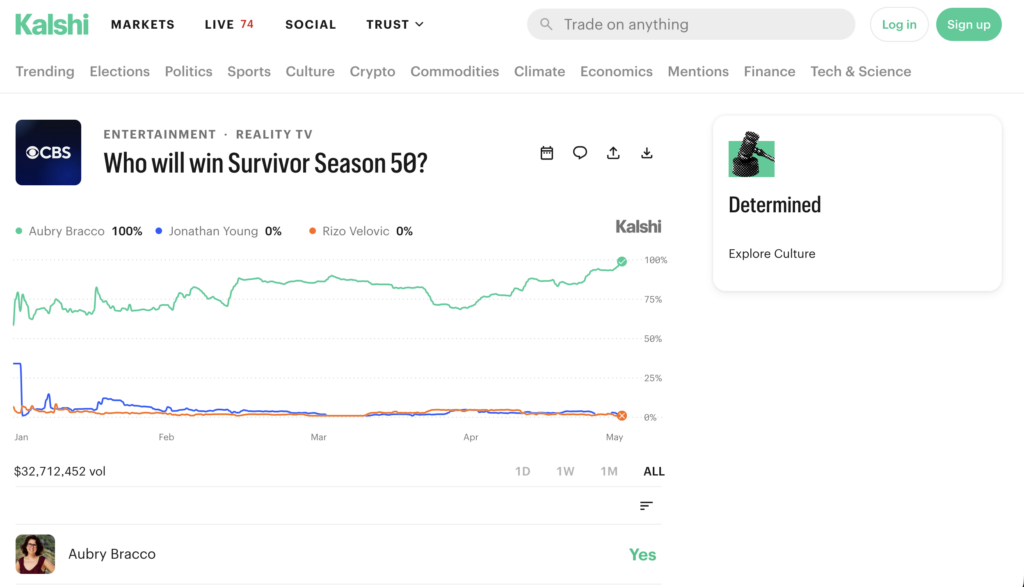
Kalshi traders had effectively settled on the winner of Survivor 50 before viewers saw a single episode. Aubry Bracco was trading around 75% to win the day after Kalshi’s winner market opened Jan. 10, more than six weeks before the season premiered Feb. 25. By finale day, Bracco was priced at 98% to win, with Joe Hunter and Jonathan Young at 1% each.
Bracco won the season Wednesday night, turning Kalshi’s Survivor 50 slate into one of the clearest examples yet of how prediction markets can track reality television outcomes before the public sees them unfold.
The winner market was only one piece of a much larger Survivor 50 board. Kalshi search results surface more than 30 Survivor 50 market groups throughout the season, with visible notional trading volume topping $40 million. The markets covered the season winner, final vote count, second- and third-place finishers, episode eliminations and words spoken by host Jeff Probst or contestants.
That accuracy is now drawing attention beyond the market results themselves. Some Survivor fans and market observers have questioned whether lopsided pricing reflected public spoiler chatter or inside information known to people connected to the show before episodes aired.
Kalshi says it has not found evidence so far that large-position traders in Survivor markets had relationships with the show or CBS. Robert DeNault, Kalshi’s head of enforcement, said Thursday that the company continues to investigate insider trading in Survivor markets, but that thousands of traders likely took early positions based on rumors.
“Public rumors don’t equal insider information,” DeNault wrote.
Winner market drove most Survivor 50 volume
The winner market carried most of the Survivor 50 trading volume and set the tone for the rest of Kalshi’s season-long markets.
The winner market showed about $32.7 million in volume by the time it resolved, making it by far the largest Survivor 50 market on the platform. Bracco’s price moved at points during the season, but traders consistently treated her as the likely winner.
That made the final week less about whether Bracco would win and more about how the rest of the results would break. Kalshi’s vote-count market pointed to a decisive outcome, with the market for the winner receiving more than seven jury votes heavily favored before the finale. The market for more than eight votes was closer to even, giving traders one of the few remaining toss-up questions on finale day.
Bracco ultimately won with eight (of 11) votes.
Kalshi also added separate second- and third-place markets the day before the finale. Those markets were far smaller than the winner market, but they pointed to the final order. Jonathan Young was the heavy favorite to finish second in a market showing about $182,000 in volume, while Joe Hunter was the favorite to finish third in a market showing volume of about $114,000.
Both markets resolved in line with the projections.
The episode-level markets followed the same pattern throughout the season. Kalshi listed elimination markets tied to individual episodes, along with mention markets on what Probst or contestants would say during broadcasts. Some of those markets drew six-figure volume, showing that traders were active not only on the season outcome but on details from individual episodes.
Kalshi’s Survivor markets were accurate last season, too, but this year brought a much bigger audience. Savannah Louie was the heavy favorite for much of the duration of Kalshi’s Survivor 49 winner market before winning that season, with the market attracting about $2.36 million in volume. Survivor 50’s winner market was nearly 14 times larger.
Kalshi says it has not found insider trading evidence on Survivor markets
The concern around Kalshi’s Survivor market accuracy stems from the show’s production timeline. While the three-hour Survivor 50 finale aired live, the season itself was filmed in Fiji months earlier. According to TV Insider, Probst announced that filming had started June 6, 2025, and production wrapped by June 30. That was more than six months before Kalshi opened its winner market and nearly eight months before the season premiered.
That does not mean traders had inside information. But it explains why the market’s accuracy drew scrutiny. By the time viewers watched the season unfold, key outcomes may have already been known to contestants, production staff, editors, network employees or others connected to the show.
Kalshi’s enforcement team had addressed those concerns before Bracco’s win. In March, Robert DeNault, Kalshi’s head of enforcement, wrote on X that the company was investigating markets tied to aliens, Survivor and The Bachelorette. He said large positions, accurate trading or online rumors do not automatically mean traders are using inside information.
“Just because someone has a large position in a market or traders follow rumors online does not mean they’re insider trading,” DeNault wrote.
On Aliens, Survivor, and The Bachelorette (so far).
— robertjdenault (@robertjdenault) March 19, 2026
TL;DR: Just because someone has a large position in a market or traders follow rumors online does not mean they’re insider trading. Aliens, Survivor, and Bachelorette markets – we’re investigating all of them, and so far, we…
DeNault acknowledged that pre-taped shows create an obvious information gap.
“Pre-taped shows mean that people have knowledge of what happens before the show airs — including contestants and production staff,” he wrote. “But they typically sign legal documents preventing them from telling people — otherwise, shows would constantly be spoiled for everybody. Using that information for profit is not allowed.”
At the time, DeNault said Kalshi had looked into the Survivor markets and had not found definitive evidence of insider trading.
“We’ve been checking backgrounds of traders in this market and have not identified anyone with any connection to Survivor,” he wrote.
He said Kalshi’s review pointed to a less direct explanation. Traders appeared to be following public rumors, copying early trades or making their own research-based calls, DeNault wrote.
DeNault updated his X followers Thursday after Bracco’s win, saying Kalshi was still reviewing trading in Survivor markets but had not changed its conclusion.
“We continue to investigate insider trading in Survivor markets, but the below still holds true: so far, no traders with large positions seem to have a relationship to the show or to the network,” DeNault wrote. “Thousands of traders took early positions consistent with the outcome, likely because of public rumors.”
Update: we continue to investigate insider trading in Survivor markets, but the below still holds true: so far, no traders with large positions seem to have a relationship to the show or to the network. Thousands of traders took early positions consistent with the outcome, likely… https://t.co/yF77b2VaAI
— robertjdenault (@robertjdenault) May 21, 2026
The questions come as trading based on nonpublic information has become a recurring flashpoint for prediction markets, though much of the recent attention has focused on geopolitical and news-driven markets on offshore platforms.
Kalshi has announced enforcement actions of its own this year, including cases involving politicians trading on election markets and a trader tied to MrBeast-related markets. The MrBeast case is the closest parallel for Survivor because it also involved markets tied to media content before the public knew the outcome. In that case, Kalshi said the trader worked for a source agency connected to the underlying YouTube videos and had material nonpublic information about how those markets would resolve before trading.
Kalshi odds become part of spoiler debate
The lopsided markets also became part of the Survivor fan conversation.
On Reddit, some users warned others not to look at Kalshi because the markets appeared to give away the season’s direction before episodes aired. One post in a Survivor fan forum was titled, “PSA: Do NOT go on Kalshi, I think I may have just had the winner spoiled for me.” The user wrote that one contestant had “overwhelming odds” and warned others not to have their “experience ruined” the same way.
Other posts also treated Kalshi odds as part of the spoiler ecosystem. In a separate Reddit thread, a user questioned why Aubry was above 70% on Kalshi and Polymarket before the show had aired, asking whether there had been “a leak” they were missing. Another Reddit user in the Kalshi forum asked why Bracco had an 80% chance before the show had even started and wondered whether it was a glitch.
It was not the first time entertainment prediction markets had drawn spoiler concerns. Polymarket odds were displayed during the Golden Globes broadcast earlier this year, drawing mixed reactions from some viewers who argued the prices could reveal award outcomes before they were announced.
Pre-taped shows pose harder market questions
Those reactions point to a wider concern about certain entertainment markets, which can look less like forecasts when they involve shows that have already been filmed, edited or seen by people before the public broadcast.
Prediction market journalist Dustin Gouker made that point on X in response to discussion of the Survivor markets, writing that he does not understand why prediction markets allow trading on “things that already happened.”
I really don’t understand why prediction markets allow betting on things that already happened. Actually kind of bizarre. https://t.co/lSI5Xmjgf1
— Dustin Gouker (@DustinGouker) May 21, 2026
That concern has surfaced around other entertainment and media markets. HBO host John Oliver made a similar point on Last Week Tonight after prediction markets listed contracts on what words he would say during the show. Because Last Week Tonight tapes before it airs, Oliver noted that studio audience members could theoretically trade with advance knowledge of the outcome. Jimmy Fallon did a bit on The Late Show Wednesday night around the same idea, with a member of his band pretending to cash in on Fallon calling prediction markets “gambling.”
MS NOW host Chris Hayes raised a related concern in a January Instagram video after traders bet on what he would say during a taped Late Show with Stephen Colbert appearance.
View this post on Instagram
For platforms, that creates a difficult line to police. Public rumors can move markets, but taped shows also create pockets of people who may know the answer before the public does. Survivor 50 showed how quickly those two realities can blur.
The post Who Won Survivor 50? Kalshi Traders Picked Aubry Early, Raising Insider Trading and Spoiler Concerns appeared first on DeFi Rate.
Related Articles
Who Won Survivor 50? Kalshi Traders Picked Aubry Early Despite ‘No Evidence’ of Insider Trading
Aubry Bracco was priced as a heavy favorite weeks before the season aired, while...
Inside the First Polymarket Private Valuation Markets for OpenAI, SpaceX and Anthropic
The contracts use Nasdaq Private Market data and give traders a public way to sp...
Interactive Brokers Expands Prediction Markets with Kalshi, CME Group Integration
IBKR’s new prediction markets interface gives its clients one place to access, c...
Markets Aren’t Buying AOC‑Backed Rabb Surge in PA-03 Democratic House Primary
Pennsylvania’s 3rd Congressional District Democratic primary isn’t just a local...