Why Bitcoin Can’t Be Explained By A Single Economic Cycle
Alex Smith
2 hours ago
Bitcoin’s price is often framed as the result of one dominant factor, whether it’s the halving cycle, macro liquidity, or speculative demand, and this view misses the deeper reality of how the asset actually trades. BTC exists within a complex economic environment where multiple forces act simultaneously, each influencing price in different ways.
When Bitcoin Cycles And Macro Cycles Overlap
Multiple interacting processes shape Bitcoin and the broader business cycle, and the dynamics are more complex than a single narrative. Crypto analyst Giovanni has highlighted on X that the FOMO halving narrative had heavily driven the early BTC cycle, and the social feedback loop matters. At the same time, the Purchasing Managers Index (PMI) also exhibited a 4-year periodicity, and this does not mean the BTC halving cycle was irrelevant.
These two cycles are interacting, and that interaction is precisely what needs to be quantified and understood, rather than dismissed with hand-waving explanations. Giovanni emphasized that the halving cycle is still real for miners and never disappeared. Block rewards are reduced on a fixed schedule, and that mechanical change directly impacts miner economics.
By extension, these effects propagate into the broader BTC economy in one form or another. The explanation is not credible if the pendulum swings from “the 4-year cycle is an illusion” to “the 4-year cycle halving cycle explains everything.” Replacing one oversimplified story with another doesn’t improve understanding; it just shifts the blind spot.
There are solid mathematical tools designed to study cycle coupling, phase alignment, and interaction effects. Giovanni argues that applying these tools is the right path, and doing so is unlikely to produce a new simple narrative. What will likely emerge is a richer structure, where internal and external cycles interact in nontrivial ways.
How The Model Estimates Up And Down Outcomes
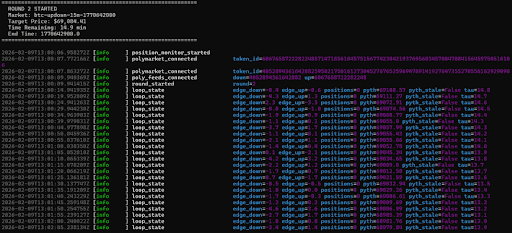
An analyst known as The Smart Ape pointed out on X about developing a theoretical probability model to estimate Bitcoin’s up and down price outcomes in the 15-minute markets on Polymarket. The model is intentionally simple, calculating probabilities by using the target price, the current BTC price, and the remaining before the market round closes.
What stood out most was how closely the theoretical outputs matched real market probabilities. The difference between the market prices and model probabilities was consistently within a narrow 1-5% range, suggesting that the model tracks actual market behaviour with remarkable accuracy.
Related Reading: Top Analyst Says ‘Paper Bitcoin’ Is Driving The Market, Not The 21 Million Supply Cap
In this market, probabilities are directly set by traders, which clearly shows how bot-dominated these markets are and are driven by logical rules and algorithms. The Smart Ape argues that if the market were primarily driven by human traders, real probabilities wouldn’t align this tightly with a theoretical model.
Related Articles
How Much Would You Have If You Put $500 In Bitcoin In 2014 Vs. XRP?
XRP and Bitcoin (BTC) were pitted against each other in a recent analysis, with...

Ethereum Whale Selloff Continues As Supply Share Drops Under 75%
On-chain data shows the Ethereum wallets with more than 1,000 ETH have reduced t...
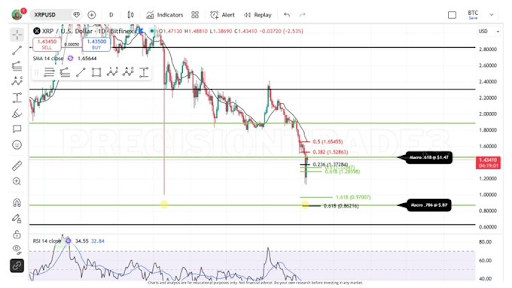
Analyst Wans XRP Price Could Crash Below $1 If Bitcoin Reaches This Level
Crypto analyst TARA has predicted that the XRP price could still crash below the...
UNI Rallies 10% As BlackRock Brings Treasury‑Backed BUIDL Token To Uniswap
Uniswap’s native token, UNI, posted a sharp gain on Wednesday after the world’s...