Why Ethereum Has Become One Of The Most Heavily Shorted Assets Globally
Alex Smith
2 hours ago
Across global markets, Ethereum has emerged as one of the most heavily shorted assets, a positioning that reflects more than simple bearish sentiment. It signals a growing divergence between market expectations and ETH’s long-term fundamentals, placing the asset at the center of an increasingly complex macro and structural narrative.
How Ethereum Short Interest Now Rivals Commodities Like Silver
Ethereum is currently one of the most heavily shorted assets in the world, approaching the scale of traditional commodities like Silver. An analyst known as DGMD.6529 on X revealed that over the past 21 months, institutions have reportedly acquired roughly $21 million in ETH per day, amounting to approximately $11.8 billion through ETFs alone.
Beyond that, firms such as Bitmine and Sharplink, along with other digital asset treasuries (DATs), have collectively acquired an additional $10-15 billion outside ETF channels. DGMD.6529 argues that the global financial system is undergoing a structural shift. Banks and financial institutions are increasingly realizing that survival in the next era requires moving on-chain and integrating Decentralized Finance (DeFi) infrastructure.
In that transaction, ETH remains the dominant platform for both DeFi and real-world assets (RWAs), with a moat that continues to expand. Its advantage lies in credible neutrality and reliability, while speed and cost continue to improve rapidly with mainnet scaling.
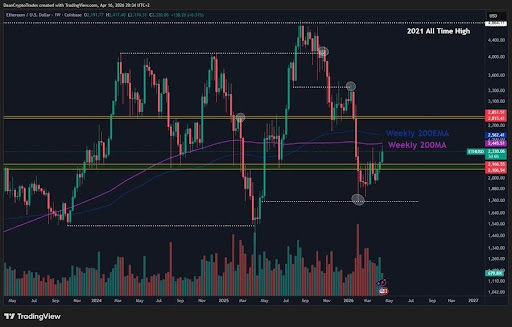
From a market structure perspective, ETH is still trading in the bottom half of a 5-year consolidation range that has persisted since 2021. Meanwhile, its product-market fit and narrative strength have never been stronger. It has been treading water, waiting for the world to be ready for mass tokenization and smart contract utilization, which is already in place.
Sharing insights on price action, Crypto analyst Daan Crypto Trades has highlighted that Ethereum is currently at a critical technical juncture as it retests its weekly 200 moving average (200MA).
Earlier this year, during the sharp January sell-off, ETH lost this key level. The move mirrors a similar breakdown seen last year during the period of heightened volatility surrounding tariff-related market uncertainty, where prices also experienced a sharp downside reaction. Daan noted that the focus shifts to whether bulls can reclaim this level as support, with ETH revisiting this weekly 200MA.
Ethereum’s Validator Lead As A Long Decade Advantage
According to Everstake, Ethereum is the number one leading network in validator distribution. With an estimated 921,500 validators, ETH operates at a scale that clearly sets it apart from the rest of the market. While other networks continue to evolve and optimize for their own priorities, ETH’s strength lies in its breadth of participation in securing the network.
Everstake pointed out that this level of distribution reinforces one of the core principles of blockchain decentralization, long-term resilience, and security. In many ways, the validator scale has increasingly become one of the clearest indicators of network maturity, and in this regard, ETH remains the reference point.
Related Articles
The Hidden FVG Zone That Says Ethereum Price Could Rally To $10,000
Ethereum has started to show signs of life again after weeks of muted price acti...

13 Years Of Data Says Bitcoin Price Has Not Bottomed Yet, Analyst Explains The Trend
Bitcoin is now printing green candlesticks on the weekly and daily timeframes, a...
Bitwise Research Shows How Much Loss Your Bitcoin Incurs Depending On How Long You Hold
Bitwise Research has shed light on how holding durations can impact the ROI and...
Dogecoin Breakout Mirrors Past Trend — Bigger Move Coming?
Dogecoin is showing signs of history repeating itself as a recent breakout begin...