Will Data Centres Turn Mumbai Into India’s Next Pollution Hotspot?
Alex Smith
3 hours ago
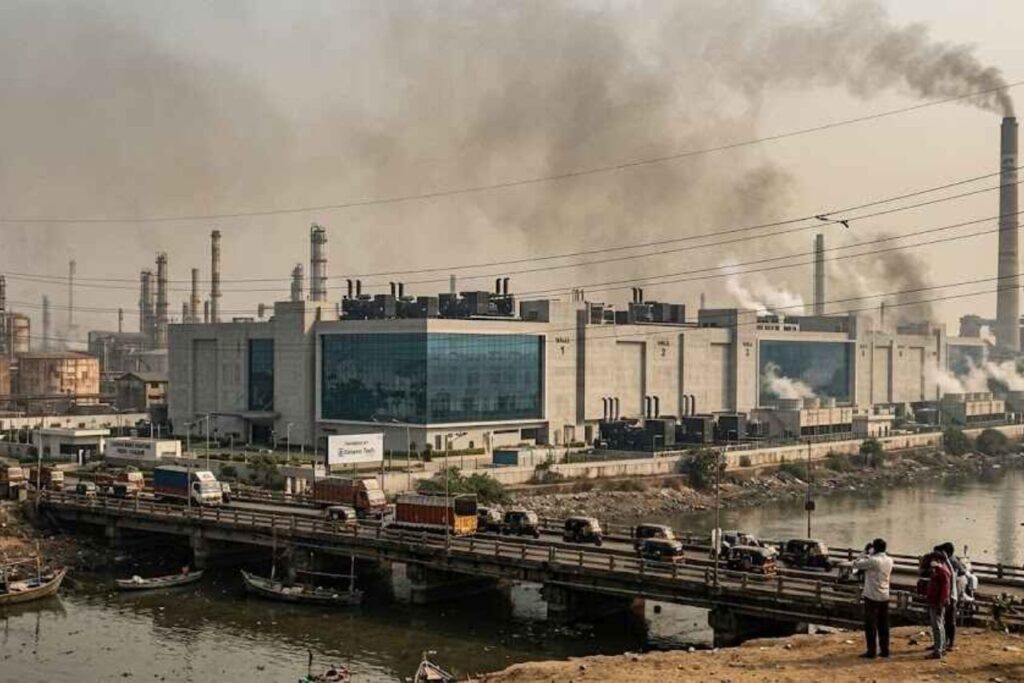
Synopsis: Mumbai’s fast-growing data centre boom is bringing new challenges alongside digital growth. Rising demand for power and water is starting to put pressure on the city’s already stressed infrastructure. As expansion continues, questions are emerging about whether this growth could quietly create bigger environmental risks in the future.
Mumbai is rapidly emerging as the centre of India’s booming data centre industry, with global technology companies and developers racing to build massive server farms across the city and its surrounding regions. These facilities power everything from cloud computing to artificial intelligence, forming the backbone of the modern digital economy.
However, their rapid expansion is also raising difficult questions about the environmental cost of this growth. Data centres require enormous amounts of electricity and water to operate, and as more of them are built in and around the city, concerns are beginning to grow about their impact on Mumbai’s already stressed infrastructure and environment. Could the city’s digital boom also bring a new wave of pollution risks?
Why Mumbai Became India’s Data Centre Capital
Mumbai’s dominance in India’s data centre industry is closely linked to its global connectivity infrastructure. According to Abhishek Lodha, Managing Director and Chief Executive Officer of Lodha Developers Ltd, nearly half of India’s total data centre capacity is concentrated in Mumbai largely because the city hosts several undersea cable landing stations that connect India directly to global digital networks.
These submarine cables link Mumbai with major internet routes across the Middle East, Europe and Southeast Asia, allowing data to travel faster between regions. Lodha explained that the current latency, or the time taken for data to travel between India and Europe, stands at roughly 140 to 150 milliseconds and could fall to around 120 milliseconds with further infrastructure investment.
Similarly, data traffic between India and the United States currently travels through Europe, resulting in latency of about 220 to 240 milliseconds, but improvements in connectivity could reduce this to nearly 170 milliseconds. Lower latency improves the speed of digital services and makes India a more attractive location for large-scale computing activities such as artificial intelligence training workloads.
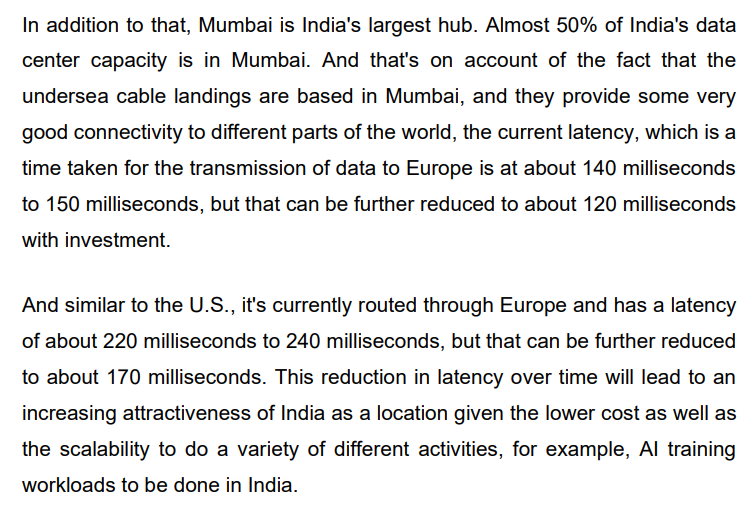
Source: Lodha-Q2FY26 Earnings Conference Call Transcript
According to CBRE South Asia, Mumbai accounted for about 53 percent of India’s total operational data centre capacity of nearly 1,530 megawatts as of September 2025, highlighting the city’s central role in the country’s digital infrastructure.
One example of the scale of expansion underway is Lodha Developers’ integrated data centre park in Palava, Navi Mumbai. The company is developing the project on roughly 400 acres of contiguous land that already has the required approvals and infrastructure. This land parcel forms part of a larger 4,000-acre site owned by the company, with the broader campus designed to support nearly 3 gigawatts of data centre capacity.
The project has already attracted interest from global operators. Amazon has acquired land within the park and secured power supply arrangements for the next fifteen years, while Singapore-based STT Global Data Centres has also taken a parcel within the development. As more hyperscale operators establish campuses in the Mumbai-Navi Mumbai corridor, the region is increasingly becoming the core hub of India’s rapidly expanding data centre industry.
The Power Problem Becoming an Air Problem For Mumbai
Mumbai’s rapidly expanding data centre industry is also raising concerns about electricity demand and its environmental consequences. Data centres require uninterrupted power to run servers continuously, and as more facilities are built, the pressure on the city’s electricity infrastructure is increasing.

This growing demand comes at a time when Mumbai is already dealing with serious air pollution concerns. According to Maharashtra health minister Prakash Abitkar, a cancer screening campaign conducted by the public health department detected 1,677 patients across the state. The findings indicated that rising pollution levels in Mumbai are contributing significantly to lung cancer, which accounts for about 57 percent of diagnosed cases.

Source: https://www.aqi.in/in/dashboard/india/maharashtra/mumbai/historical-analysis
Investigations by SourceMaterial and The Guardian suggest that the rapid expansion of data centres is already influencing energy decisions in the region. Two coal plants operated by Tata Group and Adani Group were scheduled to shut down as part of efforts to reduce emissions. However, these plans were reversed in late 2023 after companies argued that electricity demand was rising too quickly for Mumbai to operate without them. Rising energy demand from data centres was cited as one of the key reasons for extending the plants’ operations.
As a result, the Maharashtra government extended the life of Tata’s coal plant in Mahul by at least five years and also postponed the shutdown of a 500-megawatt power station operated by the Adani Group north of the city. Even with these plants continuing to operate, the city’s power grid is facing growing strain.
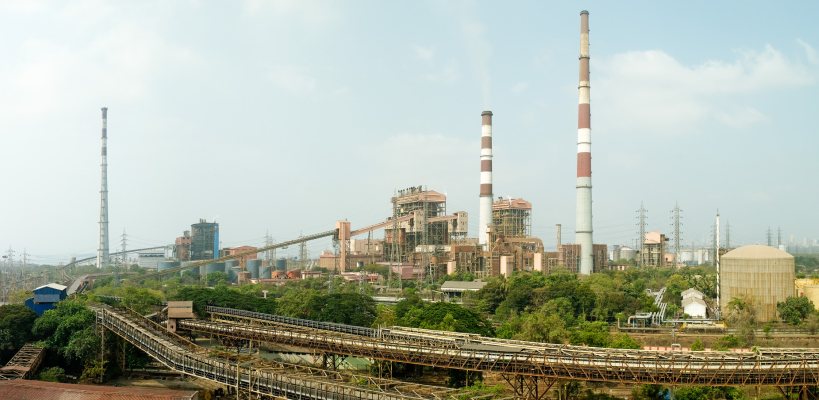
The scale of electricity consumption linked to data centres is already significant. Leaked records reviewed by investigators show that Amazon’s colocation data centres in Mumbai used around 624,518 megawatt hours of electricity in 2023, enough to power more than 400,000 Indian households for a year. While Amazon publicly lists three “availability zones” in the Mumbai metropolitan region, internal records indicate the company operates around 16 facilities through a mix of owned and leased data centre spaces.
Because uninterrupted power is essential, data centres also rely heavily on backup diesel generators to prevent outages. Documents show that Amazon’s facilities in Mumbai have already purchased 41 diesel generators and are seeking approval to install more. One site located across Thane Creek from Mahul hosts 14 generators, and another project has received permission to install 12 additional units.
Researchers warn that these backup systems could worsen air pollution in the region. A report from the Center for Study of Science, Technology and Policy (CSTEP) identified diesel generators as a major source of emissions. Air quality specialist Swagata Dey noted that the presence of large data centres relying on diesel backup systems could further increase pollution unless cleaner energy sources such as solar power are adopted.
The problem is compounded by the industrial environment surrounding Mumbai’s power infrastructure. The Mahul area, where one of the extended coal plants operates, already hosts three oil refineries and sixteen chemical factories. A 2019 report by India’s Centre for Policy Studies described the neighbourhood as a “toxic hell” because of its high concentration of polluting industries.
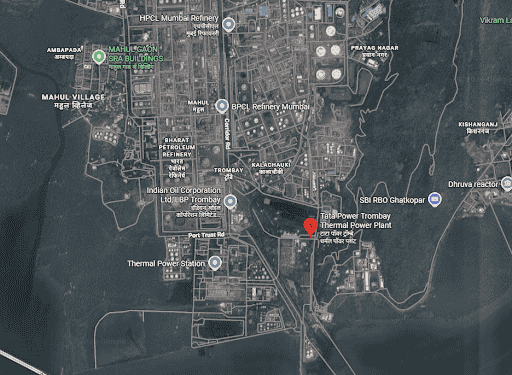
Coal-based power generation itself is a major contributor to air pollution. According to Raj Lal, chief air quality scientist at the World Emission Network, the Mahul Tata power plant is one of the key sources of pollution in Mumbai. Studies by the Centre for Research on Energy and Clean Air estimate that the plant contributes nearly one-third of local PM2.5 pollution levels. These extremely fine particles can enter the lungs and bloodstream, increasing the risk of respiratory and cardiovascular diseases. Environmental experts also warn that toxic heavy metals present in coal ash can lead to respiratory illnesses, kidney problems, skin disorders and heart-related complications.
Despite the known environmental risks, pollution control technology is still not widely installed across Maharashtra’s coal power plants. Flue Gas Desulfurization (FGD), which removes harmful sulfur dioxide emissions from exhaust gases, has been installed in only a small number of facilities. As of July 2025, just 10 out of the state’s 70 coal-fired power plant units had implemented FGD systems, and none of the state-owned plants had adopted the technology.
Air quality data already shows the pressure building across the state. Monitoring by the Central Pollution Control Board found that between January and June 2025, 17 cities in Maharashtra exceeded the national PM2.5 standard of 40 micrograms per cubic metre, while all 31 monitored cities exceeded the PM10 limit of 60 micrograms per cubic metre.
Research also shows that pollution from power plants can travel more than 200 kilometres, spreading emissions across large regions. Studies by IIT Delhi estimate that power plants contribute up to 7 percent of PM2.5 pollution in Maharashtra, while city-level research by IIT Bombay suggests the power sector accounts for between 8 percent and 74 percent of particulate pollution in cities under the National Clean Air Programme. Maharashtra currently has 19 cities included in this programme.
As data centres continue expanding across Mumbai and Navi Mumbai, their rising electricity demand is becoming part of a much larger environmental challenge, raising questions about how the city will balance digital growth with air quality and public health.
The Water Problem With Data Centres
While electricity demand often dominates discussions around data centres, their water usage is another growing environmental concern. Large data centres rely heavily on cooling systems to prevent servers from overheating. Many of these facilities use evaporative cooling, a method that removes heat by evaporating water. At first glance this process appears clean because the main byproduct is water vapor, but the reality is more complicated.
According to an article from Data Center Knowledge, chemicals used inside cooling systems can mix with the water during the cooling process. Small amounts of these chemicals may then leave the system through excess liquid that is periodically drained from the cooling equipment. This wastewater can contain substances such as biocides used to control bacteria and algae, corrosion inhibitors like phosphates that protect system components, and trace heavy metals including copper, zinc, or occasionally lead that come from the gradual wear of metal equipment.
While these chemicals are usually present in small quantities, the enormous volumes of water used by data centres can amplify their environmental impact. In some cases, wastewater from cooling systems is not routed through municipal treatment plants but discharged into nearby lakes, streams or groundwater systems, where contaminants may enter local ecosystems.
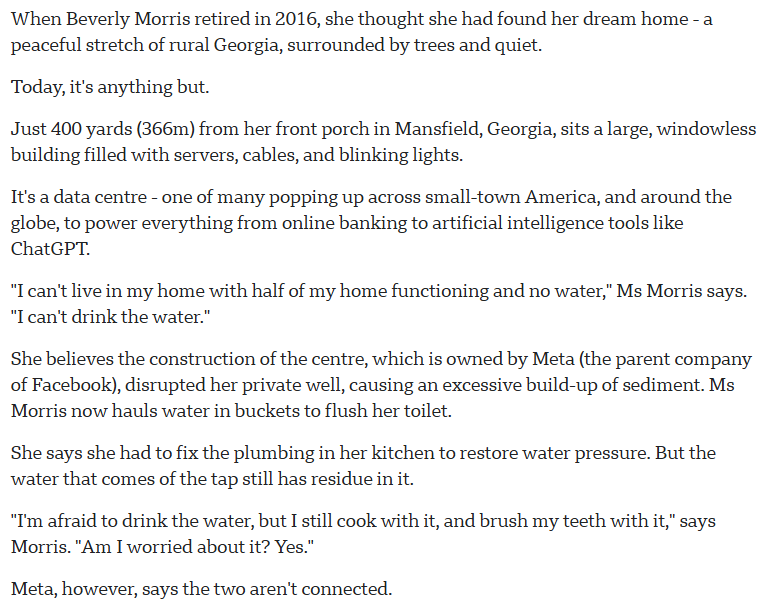
Concerns about water impacts have also emerged in communities located near data centre developments. A report by the BBC highlighted the experience of Beverly Morris, a resident of Mansfield, Georgia, whose home is located about 400 yards from a large data centre owned by Meta. Morris believes construction of the facility disrupted her private well, causing excessive sediment buildup and water pressure problems in her home. She now hauls water in buckets to flush her toilet and says the tap water still contains residue. Meta has denied any connection between the facility and the groundwater issues, stating that an independent study found no evidence that the data centre affected local groundwater conditions.
Source: https://www.bbc.com/news/articles/cy8gy7lv448o
Environmental groups say the concerns extend beyond individual cases. Gordon Rogers, executive director of the nonprofit Flint Riverkeeper, pointed to sediment runoff from nearby data centre construction sites as a potential source of water contamination. A water sample collected near a new facility being built by Quality Technology Services appeared cloudy and brown, suggesting possible sediment runoff and the presence of flocculants, chemicals used during construction to prevent soil erosion but which can form sludge if they enter waterways. While companies say their facilities meet environmental standards, local residents often argue that communities ultimately bear the environmental consequences.
Similar tensions have emerged in other regions where data centres compete with existing water needs. In Arizona, large data centre projects have been criticized for competing with agriculture in water-scarce areas, potentially affecting crop production and increasing costs for farmers. In South Carolina, environmental groups opposed a permit that allowed Google to draw up to 1.5 million gallons of water per day, arguing that the project prioritised technology infrastructure over local water security. Across parts of the American West, where drought conditions already affect millions of people, critics say the cooling demands of data centres could further strain rivers and underground aquifers.
Even proposed solutions such as recycling water come with challenges. According to Shashank Palur, a hydrologist with the Urban Water program at WELL Labs in Bengaluru, recycling and reuse can reduce freshwater demand but only if water quality standards are carefully maintained. Poorly treated reclaimed water can cause corrosion, scaling and microbial growth in cooling systems, making it difficult for operators to rely on recycled sources without proper treatment.
Industry players acknowledge the need for clearer guidelines. Yotta Data Services has said that India’s upcoming national Data Centre Policy should establish clear standards for non-potable water use, wastewater recycling and cooling efficiency so that the expansion of digital infrastructure does not compromise local water security.
As data centres continue to expand in major urban hubs, the debate over their water footprint is becoming increasingly important. The challenge is not just about how much water these facilities consume, but also how their cooling systems interact with surrounding ecosystems and local water supplies.
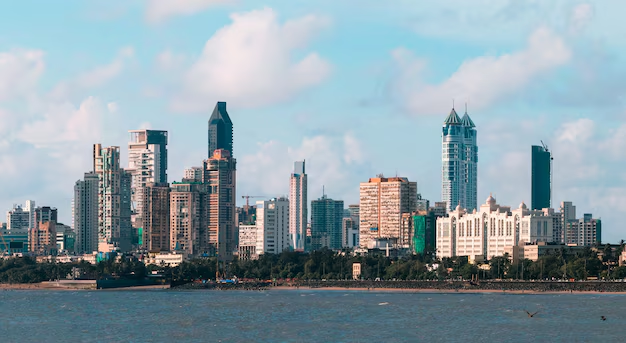
The risks could become even more serious in Mumbai as data centre construction continues to grow rapidly, especially within urban areas close to residential zones. When large facilities that use huge volumes of water operate near the city, any wastewater discharge or contamination could affect nearby water sources. The scale of upcoming projects also raises concerns. Lodha Developers, for example, is building one of India’s largest data centre campuses in Palava, just outside Mumbai. As more such large facilities are developed around the city, there are growing questions about how their cooling systems, wastewater management and water usage could affect Mumbai’s already stressed water resources.
Disclaimer: The views and investment tips expressed by investment experts/broking houses/rating agencies on tradebrains.in are their own, and not that of the website or its management. Investing in equities poses a risk of financial losses. Investors must therefore exercise due caution while investing or trading in stocks. Trade Brains Technologies Private Limited or the author are not liable for any losses caused as a result of the decision based on this article. Please consult your investment advisor before investing.
The post Will Data Centres Turn Mumbai Into India’s Next Pollution Hotspot? appeared first on Trade Brains.
Related Articles

Ashish Kacholia Stock with Revenue CAGR Guidance of 20% in the next 5 Yrs to Add to Your Watchlist
Synopsis: Megatherm Induction Limited targets strong growth with revenue reachin...

Paint Stocks to Buy Now for an Upside of 42%; Recommended by Macquarie
SYNOPSIS: Rising crude oil prices are pressuring paint companies’ margins, promp...

Mankind Pharma and 9 Other Stocks Trading Near 52-Week Lows to Keep on Your Radar
Synopsis: BSE 500 stocks, Petronet LNG, Mahanagar Gas, SBI Cards, Lodha Develope...

Infra Stock in Focus After Securing Order for 1,125 MW Hydropower Project in Bhutan
Synopsis: Patel Engineering’s shares jump after securing a BTN/INR 230.70 crore...