Will India’s Data Centre Boom Put Your Home’s Power and Water at Risk?
Alex Smith
2 hours ago
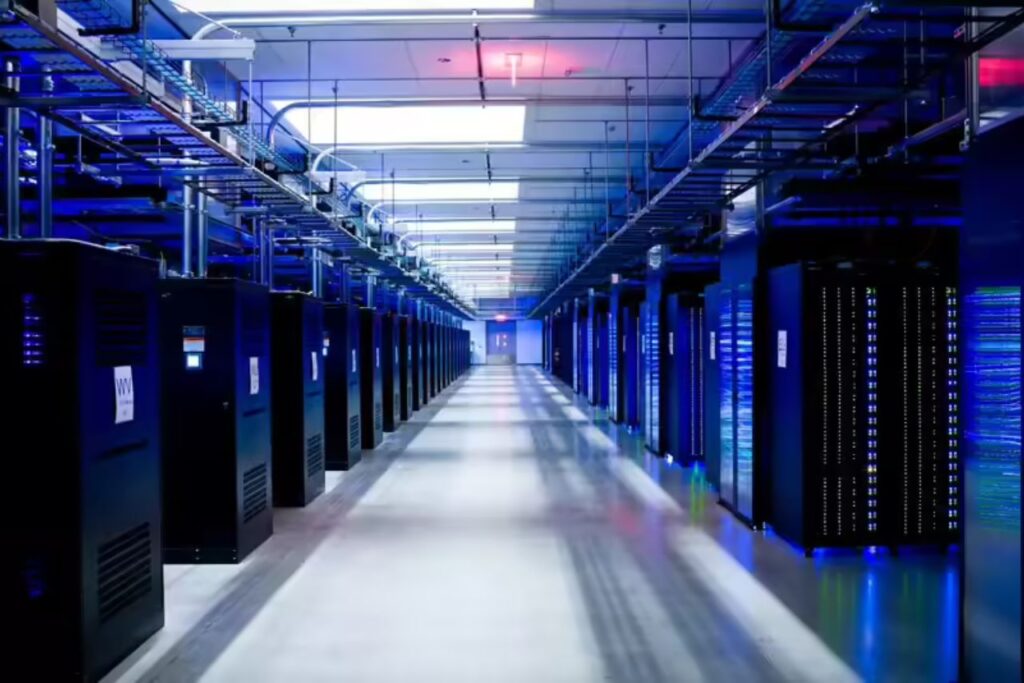
Synopsis: India’s rapid data centre expansion is driving investment and digital growth, but it also raises concerns around rising electricity demand, increasing water usage, and long-term sustainability. As infrastructure scales up, questions are emerging about whether this growth could strain essential resources and impact everyday access to power and water.
India’s data centre industry is entering a strong growth phase, supported by both government policy and rising global demand for digital infrastructure. In the Union Budget 2026-27, the government introduced a major incentive to attract global cloud and data centre companies by offering a long-term tax benefit. Under this proposal, foreign companies that set up and operate data centres in India, and meet the required conditions, can avail a tax holiday that extends all the way till 2047.
While presenting the Budget on February 1, Finance Minister Nirmala Sitharaman highlighted the need for robust digital infrastructure and large-scale investment in data centres. She stated that foreign companies providing cloud services to global customers through data centres located in India would qualify for this tax exemption, making India an increasingly attractive destination for such investments.
According to Morgan Stanley, the country’s installed capacity is expected to grow from around 1.8 gigawatts in FY26 to nearly 10.5 gigawatts by FY31. This expansion is likely to trigger an investment cycle of about USD 60 billion over the next five years. The sector also offers relatively strong returns, with data centre yields estimated between 13 percent and 16 percent, which is higher than office real estate yields of around 10 percent to 11 percent.
The Power Problem
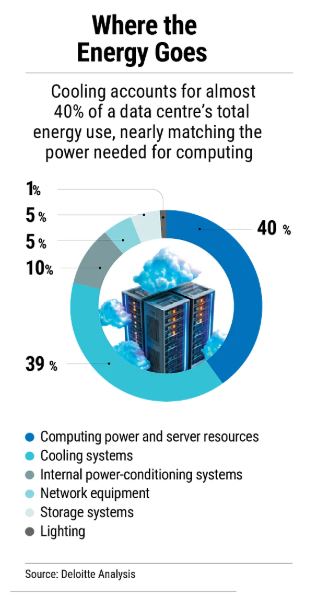
Data centres are not just storage facilities, they are massive consumers of electricity. According to the International Energy Agency, nearly 60 percent of a data centre’s total electricity consumption is used to power servers that store and process data. This demand becomes even more intense in AI-focused hyperscale facilities. These centres use advanced chips capable of performing trillions of calculations every second, and compared to traditional systems, they require two to four times more electricity. As artificial intelligence expands, energy demand does not rise gradually, it increases sharply.
The concern is not just how much electricity is being used, but also where it is being consumed. Data centres are often concentrated in specific regions, which puts pressure on local power grids. This issue is already visible globally. According to data from Ireland’s energy system, data centres accounted for about 22 percent of the country’s electricity consumption in 2024, leading to restrictions on new grid connections. In the United States, according to industry estimates, data centres consumed around 183 terawatt-hours of electricity in 2024, with some states seeing them use more than a quarter of local supply. Similar challenges are emerging across the Asia-Pacific region and the Netherlands, where rapid expansion is facing grid capacity limits and transmission constraints.
According to NITI Aayog, the share of data centres in India’s total electricity demand is expected to increase from about 0.8 percent to around 2.5 to 3 percent by 2030. While this may appear small at a national level, the impact is much higher locally. In states like Maharashtra, Tamil Nadu, Karnataka and Telangana, peak electricity demand could rise by 5 to 20 percent due to concentrated data centre clusters.
According to a Financial Express report, India’s data centres currently consume around 10 to 15 terawatt-hours of electricity, and this is expected to rise to 40 to 45 terawatt-hours by 2030. One terawatt equals 1000 gigawatts, which can power hundreds of thousands of homes.
As India builds large data centre hubs from Navi Mumbai to Visakhapatnam, this concentrated demand is adding pressure on a power system already dealing with ageing infrastructure, renewable integration challenges and transmission bottlenecks. If regulators and developers fail to plan capacity and build adequate transmission networks, it could lead to major blackouts, especially since India operates on a unified national grid.
As Sunil Gupta, Managing Director and Chief Executive at Yotta, said, “With so many data centres coming up in these regions, the load on transmission lines and substations has become extremely high. This is the same phenomenon seen in Ashburn, US and in Singapore, where rapid concentration of data centres ran up against local grid constraints.”
Some steps are already being taken to address this issue. In February, according to company announcements, Nxtra, the data centre arm of Bharti Airtel, partnered with AmpIn Energy and Amplus Energy to set up captive solar and wind power projects of 48 megawatts direct current and 24.3 megawatts for its facilities in Tamil Nadu, Uttar Pradesh and Odisha. Similarly, according to company disclosures, AdaniConneX has secured sustainability-linked financing worth 1.44 billion dollars to fund renewable-powered data centres.
However, these green efforts have limitations. According to NeevCloud’s Sen, most data centres are currently able to meet only 25 to 30 percent of their energy needs through renewable sources, as renewable power is time-bound and weather-dependent, while data centres require continuous and uninterrupted electricity supply.
The scale of consumption is already becoming significant. According to a report from The Guardian, Amazon’s Mumbai colocation data centres used 624,518 megawatt-hours of electricity in 2023, which is enough to power over 400,000 Indian households for a year. According to S&P, India is expected to overtake Japan and Australia to become the second-largest data centre electricity consumer in the Asia-Pacific region. By 2030, according to Ankit Saraiya, Chief Executive of Techno Electric Engineering, data centres could consume nearly one-third of Mumbai’s total electricity.
According to Mint, India’s AI-driven data centre expansion could require an additional 40 to 45 terawatt-hours of electricity by 2030, up from 10 to 15 terawatt-hours in 2024. Deloitte also highlights the scale of this shift, noting that while a traditional data centre consumes around 5 to 10 kilowatts per rack, AI-focused racks can require at least 10 to 15 times more power.
Debasish Mishra, Chief Growth Officer at Deloitte South Asia, said that large data centre clusters could each consume around 2 gigawatts of power continuously. This level of demand can significantly change the electricity consumption profile of entire regions and states, and since India operates a fully integrated national grid, the impact can extend across the country.
The Water Problem
Along with electricity, water is becoming a critical and often overlooked challenge in India’s data centre expansion. According to industry estimates, water consumption by data centres in India is expected to rise sharply from around 150 billion litres in 2025 to about 358 billion litres by 2030. This increase is especially concerning because most data centres are concentrated in major urban clusters such as Mumbai, Hyderabad, Chennai and Bengaluru, where water demand is already high.
The broader context makes this issue even more serious. According to the World Bank, India has about 18 percent of the world’s population but only 4 percent of its water resources, making it one of the most water-stressed countries globally. Adding large-scale industrial water demand on top of this imbalance could further strain already limited supplies.
A major part of water usage in data centres comes from cooling systems. After servers, cooling is the second largest energy-consuming component inside a facility. In highly efficient hyperscale centres, cooling accounts for around 7 percent of total energy use, while in less efficient setups it can exceed 30 percent. As workloads from artificial intelligence and cloud computing increase, heat generation rises, making cooling systems even more essential. Traditional air-based cooling systems use air conditioning, fans and ventilation, and typically support up to 20 kilowatts per rack, or about 35 kilowatts in more advanced setups. However, as computing density increases, many facilities are shifting to liquid-based cooling methods such as immersion cooling and direct-to-chip cooling, where liquids are used to absorb and remove heat more efficiently.
This cooling demand directly translates into large-scale water usage. According to a study by Deloitte, a 1 megawatt data centre requires about 68,500 litres of water every day. A larger 20 megawatt facility would need around 1.4 million litres daily, which is equivalent to the daily water consumption of about 27,000 families. India’s total data centre capacity has already grown significantly, from about 520 megawatts in 2020 to around 1.5 gigawatts by mid-2025, further increasing total water demand.
According to researchers at the University of California, Riverside, generating a simple 100-word AI response can lead to the evaporation of around 519 millilitres of water from cooling systems. While this may seem small, the impact multiplies significantly as billions of such interactions happen globally every day.
Global trends also highlight how large this issue can become. According to a 2024 Berkeley Lab report commissioned by the U.S. Department of Energy, data centres in the United States directly used about 17 billion gallons of water in 2023, with hyperscale and colocation facilities accounting for 84 percent of that total.
In India, the situation is already becoming visible in certain regions. According to a report by the Times of India, Bengaluru’s rapid data centre expansion is adding pressure to an already strained water system. Karnataka IT Minister Priyank Kharge stated that out of 32 operational data centres in the state, 31 are located in Bengaluru, with 10 more in the pipeline. Areas like Whitefield, Electronics City, Navarathna Agrahara, Bidrahalli and Bidadi are emerging as major hubs. However, Bengaluru faces a unique challenge. Unlike coastal cities, it does not have direct access to large water sources or submarine cable infrastructure. This means water often has to be transported over long distances, even as the city struggles to meet basic drinking water needs.
Local concerns are also growing in other parts of the country. In Visakhapatnam, according to statements by HRF leaders Y. Rajesh and VS Krishna, the expansion of data centre projects could worsen existing water stress caused by groundwater depletion, erratic rainfall and climate variability, potentially diverting water away from local communities.
Similarly, according to a report by Down to Earth, residents of Tusiyana village in Uttar Pradesh have already experienced declining groundwater levels near a large data centre project. Villagers reported that water, which was earlier available at depths of 20 to 30 feet, now requires digging up to 80 feet. The area relies primarily on groundwater, and further expansion is planned after Uttar Pradesh signed a Rs. 39,000 crore agreement with Yotta to build six more data centres over the next seven years.
Experts also warn that the problem could worsen in specific regions. Groundwater specialist and IIT Kharagpur professor Abhijit Mukherjee told The Telegraph Online that South Indian cities are likely to face the greatest impact due to relatively lower groundwater availability compared to other parts of the country.
Another key concern is the lack of policy focus. According to Sahana Goswami of WRI India, current regulations around data centres cover areas such as data protection, zoning and energy use, but water consumption is not adequately addressed. She described this as a major gap that could pose risks to the long-term sustainability of these facilities.
Overall, as India’s data centre capacity continues to expand, the water required to support this growth is rising rapidly. In regions that are already struggling with water availability, this could create a direct conflict between industrial demand and basic human needs.
Conclusion
As India pushes aggressively to become a global data centre hub, the pressure is beginning to show across cities, infrastructure, and natural resources. Large-scale projects, especially in regions like Visakhapatnam, are raising serious concerns. According to HRF representatives Y. Rajesh and VS Krishna, such developments in hot climates will require highly water-intensive cooling systems, which could further deplete groundwater levels and even risk contamination through chemical discharge. They also highlighted that a one-gigawatt data centre can consume as much electricity as a mid-sized city with lakhs of homes, placing additional strain on already stressed power grids.
They further questioned the sustainability claims made by companies, stating that operating such massive facilities entirely on renewable energy is not practically feasible. Since renewable power is intermittent, these data centres still depend heavily on fossil fuel-based backup during peak demand, leading to high carbon emissions and weakening their so-called green positioning. It is because of these combined pressures on water, energy and the environment that communities across the world have started opposing similar data centre projects, even those smaller in scale than the ones being planned in India.
The economic argument is also being questioned. According to HRF representatives, these projects are often presented as drivers of jobs and growth, but the actual employment generated is limited. Referring to global examples, they pointed out that Google’s data centres in Ashburn and Leesburg employ only around 400 people directly, despite creating about 3,100 indirect jobs. Similarly, Meta’s large AI data centre project in Louisiana, which involves an investment of 10 billion dollars, is expected to generate only around 500 permanent jobs. This highlights a clear gap between the scale of investment and the level of direct employment created.
At the same time, India’s policy approach is shaping how this growth will benefit the economy. By offering long-term tax breaks to foreign cloud companies while requiring them to route services through local structures, the system risks turning India into a “digital toll booth.” While this may bring in investment, it could also mean that the country earns limited value from a rapidly expanding digital ecosystem, without building strong global technology players of its own.
Taken together, the picture is becoming harder to ignore. India’s data centre boom is not just about digital growth, it is about how that growth is powered and sustained. As demand for electricity rises and water resources come under increasing stress, the burden may not remain limited to infrastructure alone. It could begin to affect everyday access to power and water in the very cities that are hosting this expansion.
The question is no longer whether India can build more data centres. The real question is whether it can do so without quietly passing the cost of that growth onto its own people.
Disclaimer: The views and investment tips expressed by investment experts/broking houses/rating agencies on tradebrains.in are their own, and not that of the website or its management. Investing in equities poses a risk of financial losses. Investors must therefore exercise due caution while investing or trading in stocks. Trade Brains Technologies Private Limited or the author are not liable for any losses caused as a result of the decision based on this article. Please consult your investment advisor before investing.
The post Will India’s Data Centre Boom Put Your Home’s Power and Water at Risk? appeared first on Trade Brains.
Related Articles

Meesho Eyes 440 Million Users with 29% GMV Growth; Is This a Buying Opportunity?
Synopsis: Brokerage turns bullish on Meesho, citing strong growth outlook, impro...
Top Defence stocks to benefit from ₹2.38 Lakh Cr Defence Acquisition Council approvals
Synopsis: Brokerages turn bullish on defence stocks after DAC approves Rs 2.38 l...

Markets vs Geopolitics: How key Nifty indices have performed since the US-Iran conflict
SYNOPSIS: Geopolitical tensions since 28th February have pressured Indian market...

Oversold Zone: Hyundai Motor and 9 other stocks trading at RSI Level below 30
Synopsis: Hyundai Motor, Ashok Leyland, Cipla, HDB Financial Services, PTC Indus...