Retail Capitulation Hits AAVE, But Smart Money Starts Positioning: Here The Post-Crisis Market Structure
Alex Smith
2 hours ago

Aave entered April 2026 as DeFi’s most trusted lending protocol. It is ending the month navigating the most damaging crisis in its history — one that did not require a single line of its own code to be broken.
The attack began at Kelp DAO, where an attacker exploited a vulnerability in the rsETH bridge to drain approximately $292 million in stolen tokens. What followed was not an isolated protocol incident. The attacker deposited the stolen rsETH as collateral on Aave V3 and borrowed against it. Using fraudulent assets to extract real ones. Because Aave had accepted rsETH as legitimate collateral, the protocol had no mechanism to reject the deposits in real time. By the time the damage was visible, between $170 million and $230 million in bad debt had accumulated inside the system.
The market’s response was immediate and severe. Users who had previously trusted Aave with their assets moved to withdraw. TVL fell by billions of dollars as confidence drained alongside the liquidity. The AAVE token, already under pressure from previous contributor departures, collapsed to $93.90.
The protocol’s own smart contracts were never compromised. Its reputation, its liquidity, and its price were. In DeFi, where trust is the product, the distinction between a direct exploit and a collateral-triggered crisis offers less comfort than it might appear.
Retail Is Selling. Whales Are Watching. The Bottom May Be Forming
A CryptoQuant report tracking AAVE’s market structure on Binance reveals a picture that tells two different stories depending on which participants you are watching.
The first story belongs to retail. Exchange reserves have surged sharply — a significant increase in AAVE being deposited onto Binance. Reflecting holders moving to the sell side at scale. The average spot order size has plunged to approximately $80 to $100, confirming that the selling activity is dominated by small participants reacting to the crisis rather than large holders making strategic decisions. When average order sizes collapse to that level, it reflects fear-driven liquidation rather than informed distribution.
The second story is more nuanced. Amid the flood of small sell orders, big whale orders are appearing sporadically in the bottom zone — large, deliberate positions being tested at current price levels by participants whose behavior is the opposite of the retail panic surrounding them. These orders are not consistent or sustained enough to confirm a bottom. They are present enough to suggest that informed capital is beginning to evaluate the current level as an entry rather than an exit.
Liquidity on Binance remains thin, which means selling pressure can move price more easily than it would in a deeper market. The conditions for a bottom are assembling gradually — retail exhaustion visible in the order size data, whale positioning visible in the sporadic large orders. Neither signal is definitive yet. Together, they describe a market in the early stages of transition from crisis to potential recovery.
AAVE Stabilizes After Capitulation, But Trend Remains Fragile
AAVE is attempting to stabilize around the $90–$100 range following a sharp capitulation phase that reset price structure across the chart. The breakdown in February marked a decisive loss of trend, with price collapsing through multiple support levels and accelerating into a high-volume selloff. That move established the current range as a post-crisis consolidation zone rather than a confirmed bottom.
Since then, price action has shifted into compression. AAVE is trading below all major moving averages, with the 50-day acting as immediate resistance and the 100-day and 200-day trending downward above it. This alignment reflects a market still structurally bearish despite the short-term stabilization.
The recent bounce attempts have lacked follow-through. Sellers reject each push toward the $105–$110 region, keeping supply active on rallies. At the same time, buyers absorb the downside near the $85–$90 zone, stepping in more consistently. This creates a tightening range, typically a precursor to expansion.
Volume behavior supports this interpretation. The capitulation spike has not been matched by equivalent buying pressure, indicating that accumulation, if present, is gradual and not aggressive.
A break above $110 would be the first meaningful shift in structure. Until then, AAVE remains in a fragile equilibrium.
Featured image from ChatGPT, chart from TradingView.com
Related Articles
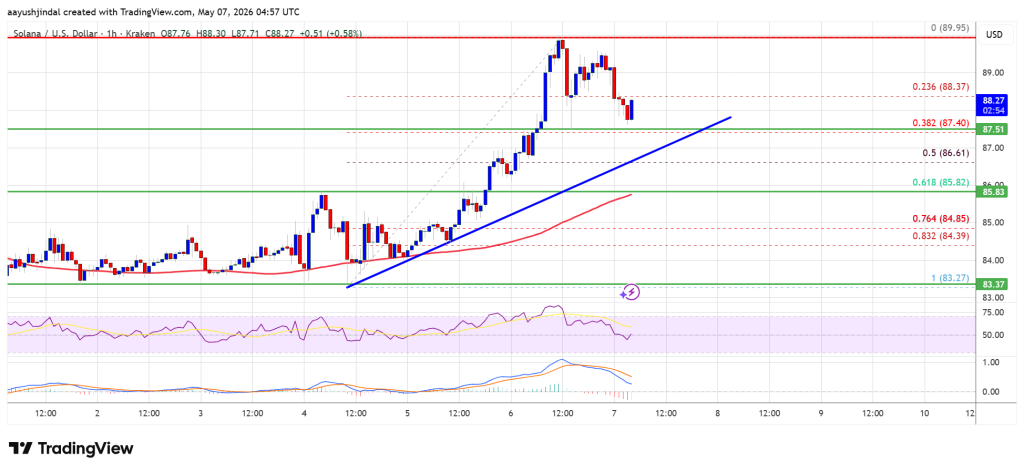
Solana (SOL) Strength Improves, $90 Resistance Keeps Traders Cautious
Solana started a fresh increase above the $86 zone. SOL price is now consolidati...
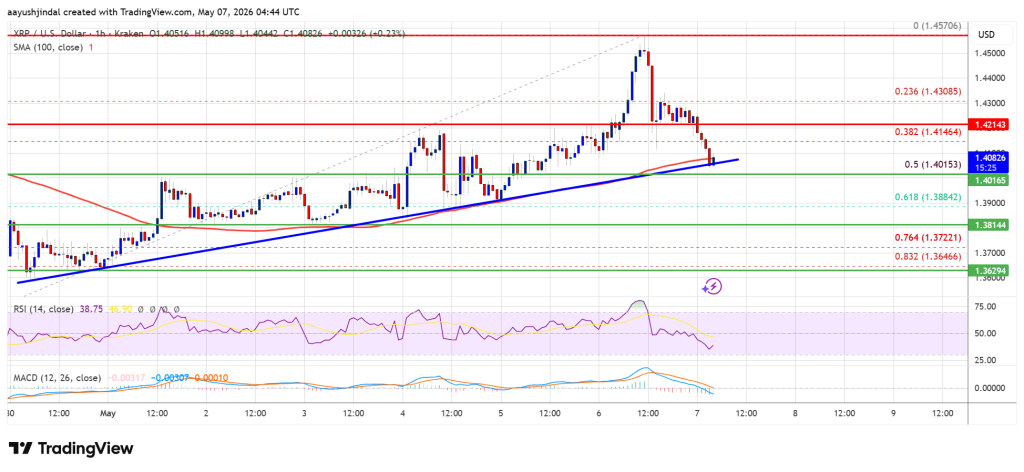
XRP Price Weakens Further, Sellers Tighten Grip On Trend
XRP price started a downside correction from the $1.4550 zone. The price is now...

Solana Sees Rising Social Hype, Yet Network Activity Is Falling
Data shows social media sentiment around Solana has been rising recently, but ne...
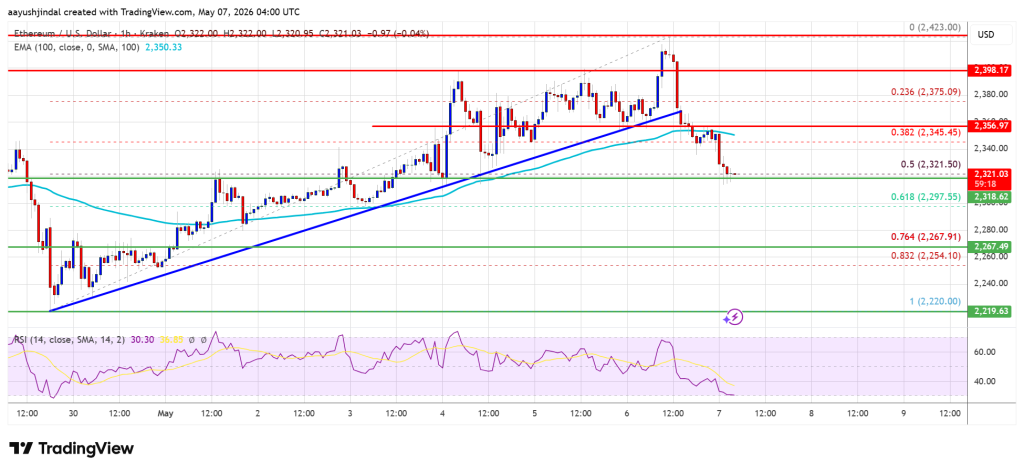
Ethereum Price Struggles To Hold Strength, Downside Risks Build
Ethereum price started a fresh increase and remained stable above $2,380. ETH is...