CMS Info Systems Share: Can SBI, HDFC and ICICI Wins Drive Revenue and Margin Growth?
Alex Smith
2 hours ago
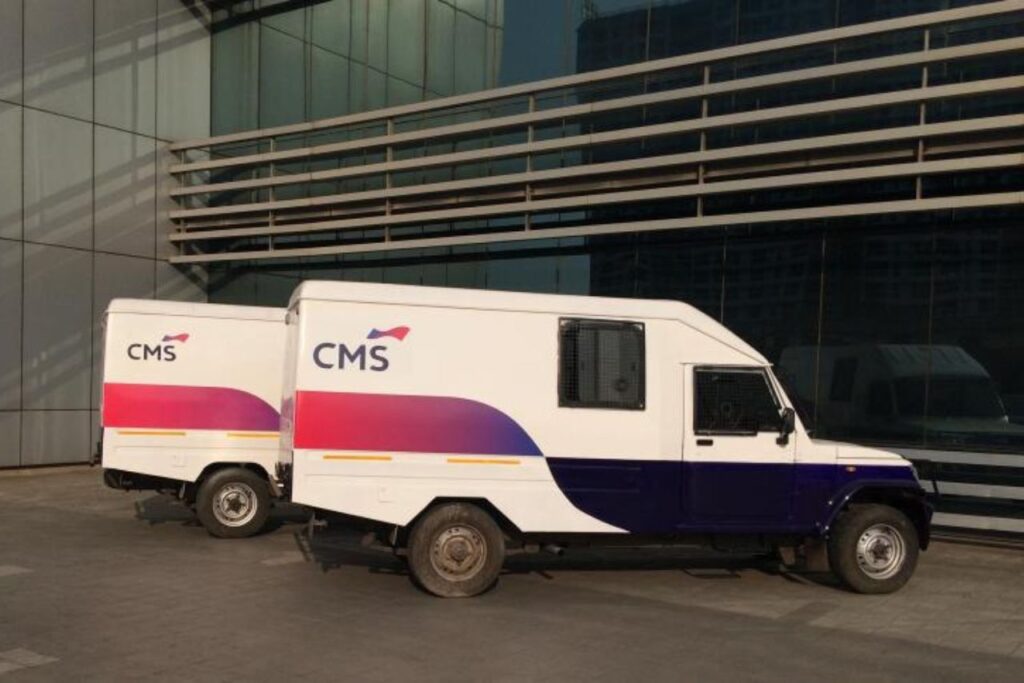
Synopsis: CMS Info Systems Limited faced a difficult FY26 due to delayed contracts, weak consumption and ATM industry disruption, but Q4 margin recovery, large SBI, HDFC and ICICI Bank wins, fixed-fee contracts and rapid growth in AI-led technology businesses could support stronger revenue growth and profitability recovery in FY27.
CMS Info Systems Limited entered FY27 after a challenging year marked by delayed contracts, slowing ATM industry growth and margin pressure. However, the company is now attempting to reposition itself through large banking contracts, fixed-fee outsourcing models and expansion into AI-driven technology and payment solutions businesses.
With major wins from SBI, HDFC Bank and ICICI Bank, a Rs 2,000 crore order book and improving Q4 margins, CMS is targeting stronger revenue growth and margin recovery while transforming beyond traditional cash logistics services. With a market cap of Rs 5,000 crore, the shares of CMS Info Systems Ltd are trading at Rs 306 and are trading at a PE of 16.2 compared to their industry’s PE of 20.3.
FY26 became a reset year for CMS Info Systems
CMS Info Systems Limited had begun FY26 with high growth expectations, but it turned out to be a “hard year” for the company. This was due to the many disruptions that the company had faced, such as consumption slowdowns, delays in the SBI cash outsourcing deal, contraction in the offsite ATM market owing to the exit of AGS, and abnormal wage increases related to long-term settlements with employees.
The management had estimated that all these disruptions combined resulted in a revenue loss of almost Rs 150 crore in FY26 service revenues. The biggest disruption for the company came from the SBI cash outsourcing deal. The company had made huge investments in routes and infrastructure in preparation for the deal, but the process kept getting delayed from February to April and later to December, resulting in an estimated revenue loss of Rs 100 crore for the year.
On top of that, the company faced weak consumption due to adverse weather and geopolitical situations, which resulted in low cash flows and reduced ATM transactions by an estimated Rs 25 crore. Despite these headwinds, CMS still reported FY26 revenue of Rs 2,487 crore, up 3% year-on-year, while services revenue grew 6% to Rs 2,312 crore.
However, profitability remained under pressure. EBITDA declined 5% to Rs 600 crore, while profit after tax fell 20% to Rs 303 crore. EBIT margins contracted sharply from 19.2% in FY25 to 15.6% in FY26, reflecting the impact of operating deleveraging, higher wage costs and revenue disruption.
Q4 recovery signals that margins may have bottomed out
Despite FY26 proving to be another difficult year, management repeatedly highlighted the fact that Q3 was the bottom for margins and that recovery had commenced in Q4. According to CMS, revenue from services witnessed a 6% increase on a quarter-on-quarter basis during Q4 FY26, with total revenue of Rs 633 crore in the quarter.
EBITDA grew by 15% quarter-on-quarter to reach Rs 162 crore, while PAT grew by 38% quarter-on-quarter to reach Rs 79 crore. Perhaps most importantly, EBITDA margins improved sharply by 280 basis points quarter-on-quarter during Q4 FY26, beating the company’s own forecasted improvement in margins of 150-170 basis points.
According to management, the primary drivers behind the recovery were an improvement in operating leverage, optimisation of routes, maintaining strict pricing discipline, and shifting more towards fixed-fee contracts. CMS used advanced AI and machine learning algorithms to optimise its route network, reducing its route network by 10% from September 2025 to March 2026.
CMS shifted its focus towards improving profitability instead of growing revenues aggressively. According to management, CMS made efforts to exit from certain low-yield contracts and increase prices where possible. In case pricing did not become attractive, CMS migrated away from these contracts.
Importantly, management remains focused on defending EBITDA margins around the 25% range in FY27, although it acknowledged that fuel inflation, geopolitical uncertainty and wage pressures could continue creating volatility.
SBI, HDFC and ICICI wins improve revenue visibility
One of the significant positives which emerged out of the earnings call was CMS’ ability to land huge contracts with three of India’s biggest banks , State Bank of India (SBI), HDFC Bank, and ICICI Bank. According to management, these were ‘huge deals and wins’. It also came to light that all of these contracts are fixed-fee contracts and not based on transactional models.
Management stated that these contracts alone provide close to 85% of CMS’ FY27 revenues. CMS has kept FY27 services revenue guidance for the company unchanged at Rs 2,700-2,800 crore despite the challenging FY26 situation. This means that the company is expecting 17-21% services revenue growth for FY27. Revenue guidance for FY27 remains unchanged at Rs 2,800-2,900 crores, indicating 13-17% growth.
CMS expects the HDFC contract to bring in an additional revenue of Rs 50-75 crore for FY27. Management also mentioned that there are further orders in the pipeline as well as almost 25% of the Rs 2,000 crore order wins in FY26 which are yet to be executed.
These large banking wins are especially important because CMS has consciously diversified away from its earlier dependence on SBI-led growth. Historically, the company’s customer mix was heavily skewed toward cash management and public-sector banking relationships. However, management highlighted that the revenue mix between public-sector-linked and private-sector-linked business shifted sharply from 58:42 in FY25 to 48:52 in FY26, indicating a major transformation in the company’s customer portfolio.
CMS is trying to reshape the ATM outsourcing industry
One of the main themes running throughout the conference was the strategy by CMS to move the entire ATM industry out of the transaction fee pricing structure into the fixed-fee outsourcing arrangement. Management made it abundantly clear that the old model is no longer economically feasible for either banks or outsourcing service providers.
Historically, the outsourcing of ATMs involved transaction-based pricing. As such, service providers earned more money as transaction volumes grew. However, due to growing interchange fees, declining transaction volume, and rising operating costs, the old transaction-based model has lost its relevance. In fact, management even revealed that CMS deliberately abandoned an Rs 700 crore deal which included transaction-based pricing of Rs 19 per transaction but would still yield Rs 75 crore per year in revenue.
Rather than chase unprofitable growth, CMS opted to save close to Rs 100 crore of its capital for companies with better economic returns. Management also indicated that the broader industry is gradually moving toward fixed-fee structures because banks increasingly prefer predictable operating costs and integrated service models. CMS believes its success with large banks like SBI, ICICI and HDFC could accelerate wider adoption of fixed-fee outsourcing contracts across the industry.
ATM infrastructure is evolving beyond cash dispensing
Moreover, CMS pointed out the structural shift that is underway within the Indian ATM landscape. According to management, banks are increasingly looking at their ATMs not only as cash withdrawal points but also as alternative branch banking platforms.
Such a trend is resulting in the increased use of cash recyclers instead of cash dispensers. As noted by management, ICICI Bank has seen its ATM mix move from 20% cash recyclers and 80% dispensers two years back to close to the opposite now. With cash recyclers, banks are able to offer value-added features like cash deposit, video KYC, instant card issuance and more.
In CMS’s opinion, such changes could lead to new growth opportunities for the company, even if the rate of growth in offsite ATM deployments slows down. Banks are now placing greater emphasis on ATM quality, functionalities and customer life cycle management instead of just deploying as many ATMs as possible. It may also mean greater value in managed services over time.
Management also added that there were currently around 6,000-7,000 ATMs under various RFP processes. In almost all cases, these would take a product-purchase or fixed-fee outsourcing route and not a transaction-based one.
Technology and AI-led businesses are becoming a larger growth driver
Diversification into technology and payments solutions business became another major theme of the discussion at the earnings call. Management has stated that the company no longer considers itself a pure-play cash logistics business and has been focusing on three main platforms: ATM management solutions, retail & currency logistics and technology & payments solutions.
The technology and payments solutions business has increased its share from 7% in FY22 to 16% in FY26 and has evolved into a Rs 370 crore business. One of the biggest contributors to the expansion of this business has been the Hawkai platform of CMS, an AI-driven remote monitoring platform that has doubled in size in the past two years and contributes revenue worth around Rs 200 crore annually.
CMS manages around 50,000 sites using remote monitoring solutions, whereas it has built 70,000 ATMs over the past two decades. Management believes that this shows how scalable the technology-driven business is compared to a traditional cash logistics business.
CMS mentioned that Hawkai and other technology platforms target a total addressable market of around Rs 8,000 crore. In the BFSI segment, CMS has managed to grab around 36% market share in some technology-led businesses.
Acquisitions are strengthening diversification strategy
FY26 was also significant for CMS’ inorganic growth strategy, which involved making two acquisitions, Securens and the managed services division of FSS, after reviewing almost 15 opportunities over four years.
The acquisition of Securens further cements CMS’ strengths in vision AI and remote monitoring technologies and is expected to be earnings accretive by FY27. On the other hand, the FSS acquisition is likely to help CMS further penetrate the managed services space and give it access to private banks to cross-sell its products.
CMS management stated that the FSS business is one of the highest-quality managed services businesses in the industry and noted that the firm has great client relationships and cross-selling potential for CMS’s offerings like Hawkai and ALGO MVS software. This acquisition will help CMS consolidate its scale and create synergies going forward.
It must be noted that technology-based businesses are more capital-intensive in nature, which is evident from the fact that depreciation increased from Rs 54 crore to Rs 59 crore quarter-on-quarter due to acquisitions and FY26 capital expenditures.
Can CMS sustain growth while protecting margins?
The major concern for investors currently would be whether CMS can grow and restore margins at the same time despite the disruption caused by FY26. The management is optimistic that the company’s growth story will continue despite the temporary setback.
CMS’ order book stood at Rs 2,000 crore at the end of FY26 , among its best ever , while order execution should be better in FY27. According to the management, its three growth platforms now have a combined addressable market of close to Rs 20,000 crore.
Still, there are risks that cannot be ignored. Fuel inflation, consumption trends and economic volatility may continue to pose challenges to transaction and cost performance. As the management itself admitted, the outlook regarding achieving the 25% EBITDA margin target is unclear due to uncertainties in external factors.
However, the general trend seems more and more evident. CMS is becoming a technology-driven financial infrastructure and service provider instead of just an ATM cash logistics operator. With large, long-term agreements with banks, growing fixed-fee outsourcing, AI-powered efficiency improvement and expansion into technology-led, high-margin businesses, CMS might have the potential to drive the next growth cycle, assuming effective execution in FY27 and further ahead.
Disclaimer: The views and investment tips expressed by investment experts/broking houses/rating agencies on tradebrains.in are their own, and not that of the website or its management. Investing in equities poses a risk of financial losses. Investors must therefore exercise due caution while investing or trading in stocks. Trade Brains Technologies Private Limited or the author are not liable for any losses caused as a result of the decision based on this article. Please consult your investment advisor before investing.
The post CMS Info Systems Share: Can SBI, HDFC and ICICI Wins Drive Revenue and Margin Growth? appeared first on Trade Brains.
Related Articles

Adani Power, Ola Electric and 6 Other Stocks in Which Mutual Funds Increased Stakes in Q4
Synopsis: Mutual funds aggressively increased exposure to several high-interest...
DJ Mediaprint & Logistics Jumps 2% After Q4 FY26 Profit Surges 225% QoQ; Revenue Doubles to ₹46 Cr
Synopsis: DJ Mediaprint & Logistics Ltd. reported a strong Q4 FY26 performan...
Puravankara’s Subsidiary Starworth Infrastructure Wins ₹133 Cr Order From Embassy Eden
Synopsis:- In a disclosure filed with BSE and NSE on May 20, 2026, Starworth Inf...

2 Stocks and Sectors in Which FIIs Are Betting the Most in Q4FY26
Synopsis: FIIs are heavily betting on Telecom and Financial Services, which show...