Modi vs Vijay: Could Tamil Nadu’s Gold Promise Trigger a Rupee Crisis?
Alex Smith
1 hour ago
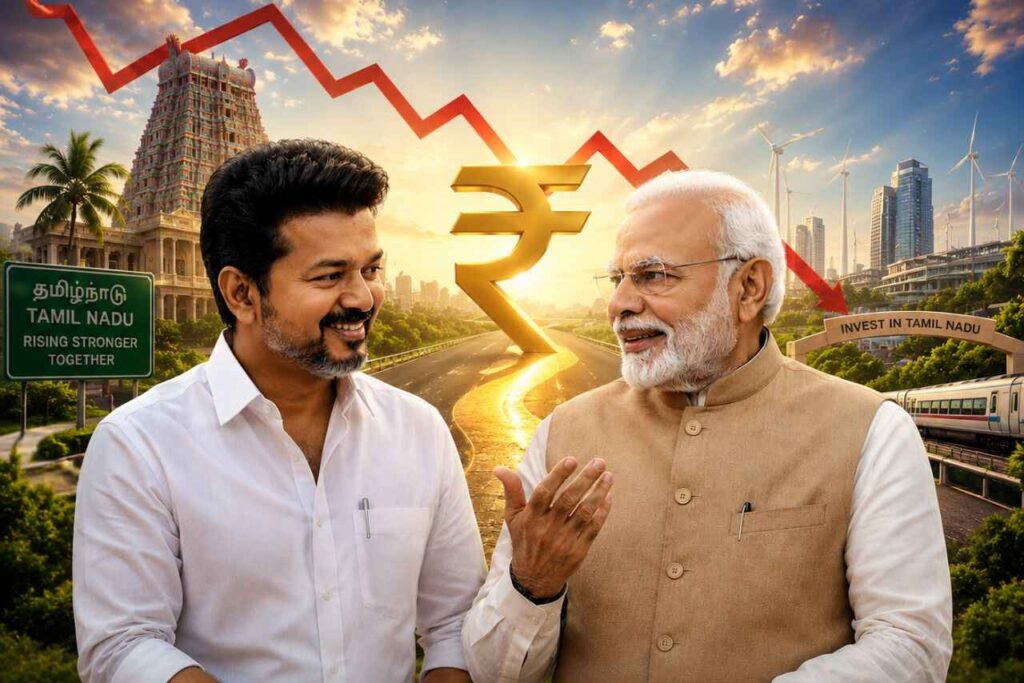
Synopsis: A historic election victory in Tamil Nadu has just lit the fuse on an unprecedented economic standoff between a populist Chief Minister and a panicked national treasury. By legally mandating physical gold payouts for hundreds of thousands of brides and newborns, this massive state-sponsored gold rush crashes directly into the Prime Minister’s desperate attempts to hoard foreign exchange.
A blockbuster political promise by CM Vijay Joseph led him to victory and made him the 9th Chief Minister in the Tamil Nadu 2026 elections, electrifying millions but sending shockwaves through the national economy. By turning a heavily imported, wealth-draining asset into a mandated public right, this promise risks a major fiscal crisis and affects the already depreciating Rupee. Read below to uncover the hidden trigger behind this unprecedented showdown between state optics and national survival
TVK Manifesto: Inside CM Vijay Joseph’s Gold Promises
Chief Minister Vijay Joseph’s Party, Tamilaga Vettri Kazhagam (TVK), manifesto introduced dozens of sweeping welfare promises aimed at transforming the state’s social safety net, including free cylinders, electricity, transport, support for education, farmers, women’s empowerment, and more. Here, we will be examining the two schemes that stand out: “The Marriage Assistance Scheme” and “The Newborn Welfare Scheme.”
CM Vijay Joseph promised one pavan (sovereign) of gold and a silk saree for the marriages of young women from economically backward families, and a gold ring along with a welcome kit involving all newborn necessities under the “The Marriage Assistance Scheme” and “The Newborn Welfare Scheme” respectively.
While gifting precious metals during marriages and childbirths is a practice deeply woven into the cultural roots and traditional fabric of Tamil Nadu, elevating this custom to a state-mandated welfare scheme carries massive macroeconomic consequences. Even though the policy restricts the marriage gold to “economically backward” families, a vast portion of the state’s demographic still qualifies, and promising a gold ring to every newborn introduces a relentless, daily demand for state-funded bullion.
As the government is legally committed to delivering physical gold, 8 grams per bride and individual rings for babies rather than cash equivalents, the state will be forced to continuously procure bulk gold from the open market, directly driving up India’s import volumes and sharply contradicting the Center’s urgent push to narrow the national trade deficit.
Economic Cracks and PM Response
Just over a year ago, the Indian Rupee was holding a steady line near ₹85 to the dollar, but a brutal economic shockwave, ignited by Donald Trump’s aggressive new export tariffs and compounded by soaring crude oil prices topping $110 a barrel amidst the escalating US-Iran conflict, has since sent the currency plunging to a historic low near ₹96.
Addressing this severe forex drain, Prime Minister Narendra Modi made an urgent, unprecedented appeal to the country, urging citizens to avoid buying gold for a year, cancel foreign vacations or destination weddings, and conserve fuel in the “national interest.”
Behind the Prime Minister’s warning is a basic, unyielding economic fact that, while India produces a mere 1 to 2 tonnes of gold domestically, its insatiable demand forces the import of nearly 800 tonnes annually. This staggering import volume requires massive dollar outflows, bleeding the country’s foreign exchange reserves, which have just slipped below $689 billion amid recent global shocks and exerting severe downward pressure on an already falling Indian Rupee.
This relentless depreciation has effectively weaponized India’s trade deficit, aggressively driving up the cost of essential imports, severely draining the Reserve Bank’s foreign exchange reserves, and threatening to unleash a fresh wave of imported inflation across the national economy
Tamil Nadu Marriages and Births
Despite being a state with a stabilizing population, the absolute numbers in Tamil Nadu present a staggering logistical challenge for any physical welfare scheme. According to recent vital statistics and civil registration data, Tamil Nadu records roughly 8.5 to 9 lakh live births every single year, and according to the National Family Health Survey (NFHS-5), Tamil Nadu boasts a highly progressive Total Fertility Rate (TFR) of 1.8 children per woman, well below the national replacement level of 2.1.
The financial pressure drastically multiplies when looking at the state’s marriage statistics. While exact annual tracking fluctuates, demographic estimates show that hundreds of thousands of marriages are solemnized in Tamil Nadu every year, with a significant majority falling under the “economically backward” classification eligible for the welfare scheme.
Even with a controlled fertility rate, a population base of over 80 million ensures a massive volume of newborns, proving that tying welfare to imported bullion is a mathematically unsustainable policy that penalizes the state treasury. When compounded by the promise of an 8-gram sovereign to eligible brides, the government is essentially institutionalizing the bulk procurement of tonnes of physical gold, forcing hundreds of thousands of payouts that directly affect India’s fragile trade balance, while the Rupee is already falling.
Projected 5-Year Fiscal Outflow
With 22-carat gold currently trading near ₹14,660 per gram, handing an 8-gram sovereign to an eligible bride instantly costs the state over ₹1.17 lakh. If just 3 lakh economically backward marriages qualify annually, the state government is legally mandating the bulk import of 2.4 tonnes of physical gold every year, triggering a staggering ₹3,518 crore or $366 million outflow of foreign exchange.
Looking at the Newborn welfare scheme, around 8.5 lakh babies are born in the state annually, the mandate to provide even a modest 2-gram gold ring to every newborn legally commits the government to importing 1.7 tonnes of physical gold every single year. With rate of ₹96 to the dollar, this single welfare scheme forces an additional, staggering ₹2,492 Crores or $260 million outflow of foreign exchange.
Scheme BreakdownAnnual Gold RequiredAnnual Cost (INR)Annual Forex Drain (USD) Bridal Scheme (8g per bride, est. 3L marriages)2.4 Tonnes₹3,518 Crores$366 Million Newborn Scheme (2g per baby, est. 8.5L births)1.7 Tonnes₹2,492 Crores$260 Million Total Annual Mandate4.1 Tonnes₹6,010 Crores$626 MillionThe long-term macroeconomic math becomes even more alarming when we factor in historical market trends. Over the last five years alone, 22-carat gold has surged from roughly ₹4,600 per gram in mid-2021 to over ₹14,660 today an astonishing annualized growth rate of roughly 26%. If we cautiously project that this same growth trajectory continues over the government’s five-year term, the annual cost of funding 2.4 tonnes for brides and 1.7 tonnes for newborns will violently compound year over year.
While we must remain optimistic that global markets will cool down and the situation won’t reach these extremes, the mathematical reality of current trends cannot be ignored. If gold maintains its historical growth rate and the Rupee continues its slide to average around ₹103 to ₹104 against the dollar, this dual welfare mandate won’t just cost $3.1 billion.
Over the next five years, the compounding price of bullion could push the total foreign exchange drain well past $6.1 billion, forcing the state exchequer to burn an astronomical ₹63,500 crores. Even in an optimistic scenario, tethering a state’s welfare system to a rapidly appreciating, heavily imported commodity is a financial ticking time bomb.
Projected Cumulative Fiscal Outflow (Assuming 26% Annual Gold Growth & Rupee slide to ₹103)
TimelineProjected Gold Price (per gram)Est. Annual CostCumulative Total Year 1 (2026)₹14,660₹6,010 Crores₹6,010 Crores Year 2 (2027)₹18,484₹7,578 Crores₹13,588 Crores Year 3 (2028)₹23,307₹9,555 Crores₹23,143 Crores Year 4 (2029)₹29,387₹12,048 Crores₹35,191 Crores Year 5 (2030)₹37,054₹15,192 Crores₹50,383 Crores Total 5-Yr Drain----~$6.1 Billion USDThe Optimistic Approach
While the sheer scale of this gold-backed welfare mandate presents undeniable macroeconomic hurdles, it also offers Tamil Nadu a historic opportunity to pioneer an entirely new model of fiscal innovation. By transitioning these physical promises into state-backed “Welfare Gold Certificates,” the TVK government can honor its cultural commitments to brides and newborns without triggering a physical import crisis.
This strategic shift would not only protect the nation’s fragile foreign exchange reserves but also actively cultivate a groundbreaking culture of institutionalized digital savings among the state’s most vulnerable families. Ultimately, with smart economic recalibration, Tamil Nadu can successfully balance local social empathy with national financial survival.
There is a proven historical precedent for this pivot. When the central government ran the Sovereign Gold Bond (SGB) scheme from 2015 to 2024 to combat a similar forex crisis, it successfully diverted the demand for roughly 147 tonnes of physical gold into digital bonds, saving the national exchequer over ₹72,000 crores in import costs. Furthermore, World Gold Council data shows that Indian citizens are increasingly embracing non-physical gold.
If the TVK government applies this same financial mechanism at the state level issuing digital certificates that guarantee the monetary value of an 8-gram sovereign upon maturity without requiring the immediate import of physical bullion, they can fulfill their manifesto promises without collapsing the Rupee.
Conclusion
The ultimate success of the TVK government’s ambitious welfare agenda hinges not on abandoning its promises, but on outsmarting the rigid math of the global commodities market. In an era where a crashing Rupee and volatile crude prices have left India’s national balance sheet vulnerable, regional policymaking can no longer operate in a domestic silo. Forcing the state to physically acquire tonnes of imported bullion every single year turns a well-intentioned social safety net into a structural fiscal hazard.
However, by leveraging the proven success of digital gold financial instruments and paper-backed alternatives, Chief Minister Vijay Joseph has a unique chance to rewrite the script on regional populism. Converting physical payouts into state-guaranteed digital wealth protects the national treasury from severe foreign exchange drains while fulfilling the state’s cultural obligation to its citizens. By anchoring its bold social vision to sound macroeconomic strategy, Tamil Nadu can protect its vulnerable families without endangering the nation’s economic survival, proving that local empathy and national fiscal discipline can walk hand in hand.
Disclaimer: The views and investment tips expressed by investment experts/broking houses/rating agencies on tradebrains.in are their own, and not that of the website or its management. Investing in equities poses a risk of financial losses. Investors must therefore exercise due caution while investing or trading in stocks. Trade Brains Technologies Private Limited or the author are not liable for any losses caused as a result of the decision based on this article. Please consult your investment advisor before investing.
The post Modi vs Vijay: Could Tamil Nadu’s Gold Promise Trigger a Rupee Crisis? appeared first on Trade Brains.
Related Articles

Astra Microwave Shares Rise 10% As Q4 Profit Jumps 44% to ₹106 Cr
Synopsis: Astra Microwave Products Limited posted a blockbuster Q4 FY26 on May 2...
KSH International Shares Soar 15% on Robust Q4; Which Segment Drove the Most Revenue?
Synopsis: KSH International reported strong growth during FY26, supported by ris...

SRM Contractors Q4 Profit Jumps 125% YoY; Revenue Surges Above 95% in FY26
Synopsis: SRM Contractors Ltd reported a strong Q4 FY26 performance with sharp g...

Ashish Kacholia Stock Soars 6% After Bagging First-Ever Aerospace Order From the US
Synopsis: A precision engineering company backed by a marquee ace investor has c...