The Rebirth of Ethereum Derivatives
Alex Smith
6 months ago
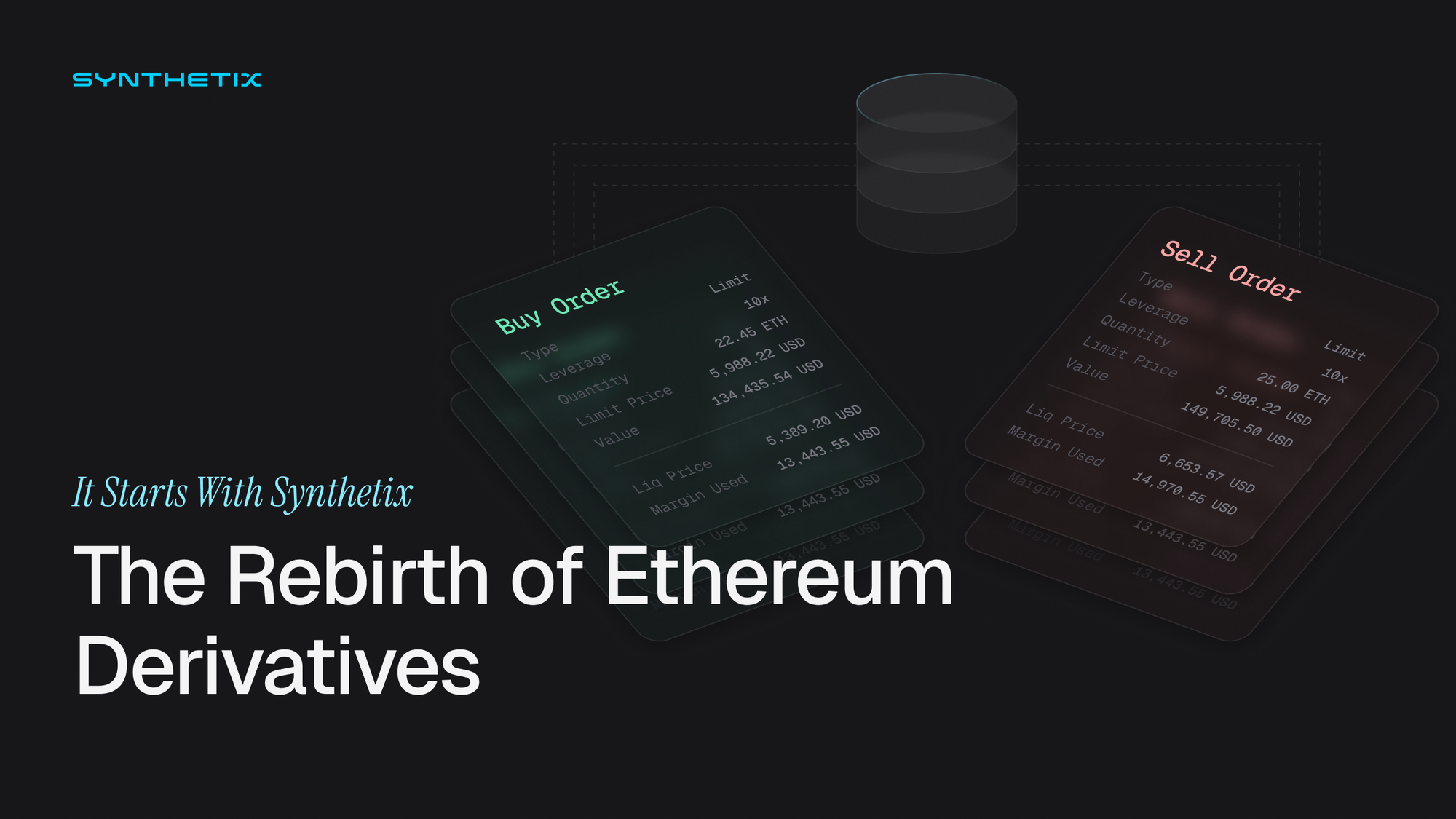
It Starts With Synthetix
Ethereum is about to become a different beast.
While everyone has been fighting over which Layer 2 or alt-L1 has the lowest fees and highest throughput, a derivatives renaissance is underway on Ethereum Mainnet.
In the coming weeks and months, we're about to see institutional-grade derivatives return to where they always belonged: on the most credibly neutral, battle-tested, liquid blockchain that exists.
And this rebirth starts with Synthetix.
The Trauma That Shaped a Generation
We all lived through the 2021 gas apocalypse:
Simple swaps cost more than $100 for a single transaction, and complex DeFi strategies became economically impossible. Derivatives protocols like Synthetix became whale-only playgrounds, and anyone with less than five figures to deploy on-chain was completely priced out. DeFi was unusable for most.
L2s or high-throughput low-fee L1s seemed like the only viable solutions at the time.
Except we now know this isn’t the case. It was just trading one set of problems for another.
The Multichain Mirage: "Cheap" Was Never Truly Cheap
Even though Multichain was cheaper on the surface, there’s a slew of hidden risks and costs that go largely under-discussed:
- Cross-Chain Bridge Risk: $2.9 billion has been stolen from bridge hacks. That's not an abstract number — it's more than 42% of all DeFi hacks ever.
- Liquidity Fragmentation: Try executing a large order on Arbitrum vs. ETH Mainnet. That extra 0.5-2% slippage? This will chew through any perceived gas savings very quickly.
- Opportunity Cost: Bridging delays kills time-sensitive trading strategies. If you have to wait more than ~5 minutes for funds to crawl their way from one chain to another, many arbitrage opportunities will disappear.
- Operational complexity: Managing positions across six different chains isn't "scaling" — it's a nightmare.
The sophisticated players figured this out early, and as a result, 67% of cross-chain arbitrageurs keep pre-positioned inventory everywhere (Stanford Research) because bridging is too slow and risky. Without tens of millions in capital to deploy across chains, you're at a structural disadvantage.
Meanwhile, something interesting was happening on Mainnet that many traders have been too busy to notice.
While Everyone Was Away, Ethereum Got Good
Infrastructure advancements over the past two years have fundamentally transformed the scope of what’s feasible on Ethereum:
- Gas costs collapsed by 99%: Ethereum went from $71 average fees in May 2021 to $0.47 today. EIP-4844 brought blob transactions that cut Layer 2 costs by another 90-99%. The gas crisis is over.
- MEV protection became systematic: CoW Protocol reduced sandwich attacks from 7-8% of trades to 0.8% — a 90% improvement. And MEV-Boost now covers 90%+ of blocks.
- Account abstraction went live: You can now trade without holding ETH for gas. Meta-transactions, sponsored transactions, gasless trading—all the UX improvements we needed are here.
- Liquidity advantage strengthened: Ethereum's DeFi TVL $84 billion vs. its closest competitor, which has $9.86 billion. This is a 9x advantage, and it's only getting wider.
- Institutional maturity arrived: The Ethereum Foundation's 2025 restructuring brought new leadership focused on accelerating Layer 1 development. Co-executive directors Hsiao-Wei Wang (research) and Tomasz Stańczak (engineering) are systematically addressing the core protocol challenges that once seemed intractable. The Foundation's $100M+ treasury deployment into DeFi protocols shows serious institutional commitment to Ethereum's long-term success.
And here's the real kicker - all of this happened while institutions were quietly amassing capital on Ethereum Mainnet.
Following The Real Money
Institutions have made their intentions clear - Ethereum Mainnet will be their home.
- BlackRock: 93% of tokenized assets on Ethereum L1
- $3.3 billion in tokenized Treasuries on Mainnet
- 49% of all stablecoins chose Ethereum as home base
- $153 billion in total stablecoin TVL
Institutions have made it clear that they optimize for security, liquidity depth, and regulatory comfort. And on those metrics, Ethereum Mainnet has no competition.
Institutions are the power users of derivatives and will have the biggest influence on which marketplaces succeed.
Enter Synthetix: Right Place, Right Time
While everyone else has been choosing to build "faster & cheaper" derivatives on experimental chains, Synthetix is taking the contrarian bet: building institutional-grade derivatives infrastructure for Ethereum Mainnet.
A year or two ago, this would’ve been insanity. Mainnet fees were beyond painful, the multichain future was the narrative du jour, and "nobody wants to trade derivatives on L1" was conventional wisdom.
Now it looks like foresight.
Synthetix's new Mainnet strategy includes:
- Professional infrastructure: 100,000 orders/sec matching engine with
Related Articles
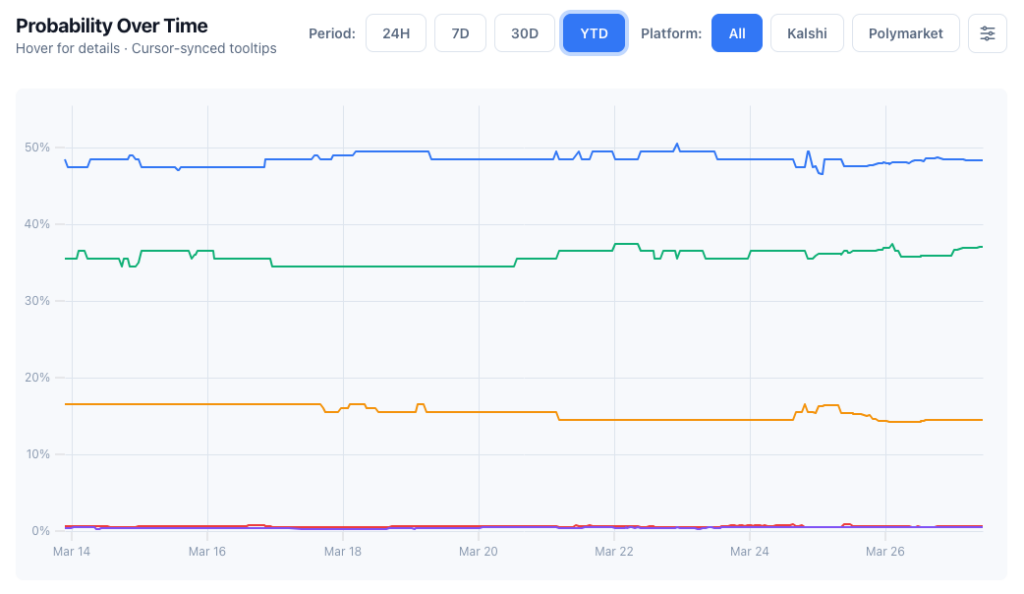
Maine Senate Primary Odds Tilt to Platner as Prediction Markets Signal Key Senate Flip Opportunity
Prediction markets show Graham Platner at ~80% odds to win Maine’s Democratic Se...

PredictIt Rolls Out New Design After Surviving CFTC Shutdown Attempt
The academic prediction market platform focused on politics modernizes its inter...
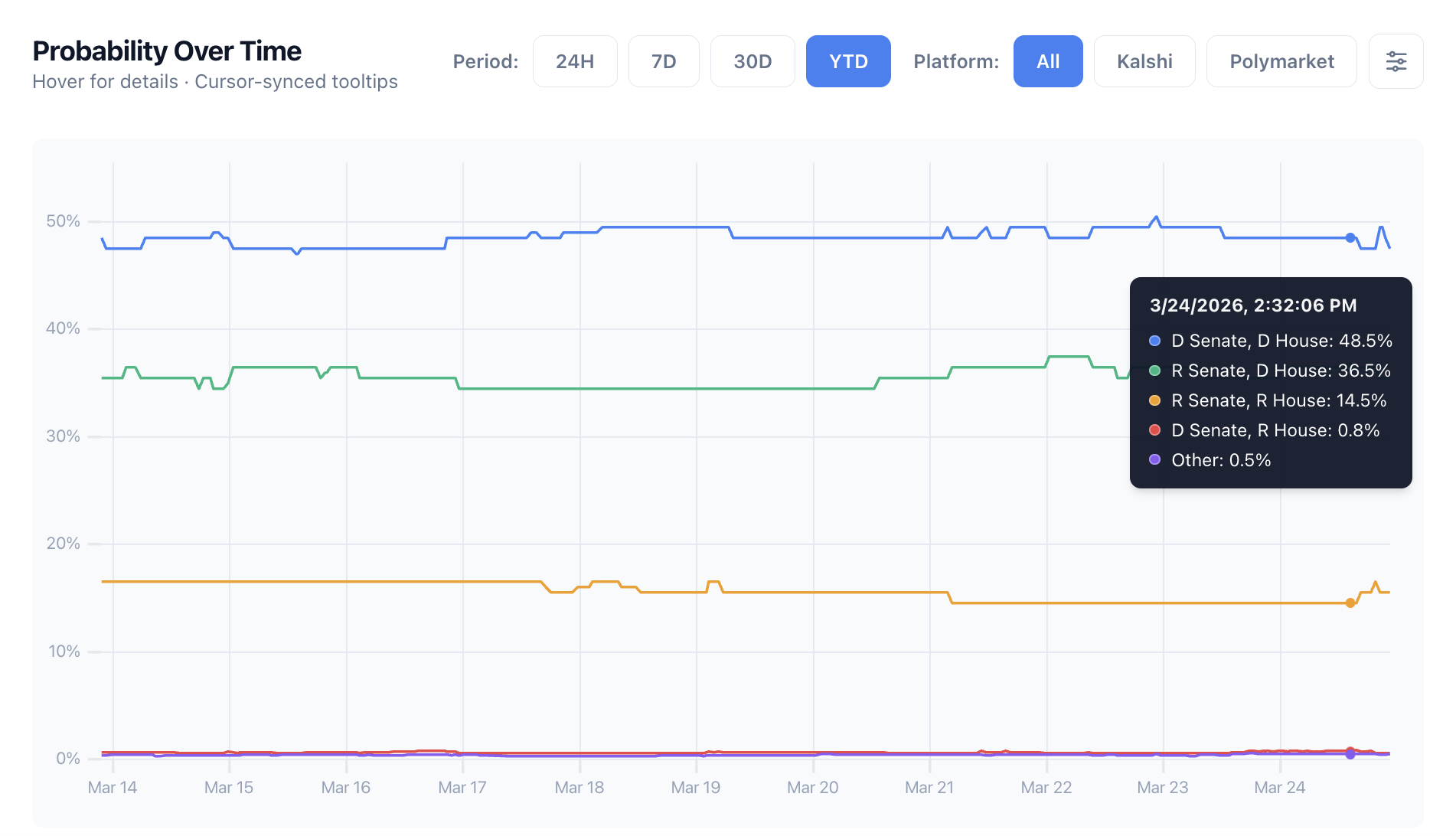
Democrats 85% to Flip the House in 2026 Midterms, Senate Still a Toss-Up
Prediction markets are forecasting an 85% chance of House control flipping to De...
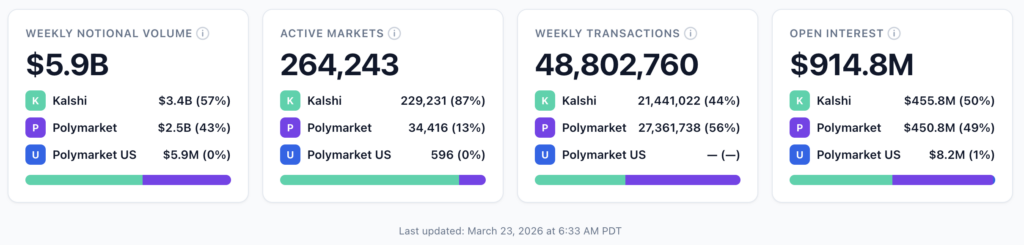
Kalshi Hits Record $3.4B Week, Polymarket Sports Surge as March Madness Heats Up
Kalshi posted a new record $3.40 billion notional volume week as Polymarket's sp...